

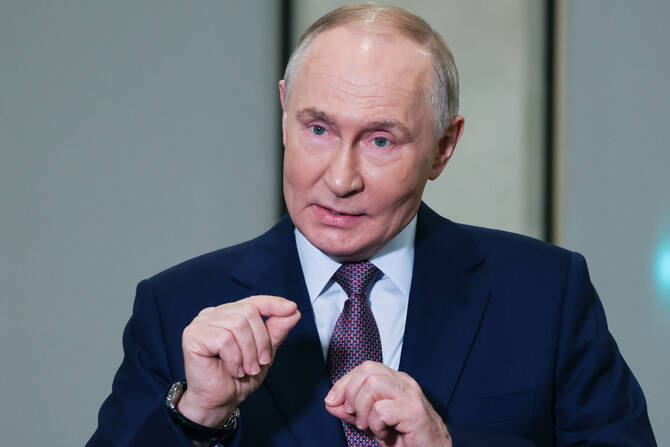

MOSCOW: Russian President Vladimir Putin remained defiant on Thursday after US President Donald Trump hit Russia’s two biggest oil companies with sanctions to pressure the Kremlin leader to end the war in Ukraine, a move that pushed global oil prices up 5 percent.
The US sanctions prompted Chinese state oil majors to suspend Russian oil purchases in the short term, trade sources told Reuters. Refiners in India, the largest buyer of seaborne Russian oil, are set to sharply cut their crude imports, according to industry sources.
The sanctions target oil giants Rosneft and Lukoil, which together account for more than 5 percent of global oil output, and mark a dramatic U-turn by Trump, who said only last week that he and Putin would soon hold a summit in Budapest to try to end the war in Ukraine.
While the financial impact on Russia may be limited in the short term, the move is a powerful signal of Trump’s intent to squeeze Russia’s finances and force the Kremlin toward a peace deal in its 3-1/2-year-old full-scale invasion of Ukraine.
Putin derided the sanctions as an unfriendly act, saying they would not significantly affect the Russian economy and talked up Russia’s importance to the global market. He warned a sharp supply drop would push up prices and be uncomfortable for countries like the United States.
“This is, of course, an attempt to put pressure on Russia,” Putin said. “But no self-respecting country and no self-respecting people ever decides anything under pressure.”
Asked about Putin comment that the new sanctions would not have significant impact, Trump told reporters later on Thursday: “I’m glad he feels that way. That’s good. I’ll let you know about it in six months from now.”
With Ukraine asking US and European allies for long-range missiles to help turn the tide in the war, Putin also warned that Moscow’s response to strikes deep into Russia would be “very serious, if not overwhelming.”
Trump’s latest about face
Trump, in his latest about-face on the conflict, said on Wednesday that the planned Putin summit was off because it would not achieve the outcome he wanted and complained that his many “good conversations” with Putin did not “go anywhere.”
“We canceled the meeting with President Putin — it just didn’t feel right to me,” Trump told reporters at the White House. “It didn’t feel like we were going to get to the place we have to get. So I canceled it, but we’ll do it in the future.”
Putin said Trump most likely meant the summit had been postponed. The two leaders met in Alaska in August.
Russia has signalled that its conditions for ending the war in Ukraine — terms which Kyiv and many European countries regard as tantamount to surrender — remain unchanged.
The conflict raged on as European Union leaders and Ukrainian President Volodymyr Zelensky met in Brussels on Thursday to discuss funding for Ukraine.
EU leaders agreed to meet Ukraine’s pressing financial needs for the next two years but stopped short of explicitly endorsing the use of Russian frozen assets to give Kyiv a large loan, after concerns were raised by Belgium.
Moscow said it would deliver a “painful response” if the assets were seized.
Zelensky urges more pressure on Moscow
Ukraine’s Zelensky hailed the sanctions as “very important” but that more pressure would be needed on Moscow to get it to agree to a ceasefire.
After the August summit with Putin, Trump dropped his demand for an immediate ceasefire in Ukraine and embraced Moscow’s preferred option of going straight to negotiating an overall peace settlement.
But in recent days he has reverted to the idea of an immediate ceasefire, something that Kyiv supports but which Moscow, whose forces are steadily edging forward on the battlefield, has repeatedly made clear it has no interest in.
Russia has said it opposes a ceasefire because it believes it would only be a temporary pause before fighting resumes, giving Ukraine time and space to rearm at a time when Moscow says it has the initiative on the battlefield.
Separately, EU and NATO member Lithuania on Thursday said two Russian military aircraft briefly entered its airspace, prompting a formal protest and a reaction from NATO forces, while Russia denied the incident.
EU targets Russian LNG
In another bid to starve Moscow of revenue, the European Union adopted its 19th package of Russia sanctions on Thursday, banning Russian liquefied natural gas imports and targeting entities including Chinese refiners and Central Asian banks.
The EU has reduced its reliance on once-dominant supplier Russia by roughly 90 percent since 2022, when the current conflict began, but nonetheless imported more than 11 billion euros of Russian energy in the first eight months of this year. LNG now represents the biggest EU import of Russian energy.
Russian oil and gas revenue, currently down by 21 percent year-on-year, accounts for around one-quarter of its budget and is the most important source of cash for Moscow’s war in Ukraine, now in its fourth year.
However, Moscow’s main revenue source comes from taxing output, not exports, which is likely to soften the immediate impact of the sanctions on state finances.


