

South Africa seeks to save birds from wind turbine risks

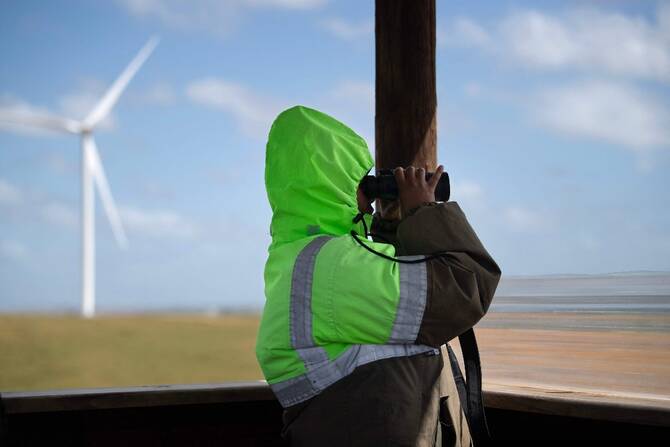
A bird monitor looks out for endangered birds close to the wind turbines at Excelsior Wind Farm near Swellendam, S Africa. (AFP)
Short Url
Updated 23 October 2025
Follow

South Africa seeks to save birds from wind turbine risks

  • With more than 1,400 turbines operating across South Africa, an estimated 6,000 birds die this way a year, ten percent are endangered species
  • To mitigate the impact, Excelsior Wind Farm has implemented a Shutdown on Demand Protocol that prioritizes six vulnerable species, including the Cape vulture and endangered black harrier

SWELLENDAM: Powerful gusts shook an observation post perched on a hill at a wind farm in South Africa as two monitors scanned the landscape through binoculars.
The Overberg mountains stretched along the horizon, but the monitors — bundled in scarves — were focused on activity much closer: around a giant wind turbine, a small, dark silhouette had appeared.
“Stop turbine 11, please. Cape vulture,” one said into a walkie-talkie. “Stopping turbine 11,” came the reply.
Immediately, the blades of the 150-meter (500-feet) turbine began to slow, coming to a complete stop in less than a minute.
BirdLife South Africa estimates that every year an average 4.25 birds are killed per wind turbine, most often when they fly into blades that can reach speeds of up to 280 kilometers (175 miles) per hour.
With more than 1,400 turbines operating across South Africa, an estimated 6,000 birds die this way a year, the group says. Ten percent are endangered species.
To mitigate the impact, Excelsior Wind Farm has implemented a Shutdown on Demand Protocol that prioritizes six vulnerable species, including the Cape vulture and endangered black harrier.
When monitors spot one, “they inform the control room via radio and that’s when they will turn off the turbine,” said conservationist Clarissa Mars, who oversees the program at the farm 200 kilometers east of Cape Town.
“That takes approximately 43 seconds,” she told AFP.
“There were less than eight fatalities for the site in approximately five years,” Mars said. “And I’m just very happy knowing there were no fatalities this year.”
The Stop on Demand Protocol — developed in the late 2010s, notably in Kenya — has been adopted worldwide and was introduced at Excelsior in 2020.
Its impact on energy output at its small operation of 13 turbines has been negligible, said site manager Jacques Redelinghuys.
“We’ve lost less than 0.5 percent of revenue due to the program,” he said. “And on days like today, when we do produce more due to our high wind speed, we make up for the losses that we incurred.”

- Extinction by wind farm? -

While the shutdown protocol has saved some species from the blades at Excelsior, such as the Cape vulture, it has been less effective for the black harrier, a critically endangered bird of which only around 1,300 remain in the world.
The smaller bird is harder for the monitors to spot, conservationist Odette Curtis-Scott said.
The Overberg region is a vital breeding ground for the black harrier, but 95 percent of its natural habitat here has been lost to agriculture, she said.
This forces the bird to travel further in search of water and prey, increasing the risks of colliding with turbines.
“It’s not ideal that the wind farm is where it is,” said Curtis-Scott, who heads the Overberg Renosterveld Trust.
In early 2025, the trust bought land five kilometers from Excelsior where there is a black harrier colony and about 40 return to breed each year.
Despite the efforts, around 13 black harriers have been killed at South Africa’s more than 30 wind farms in the past decade, according to University of Cape Town professor Rob Simmons.
“If we were to kill an extra three to five adult black harriers per year through wind farms, the population will go extinct within 75 to 100 years,” he said.
“It’s one of the first species in South Africa, possibly even in Africa, for which we know that wind farms can have a direct effect on the potential extinction.”
Another potential solution to this “green-green dilemma” is painting turbine blades, Simmons said.
“Birds do not see black and white contrasts as well as we do,” he said. “They, therefore, do not see a white blade spinning against a cloudy sky. This is very likely why they do not avoid it.”
An experiment at a wind farm 90 kilometers north of Cape Town, where blades were painted with bold red stripes, resulted in a 87 percent drop in bird mortality over two years, he said.
“We cannot continue burning fossil fuels,” he said. “Some species, like the black harrier, will not survive climate change. But we also cannot sacrifice numerous birds on the altar of renewable energy.”


Ramadan lights illuminate London’s heart as mayor calls for unity

Updated 4 sec ago
Follow

Ramadan lights illuminate London’s heart as mayor calls for unity

  • A sign reading ‘Happy Ramadan,’ decorated with stars and crescent moons, will be illuminated from sunrise to sunset
  • This year, the Muslim fasting month coincides with Lent, a 40-day season of prayer, fasting, and almsgiving

LONDON: Mayor of London Sadiq Khan has switched on the Ramadan lights as British Muslims prepare to welcome the fasting month this week.

“A beautiful celebration of the holy month and a reminder that our city is a beacon of hope, unity, and inclusivity. A city where diversity is a strength, and where everyone is loved and wanted,” Khan wrote on X.

The heart of London’s West End is now illuminated by 30,000 LED bulbs for the fourth consecutive year, celebrating culture, cuisine, and community during the holy month when Muslims fast from sunrise to sunset.

Rahima Aziz BEM, a trustee of the charitable Aziz Foundation, told Arab News that organizing the canopy of lights on Coventry Street, near Piccadilly Circus, has expanded every year since 2023.

“And what started as just a simple light installation has become something where you can really experience the spirit of Ramadan and what it has to offer,” she said.

For this year’s program, the Aziz Foundation has organized “Shared Lights,” an interfaith art exhibition in the basement of the Zedwell Hotel, featuring 20 artists from across the UK who explore the values central to Ramadan, including love, peace, generosity, and hope.

For this year’s program, the Aziz Foundation has organized “Shared Lights,” an interfaith art exhibition in the Zedwell Hotel’s basement. (Credit: Aziz Foundation)

The charity has also created an interactive digital map of halal and vegetarian-friendly restaurants, allowing visitors to plan their iftar meals from exclusive set menus and locate nearby prayer spaces and evening activities.

“Many young Muslims will choose to have iftar out with their friends and family, in central London. So, we wanted to provide them with more incentive to really spend and boost the local economy, through freebies and special discounts,” Aziz said.

An estimated 4 million British Muslims live across England, Scotland, Northern Ireland, and Wales, with over 1 million living in London alone, according to the 2021 census. London was the first major European city to adorn its central streets with Ramadan lights, which have become part of the city’s calendar alongside Hanukkah and Diwali.

A sign that reads “Happy Ramadan,” decorated with stars and crescent moons, will be illuminated nightly from 5:00 p.m. until 5:00 a.m., and will then change to “Happy Eid” in celebration of Eid Al-Fitr in March. This year, Ramadan coincides with Lent, a 40-day season of prayer, fasting, and almsgiving. Lent begins on Feb. 18 and concludes on April 2. If the moon is sighted, Ramadan is expected to start on Feb. 17 and end on March 18.

“Eventually, we’ll get to a time where we’re sharing Ramadan with Christmas, which is just beautiful. Great opportunity for some cross-cultural experiences,” Aziz added.

London was the first major European city to adorn its central streets with Ramadan lights. (Credit: Aziz Foundation)

Ramadan, which follows the lunar Hijri calendar, occurs approximately 10 to 11 days earlier each year in relation to the Gregorian solar calendar. This year, Muslims in London will fast for between 12 and 14 hours daily. Iftar is held around 5:30 p.m. at the beginning of the month and around 6:30 p.m. as the month approaches the end. However, when Ramadan falls in the summer, the fasting period can last nearly 19 hours, and these hours vary across countries and regions within a country.

Fasting during Ramadan is one of the five pillars of Islam, alongside the Shahada, a profession of faith, prayer, giving alms, and performing Hajj. Muslims refrain from food, drink, and some activities during daylight for 30 days as a way to reflect on religion, life, and empathize with the poor.

“I grew up in London. I’ve been here most of my life,” Aziz said. “What is really special for me is seeing the curiosity about Ramadan and about Islam increase. Ramadan lights are about making people feel that London is a melting pot of diversity, for everyone.”
