

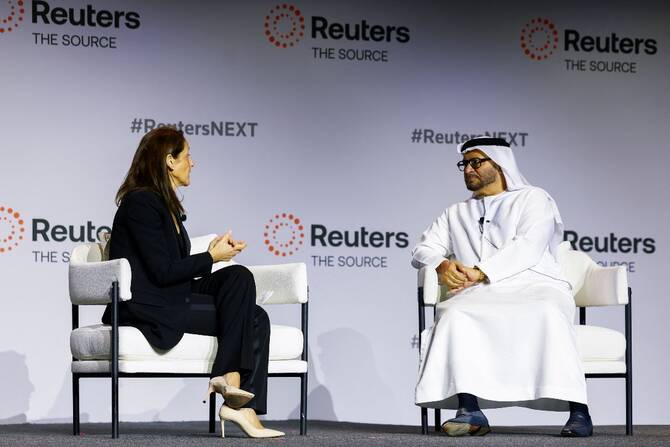

ABU DHABI: Anwar Gargash, diplomatic adviser to the United Arab Emirates president, called on Wednesday for compromise to end the Middle East conflict by providing security for Israel and a viable state for Palestinians.
The Gaza ceasefire that came into force earlier this month presents an important opening but the approach to one of the world’s most complex and intractable conflicts needs to change, Gargash said in an interview at the Reuters NEXT Gulf Summit in Abu Dhabi.
“This is definitely a moment of opportunity. I think the first thing to say, we see opportunity because we have a chance today to change course,” he said.
The UAE, a wealthy Gulf Arab state, is seen as a vital player in efforts to rebuild Gaza after two years of war — following the deadly attack on southern Israel by militant group Hamas — that killed tens of thousands of people and demolished the Palestinian enclave, creating widespread hunger and a humanitarian disaster.
“Some policies are no longer valid and should not be reincarnated, the maximalist views on the Palestinian issue are no longer valid, we have to address the issue that we have two contending nationalisms fighting on one piece of land and that land has to be divided,” Gargash said.
“Are we going to continue with this sort of maximalist views on how to address the Palestinian issue, for example, by the Israeli right, which has to understand that this is not going to go away,” added Gargash, who served as the UAE’s minister of state for foreign affairs from 2008 to 2021.
Prime Minister Benjamin Netanyahu, who leads the most far-right government in Israel’s history, has rejected the idea of a Palestinian state.
UAE’S INFLUENTIAL ROLE IN THE REGION
Abu Dhabi, a major oil producer, punches above its weight diplomatically in the region and beyond and has gained vast influence by strategically investing everywhere from the West to Africa.
The UAE was the most prominent of the Arab states to sign US-brokered normalization deals with Israel in 2020 known as the Abraham Accords.
UAE Minister of State Lana Nusseibeh said during a panel at the Reuters NEXT Gulf Summit that the UAE normalized relations with Israel to foster tolerance and change mindsets in the region.
“We partnered with the Arab region, with the United States and with Israel using the Abraham Accords to help achieve this ceasefire in Gaza that was so desperately needed,” said Nusseibeh.
Gargash reiterated that Israeli annexation in the occupied West Bank would constitute a “red line” for the UAE.
Asked if that red line could lead to the end of the Abraham Accords, which US President Donald Trump wants to expand to include other Arab states to stabilize the Middle East and promote economic growth, Gargash said the focus now should be on making Trump’s plan to end the Gaza war work.
As Gaza faces a shaky ceasefire, highly sensitive questions remain for the next phase of the truce in the US plan, such as widespread calls for Hamas to disarm and for the group not to play any future role in governing the enclave.
The UAE sees Islamist groups such as Hamas as an existential threat, a position that often influences its foreign policy.
“We’ve had 30 years of the trajectory of political Islam, and political Islam was the main combatant here in the two years of war,” Gargash said, adding that political Islam could now be waning.
The West Bank-based Palestinian Authority, Hamas’ rival, expects to play a significant role in post-war Gaza even though Trump’s plan sidelines it for now, and it is banking on Arab support to secure its position despite Israeli objections, Palestinian officials say.
Asked about the PA, Gargash noted that it has stated that it is willing to reform, but he added that changes such as financial transparency were needed.


