

Unspoilt corner of Portugal fears arrival of high end tourism

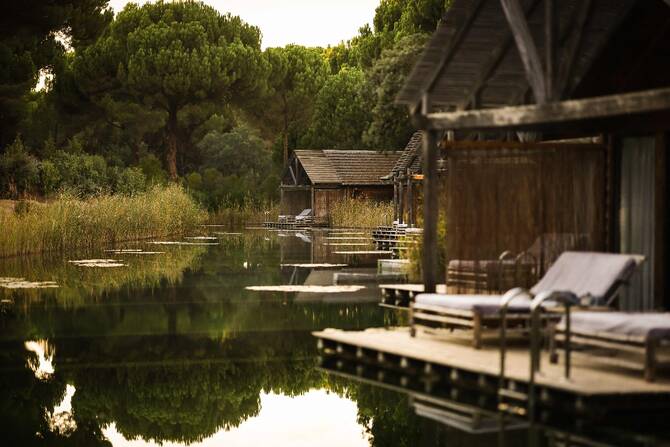
A view of the “Sublime” hotel in Comporta, Portugal. (AFP)
Short Url
Updated 22 October 2025
Follow

Unspoilt corner of Portugal fears arrival of high end tourism

  • Rapid development in the coastal region of Comporta has alarmed locals and environmentalists, who fear a repeat of the unchecked growth seen in Portugal’s southernmost Algarve province, long a package holiday destination

COMPORTA: Above the pine forests and dunes that stretch along the nearly deserted beaches of southwestern Portugal, cranes rise from building sites soon to be luxury hotels — a sign of the region’s contentious transformation into a playground for the wealthy.
Rapid development in the coastal region of Comporta has alarmed locals and environmentalists, who fear a repeat of the unchecked growth seen in Portugal’s southernmost Algarve province, long a package holiday destination.
Dubbed “the new Portuguese Riviera,” Comporta has drawn high-profile visitors including Oscar-winning actor Nicole Kidman and Princess Caroline of Monaco.
Real estate consultancy Knight Frank lists the region, located about an hour’s drive south of Lisbon, among the five most sought-after luxury residential markets worldwide.
“Comporta appeals to a wealthy clientele seeking nature, privacy and wellness,” the company wrote in a recent report.
French designer Christian Louboutin was among the first international figures to discover Comporta’s charm, opening a hotel in Melides, a small village of whitewashed houses with blue doors.
Princess Eugenie, whose uncle is Britain’s head of state King Charles III, splits her time between London and Comporta, drawn by the region’s relaxed lifestyle.
“I can go to the supermarket in sportswear, my hair in disarray, and nobody cares,” she told the podcast Table and Manners in 2023.

- ‘Overrun by tourism’ -

Environmentalists warn that development projects threaten the region’s unique mix of dunes, pine forests, gnarled cork trees and an endless patchwork of rice fields.
Campaign group Dunas Livres (Free Dunes) says eight “mega-projects” are under development, each covering hundreds of hectares, which will increase water consumption in a region already threatened by drought.
“These hotel complexes, with golf courses, swimming pools and a very large number of tourist beds, obviously consume a lot of water,” Catarina Rosa, a biologist with the group, told AFP.
“Comporta, a true natural treasure, is being overrun by tourism,” she added.
The transformation traces back to the collapse of the Espirito Santo bank during the 2011 debt crisis.
The Espirito Santo family were once the sole owners of the 12,000-hectare Herdade da Comporta estate but sold large parcels to developers following the collapse of their banking empire.
Since then, investors including French developer Claude Berda’s Vanguard Properties and US-based Discovery Land Company have launched private residences, hotel complexes and golf courses.
Discovery Land is behind the CostaTerra Golf and Ocean Club, planned to feature nearly 300 luxury villas.

- ‘Frenzy’ -

Local residents have mixed feelings about the changes.
Some have sold small properties for staggering sums, while others worry that skyrocketing real estate prices are disrupting their way of life or forcing them out.
A small house worth 20,000 euros ($23,000) two decades ago is now valued at one million euros, said Jacinto Ventura, a farmer and president of a local association in Melides.
“This real estate bubble, with no clear end in sight, has driven prices into a frenzy. And this frenzy has forced a large portion of the population to move away,” he told AFP.
Residents also complain about restricted access to public beaches and rising costs in local shops since the arrival of wealthy visitors.
While some are leaving the area, others are trying to hold on.
Belinda Sobral, 42, a former engineer who reopened her grandparents’ tavern in the nearby town of Grandola, said the problem is not tourism itself, but the pace of development.
“It has been too fast, without planning or respect for the locals,” the mother of two said.
“I want to preserve the identity of this place. Without memory, Comporta will become another Ibiza — a resort like so many others,” she added.


Ramadan lights illuminate London’s heart as mayor calls for unity

Updated 45 min 10 sec ago
Follow

Ramadan lights illuminate London’s heart as mayor calls for unity

  • A sign reading ‘Happy Ramadan,’ decorated with stars and crescent moons, will be illuminated from sunrise to sunset
  • This year, the Muslim fasting month coincides with Lent, a 40-day season of prayer, fasting, and almsgiving

LONDON: Mayor of London Sadiq Khan has switched on the Ramadan lights as British Muslims prepare to welcome the fasting month this week.

“A beautiful celebration of the holy month and a reminder that our city is a beacon of hope, unity, and inclusivity. A city where diversity is a strength, and where everyone is loved and wanted,” Khan wrote on X.

The heart of London’s West End is now illuminated by 30,000 LED bulbs for the fourth consecutive year, celebrating culture, cuisine, and community during the holy month when Muslims fast from sunrise to sunset.

Rahima Aziz BEM, a trustee of the charitable Aziz Foundation, told Arab News that organizing the canopy of lights on Coventry Street, near Piccadilly Circus, has expanded every year since 2023.

“And what started as just a simple light installation has become something where you can really experience the spirit of Ramadan and what it has to offer,” she said.

For this year’s program, the Aziz Foundation has organized “Shared Light,” an interfaith art exhibition in the basement of the Zedwell Hotel, featuring 20 artists from across the UK who explore the values central to Ramadan, including love, peace, generosity, and hope.

For this year’s program, the Aziz Foundation has organized “Shared Light,” an interfaith art exhibition in the Zedwell Hotel’s basement. (Credit: Aziz Foundation)

The charity has also created an interactive digital map of halal and vegetarian-friendly restaurants, allowing visitors to plan their iftar meals from exclusive set menus and locate nearby prayer spaces and evening activities.

“Many young Muslims will choose to have iftar out with their friends and family, in central London. So, we wanted to provide them with more incentive to really spend and boost the local economy, through freebies and special discounts,” Aziz said.

An estimated 4 million British Muslims live across England, Scotland, Northern Ireland, and Wales, with over 1 million living in London alone, according to the 2021 census. London was the first major European city to adorn its central streets with Ramadan lights, which have become part of the city’s calendar alongside Hanukkah and Diwali.

A sign that reads “Happy Ramadan,” decorated with stars and crescent moons, will be illuminated nightly from 5:00 p.m. until 5:00 a.m., and will then change to “Happy Eid” in celebration of Eid Al-Fitr in March. This year, Ramadan coincides with Lent, a 40-day season of prayer, fasting, and almsgiving. Lent begins on Feb. 18 and concludes on April 2. If the moon is sighted, Ramadan is expected to start on Feb. 17 and end on March 18.

“Eventually, we’ll get to a time where we’re sharing Ramadan with Christmas, which is just beautiful. Great opportunity for some cross-cultural experiences,” Aziz added.

London was the first major European city to adorn its central streets with Ramadan lights. (Credit: Aziz Foundation)

Ramadan, which follows the lunar Hijri calendar, occurs approximately 10 to 11 days earlier each year in relation to the Gregorian solar calendar. This year, Muslims in London will fast for between 12 and 14 hours daily. Iftar is held around 5:30 p.m. at the beginning of the month and around 6:30 p.m. as the month approaches the end. However, when Ramadan falls in the summer, the fasting period can last nearly 19 hours, and these hours vary across countries and regions within a country.

Fasting during Ramadan is one of the five pillars of Islam, alongside the Shahada, a profession of faith, prayer, giving alms, and performing Hajj. Muslims refrain from food, drink, and some activities during daylight for 30 days as a way to reflect on religion, life, and empathize with the poor.

“I grew up in London. I’ve been here most of my life,” Aziz said. “What is really special for me is seeing the curiosity about Ramadan and about Islam increase. Ramadan lights are about making people feel that London is a melting pot of diversity, for everyone.”