

‘Biggest risk’ of violence at Aston Villa game was ‘extreme Maccabi fans who want to fight’

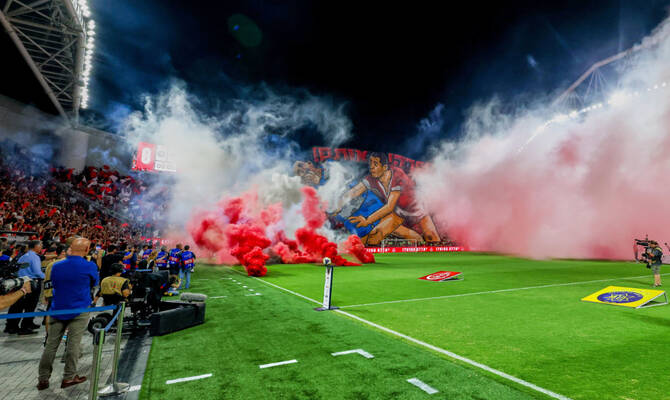
Smoke from flares thrown by fans fills the field before the soccer derby between Maccabi Tel Aviv and Hapoel Tel Aviv was called off Sunday after pregame disturbances led police to deem it unsafe to proceed at Bloomfield Stadium in Tel Aviv, Israel, Sunday, Oct. 19, 2025 . (AP)
Short Url
Updated 22 October 2025
Follow

‘Biggest risk’ of violence at Aston Villa game was ‘extreme Maccabi fans who want to fight’

  • Reports by Dutch police of attacks on Muslims by Israeli team’s fans at match in Amsterdam were reportedly a factor in decision to ban them from Europa League match in Birmingham
  • Concern about violence instigated by Maccabi fans was so great that at least 1,500 extra riot police would have had to be mobilized from across the country at a cost of $8m

LONDON: British police concluded that traveling Maccabi Tel Aviv fans represented the biggest potential threat of violence at their team’s match against Aston Villa next month.

The police assessment was a factor in the decision to ban supporters of the Israeli team from attending the Europa League game in Birmingham on Nov. 6.

The decision last week — which Aston Villa said followed “an instruction” from Birmingham’s Safety Advisory Group based on the advice of West Midlands Police — sparked controversy, including accusations of antisemitism and criticism from Prime Minister Keir Starmer.

Details of the police intelligence report and risk assessments have not been publicly shared but The Guardian newspaper reported on Tuesday that it was the Maccabi fans themselves that were the main source of concern, rather than the possibility that their supporters would be targeted by others.

Sources told the newspaper that West Midlands Police had learned scores of Maccabi fans with a history of violence and racism were expected to travel to the game. Dutch police told their British counterparts that Maccabi fans had instigated violence at a match in Amsterdam last year, randomly attacking Muslims.

UK police feared that any trouble started by the Israeli fans might spark wider clashes and reprisal attacks.

“The biggest risk was always the extreme Maccabi fans who want to fight,” a source with knowledge of the assessments told The Guardian. The police assessment was shared with the UK’s football policing unit, which backed its conclusions, the newspaper added.

Concern about the behavior of Maccabi fans was so great that at least 1,500 extra riot police would have had to be mobilized from across the country at a cost of £6 million ($8 million).

Starmer described the decision as “wrong” and said Britain would not tolerate antisemitism on its streets.

“The role of the police is to ensure all football fans can enjoy the game, without fear of violence or intimidation,” he said, amid calls for the ban to be overturned.

But it now appears the decision was made based on the checkered history of the Israeli fans themselves, which includes regular racist and anti-Arab chants, rather than concerns about their safety.

Maccabi’s scheduled match on Sunday against Hapoel in Tel Aviv was canceled before kickoff after violence erupted.

Maccabi announced on Monday they would not sell tickets for the Aston Villa match to their fans.


Ukraine’s Zelensky: We have backed US peace proposals to get a deal done

Updated 13 February 2026
Follow

Ukraine’s Zelensky: We have backed US peace proposals to get a deal done

  • “The tactic we chose is for the Americans not to think that we want to continue the war,” Zelensky ‌told The Atlantic

Ukrainian President Volodymyr Zelensky said Kyiv ‌had sought to back US peace proposals to end the war with Russia as President Donald Trump seeks to resolve the conflict before ​November mid-term elections.
Zelensky, in an interview published by The Atlantic on Thursday, said Kyiv was willing to hold both a presidential election and a referendum on a deal, but would not settle for an accord that was detrimental to Ukraine’s interests.
“The tactic we chose is for the Americans not to think that we want to continue the war,” Zelensky ‌told the ‌US-based publication. “That’s why we started supporting their ​proposals in ‌any ⁠format ​that speeds ⁠things along.”
He said Ukraine was “not afraid of anything. Are we ready for elections? We’re ready. Are we ready for a referendum? We’re ready.”
Zelensky has sought to build good relations with Washington since an Oval Office meeting in February 2025 descended into a shouting match with Trump and US Vice President JD ⁠Vance.
But he said he had rejected a ‌proposal, reported this week by the ‌Financial Times, to announce the votes ​on February 24, the fourth ‌anniversary of Russia’s invasion. A ceasefire and proposed US security ‌guarantees against a future invasion had not yet been settled, he said.
“No one is clinging to power,” The Atlantic quoted him as saying. “I am ready for elections. But for that we need security, guarantees ‌of security, a ceasefire.”
And he added: “I don’t think we should put a bad deal ⁠up for a ⁠referendum.”
Russian President Vladimir Putin has said Zelensky is not a legitimate negotiating partner because he has not faced election since coming to power in 2019.
Zelensky has said in recent weeks that a document on security guarantees for Ukraine is all but ready to be signed.
But, in his remarks, he acknowledged that details remained unresolved, including whether the US would be willing to shoot down incoming missiles over Ukraine if Russia were to violate the peace.
“This hasn’t been fixed ​yet,” Zelensky said. “We have raised ​it, and we will continue to raise these questions...We need all of this to be written out.”