

Pro-Palestine group backs Maccabi Tel Aviv fan ban but calls for Aston Villa match to be canceled

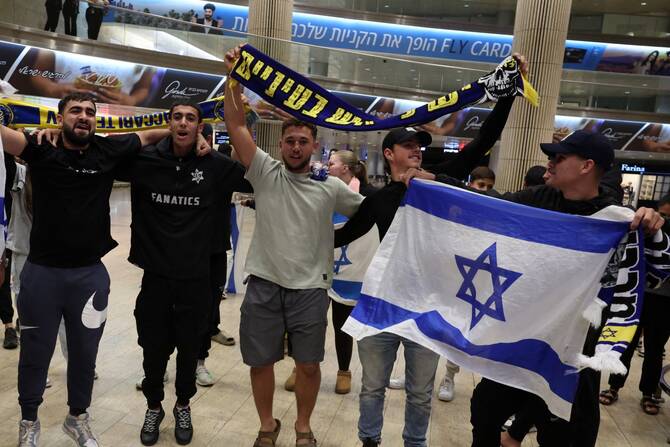
The Palestine Solidarity Campaign has welcomed the decision to ban Maccabi Tel Aviv supporters from attending their upcoming UEFA Europa League match at Aston Villa but says the fixture itself should be canceled. (AFP/File Photo)
Short Url
Updated 17 October 2025
Follow

Pro-Palestine group backs Maccabi Tel Aviv fan ban but calls for Aston Villa match to be canceled

  • PSC said the ban should be understood in the context of what it described as the club’s “track record of committing racist violence”

LONDON: The Palestine Solidarity Campaign has welcomed the decision to ban Maccabi Tel Aviv supporters from attending their upcoming UEFA Europa League match at Aston Villa but says the fixture itself should be canceled.

In a statement issued on Friday, PSC said the ban should be understood in the context of what it described as the club’s “track record of committing racist violence” in cities hosting their games, as well as Maccabi Tel Aviv’s alleged involvement in Israel’s apartheid system.

The campaign group pointed to chants reportedly used by some Maccabi fans, including: “Why is school out in Gaza? There are no children left there,” referencing the deaths of Palestinian children in the conflict.

PSC argued that UK Prime Minister Keir Starmer’s criticism of the fan ban shows “he expects Birmingham residents to tolerate racist incitement and expects police to provide cover for it,” adding that this reflects “blatant anti-Palestinian racism.”

The group also cited previous incidents of violence involving Maccabi supporters, including clashes in Amsterdam last season, where fans attacked residents and attempted to assault a taxi driver.

PSC said the club has further “directly involved itself in Israel’s atrocities,” including sending care packages to Israeli soldiers and producing videos of employees serving in the military as motivation before matches.

“Starmer’s willingness to conflate opposition to Israel’s crimes with antisemitism has now taken him to a place where he defends, supposedly in the name of antiracism, the rights of avowedly anti-Palestinian, Islamophobic, violent thugs to demonstrate their hate in a British city and at a football match,” Ben Jamal, PSC director, said.

“The Maccabi fan base has an egregious track record of racist violence that led them to being banned from the city of Amsterdam. Starmer wants Birmingham to host people who chant for Palestinians to be raped and their villages burned. The fixture should not be going ahead. Israel and all Israeli clubs should be removed from international competitions,” he added.

PSC said allowing Israeli football teams to compete in international competitions “sanitizes Israel’s horrific atrocities against Palestinians” and argued that the Israel Football Association includes clubs based in settlements on land taken from Palestinians.

The group said international sporting bodies should follow the precedent set during apartheid South Africa and ban Israeli teams from competitions.


In Ethiopia, Tigrayans fear return to ‘full-scale war’

Updated 2 min 23 sec ago
Follow

In Ethiopia, Tigrayans fear return to ‘full-scale war’

  • Flights have been suspended into Tigray since Thursday and local authorities reported drone strikes on goods lorries
  • The international community fears the fighting could turn into an international conflict between Ethiopia and Eritrea
ADDIS ABABA: Tigrayans in northern Ethiopia fear a return to all-out war amid reports that clashes were continuing between local and federal forces on Monday, barely three years after the last devastating conflict in the region.
The civil war of 2020-2022 between the Ethiopian government and Tigray forces killed more than 600,000 people and a peace deal known as the Pretoria Agreement has never fully resolved the tensions.
Fighting broke out again last week in a disputed area of western Tigray called Tselemt and the Afar region to the east of Tigray.
Abel, 38, a teacher in Tigray’s second city Adigrat, said he still hadn’t recovered from the trauma of the last war and had now “entered into another round of high anxiety.”
“If war breaks out now... it could lead to an endless conflict that can even be dangerous to the larger east African region,” added Abel, whose name has been changed along with other interviewees to protect their identity.
Flights have been suspended into Tigray since Thursday and local authorities reported drone strikes on goods lorries on Saturday that killed at least one driver.
In Afar, a humanitarian worker, speaking to AFP on condition of anonymity, said there had been air strikes on Tigrayan forces and that clashes were ongoing on Monday, with tens of thousands of people displaced.
AFP could not independently verify the claims and the government has yet to give any comment on the clashes.
In the regional capital Mekele, Nahom, 35, said many people were booking bus tickets this weekend to leave, fearing that land transport would also be restricted soon.
“My greatest fear is the latest clashes turning into full-scale war and complete siege like what happened before,” he told AFP by phone, adding that he, too, would leave if he could afford it.
Gebremedhin, a 40-year-old civil servant in the city of Axum, said banks had stopped distributing cash and there were shortages in grocery stores.
“This isn’t only a problem of lack of supplies but also hoarding by traders who fear return of conflict and siege,” he said.
The region was placed under a strict lockdown during the last war, with flights suspended, and banking and communications cut off.
The international community fears the fighting could turn into an international conflict between Ethiopia and Eritrea, whose relations have been increasingly tense in recent months.
The Ethiopian government accuses the Tigrayan authorities and Eritrea of forging closer ties.
United Nations Secretary-General Antonio Guterres is “deeply concerned about... the risk of a return to a wider conflict in a region still working to rebuild and recover,” his spokesman said.
The EU said that an “immediate de-escalation is imperative to prevent a renewed conflict.”