

Food flows into Gaza still far below targets, WFP says

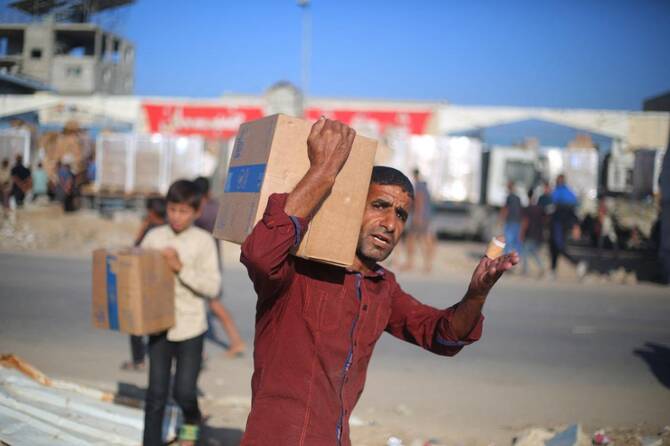
Displaced Palestinians carry boxes of food supplies that entered Gaza in the morning after receiving it from an aid distribution point at the Nuseirat refugee camp in the central Gaza Strip, on October 20, 2025. (File/AFP)
Short Url
Updated 21 October 2025
Follow

Food flows into Gaza still far below targets, WFP says

  • Food flows into Gaza still far below targets, World Food Programme says
  • “We haven’t had large-scale convoys into Gaza City or to the north of Gaza“

GENEVA: The UN World Food Programme said on Tuesday that supplies into Gaza were ramping up after the US-brokered ceasefire but were still far short of its daily target of 2,000 tons because only two crossings are open, and none to the famine-hit north of the enclave.
Around 750 metric tons of food are now entering the Gaza Strip daily, according to the WFP, but this was still well below the scale of needs after two years of conflict between Israel and Hamas that has reduced much of Gaza to ruins.
“To be able to get to this scale-up, we have to use every border crossing point right now,” WFP spokesperson Abeer Etefa told a Geneva press briefing.

NOT ALL CROSSINGS OPEN
She said only two of the Israeli-controlled crossings into Gaza were operational — Kerem Shalom in the south and Kissufim in the center.
The ceasefire plan brokered by US President Donald Trump envisages “full aid” being sent into Gaza. An Israeli security official said that humanitarian aid continues to enter through the Kerem Shalom crossing and additional crossings in accordance with the plan, without naming them.
Israeli Prime Minister Benjamin Netanyahu said on Saturday the Rafah border crossing between Gaza and Egypt will remain closed until further notice, with its reopening dependent on Hamas handing over bodies of deceased hostages.
The UN children’s agency spokesperson Ricardo Pires said on Tuesday the humanitarian response was still far below the required scale and called for all entry points to reopen.
Some nutrition supplies for children and pregnant women have reached the north via the south, Etefa said, but far short of the level required.
NO ACCESS TO ROAD RUNNING LENGTH OF GAZA
“We haven’t had large-scale convoys into Gaza City or to the north of Gaza,” she said, adding that WFP had not been granted permission to use the main north-south Salah Al-Din road.
Food supplies delivered so far are enough to feed around half a million people for two weeks, she said.
Many Gazans were storing the food they are receiving because they are afraid that supplies might again dry up.
“They eat part of it, and they ration and keep some of the supplies for an emergency, because they are not very confident how long the ceasefire will last and what will happen next,” she said.


Trump says Iran government change ‘best thing that could happen’

Updated 9 min 9 sec ago
Follow

Trump says Iran government change ‘best thing that could happen’

  • US president's comments come after he ordered a second aircraft carrier to head to the Middle East

FORT BRAGG, United States: US President Donald Trump said a change of government in Iran would be the “best thing that could happen,” as he ordered a second aircraft carrier to head to the Middle East.
“Seems like that would be the best thing that could happen,” Trump told reporters at the Fort Bragg military base in North Carolina when a journalist asked if he wanted “regime change” in Iran.
“For 47 years, they’ve been talking and talking and talking. In the meantime, we’ve lost a lot of lives while they talk,” he told reporters.

Trump declined to say who he would want to take over in Iran from supreme leader Ayatollah Ali Khamenei, but he added that “there are people.”
He has previously backed off full-throated calls for a change of government in Iran, warning that it could cause chaos, although he has made threats toward Khamenei in the past.
Speaking earlier at the White House, Trump said that the USS Gerald R. Ford — the world’s largest warship — would be “leaving very soon” for the Middle East to up the pressure on Iran.
“In case we don’t make a deal, we’ll need it,” Trump said.
The giant vessel is currently in the Caribbean following the US overthrow of Venezuela’s Nicolas Maduro. Another carrier, the USS Abraham Lincoln, is one of 12 US ships already in the Middle East.

When Iran began its crackdown on protests last month — which rights groups say killed thousands — Trump initially said that the United States was “locked and loaded” to help demonstrators.
But he has recently focused his military threats on Tehran’s nuclear program, which US forces struck last July during Israel’s unprecedented 12-day war with Iran.
The protests have subsided for now but US-based Reza Pahlavi, the son of Iran’s last shah, urged international intervention to support the Iranian people.
“We are asking for a humanitarian intervention to prevent more innocent lives being killed in the process,” he told the Munich Security Conference.
It followed a call by the opposition leader, who has not returned to his country since before the revolution, for Iranians at home and abroad to continue demonstrations this weekend.
Iran and the United States, who have had no diplomatic relations since shortly after the revolution, held talks on the nuclear issue last week in Oman. No dates have been set for new talks yet.
The West fears the program is aimed at making a bomb, which Tehran denies.
The head of the UN nuclear watchdog, Rafael Grossi, said Friday that reaching an accord with Iran on inspections of its processing facilities was possible but “terribly difficult.”

Trump said after talks with Israeli Prime Minister Benjamin Netanyahu earlier this week that he wanted to continue talks with Iran, defying pressure from his key ally for a tougher stance.
The Israeli prime minister himself expressed skepticism at the quality of any agreement if it didn’t also cover Iran’s ballistic missiles and support for regional proxies.
According to the US-based Human Rights Activists News Agency, 7,008 people, mostly protesters, were killed in the recent crackdown, although rights groups warn the toll is likely far higher.
More than 53,000 people have also been arrested, it added.
The Norway-based Iran Human Rights (IHR) NGO said “hundreds” of people were facing charges linked to the protests that could see them sentenced to death.
Figures working within the Iranian system have also been arrested, with three politicians detained this week from the so-called reformist wing of Iranian politics supportive of President Masoud Pezeshkian.
The three — Azar Mansouri, Javad Emam and Ebrahim Asgharzadeh — were released on bail Thursday and Friday, their lawyer Hojjat Kermani told the ISNA news agency.
