

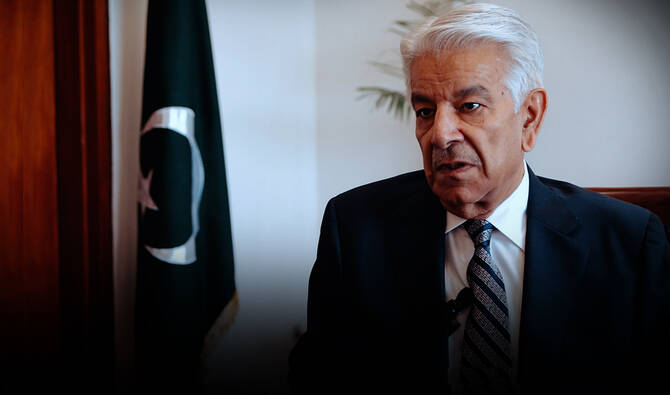

ISLAMABAD: Pakistani Defense Minister Khawaja Asif on Monday dismissed Afghan allegations that Islamabad is acting on behalf of the United States to engineer a regime change in Kabul, describing the claim as “total nonsense.”
The remarks come after a week of deadly border clashes — the worst violence between the two neighbors since the Taliban group seized power in Kabul in 2021 — that left dozens dead and hundreds injured. Both sides agreed to a ceasefire in Doha on Sunday and will meet again on Oct. 25 in Istanbul for further talks.
The ground fighting between the two nations and Pakistani airstrikes across their contested 2,600-km (1,600-mile) frontier were triggered after Islamabad demanded that Kabul rein in militants who have stepped up attacks in Pakistan, saying they operate from havens in Afghanistan. Kabul denies this.
“I don’t want to use any strong word for that, but it’s total nonsense and nothing else. Why would we? We have enough involvement in Afghan affairs,” Asif told Arab News when asked about claims by the Kabul government that Pakistan was facilitating a US-backed regime change effort in Afghanistan.
“For the last four or five decades we have had enough. We want to stay away and live like decent neighbors.”
Asif also rejected suggestions that Washington was plotting to topple the Taliban government, saying the movement already maintains cordial relations with the United States.
“If they think the US is trying to bring regime change over there, in my humble opinion, they have a comfortable relationship with the United States,” he said.
Islamabad has long said that India, its longstanding adversary, is working with Afghanistan to support the Tehreek-e-Taliban Pakistan (TTP), which is commonly known as the Pakistani Taliban, and other militants against Pakistan. New Delhi denies the claim.
The latest clashes between Pakistan and India broke out as Afghan Foreign Minister Amir Khan Muttaqi was on a multi-day trip to India, during which New Delhi upgraded relations between the two nations, raising further concerns in Pakistan.
Asif said Pakistan has no objections to Afghanistan’s relations with other nations, including India, as long as they do not threaten Pakistan’s security.
“They can have a relationship with India or any other country, we have no business with that,” the minister said. “Whatever they do in their own territory, it doesn’t become our business as long as it doesn’t spill over to our side.”
He added:
“They can have an alliance with India. They can have treaty with them. They can trade with them whatever they want to do. That’s their business. It’s not our business.”
Responding to a question about Pakistan’s recent dialogue with the Taliban in Doha, Asif said a new understanding had been reached under which Türkiye and Qatar would act as guarantors to ensure that the banned TTP no longer operates from Afghan soil.
“They [Kabul] know very well that TTP is operating from their territory and off the record they admit it. In the past, they have even discussed relocating them somewhere else far from our border,” he revealed.
“Everything hinges on this agreement, and the most important clause is that TTP should not be allowed to operate from their territory,” he said, adding that both sides will meet in Istanbul to finalize a monitoring mechanism for the arrangement.
Asif said the Taliban’s only request during the Doha talks was that Afghan refugees’ repatriation be carried out with dignity and honor.
“They just politely asked that the repatriation of Afghan refugees should be in an honorable manner,” Asif said. “They did not say don’t repatriate them, it’s part of the agreement, and we will facilitate it with dignity.”
He was referring to Pakistan’s deportation campaign against illegal aliens that has intensified over the past year, with authorities repatriating more than 800,000 Afghans since 2023 as part of a nationwide drive against undocumented foreigners.
“They were our guests or whatever you can call them for many, many years. If they are going home, we wish them luck,” Asif said.
“That is their soil. We wish them, we pray for them that they have good life under the present regime over there and that Afghanistan has stability and economic well-being.”


