

After mosque bombing, Islamabad intensifies patrols, surveillance during Ramadan prayers, iftar

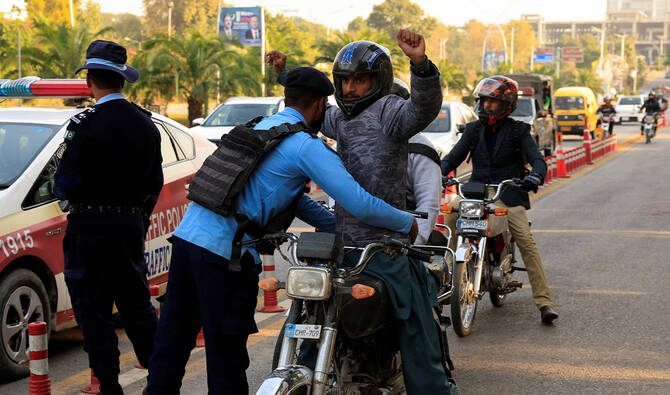
A police officer frisks a biker at a security check post along a road following yesterday's blast outside the district court building, in Islamabad, Pakistan, November 12, 2025. (Reuters/File)
Short Url
Updated 25 February 2026
Follow

After mosque bombing, Islamabad intensifies patrols, surveillance during Ramadan prayers, iftar

  • Police chief orders enhanced screening at capital city’s entry and exit points after Feb. 6 blast
  • Safe City cameras to monitor Islamabad round the clock as special pre-iftar traffic plan enforced

ISLAMABAD: Police in the federal capital have been instructed to step up patrols, surveillance and checkpoint inspections during Ramadan prayers and iftar hours, an official statement said on Wednesday, as the city’s police chief chaired a security meeting following a deadly mosque bombing earlier this month.

Inspector General of Police Syed Ali Nasir Rizvi directed senior officers to ensure “foolproof security” across the city, with special focus on mosques during peak congregational times.

The meeting comes after a suicide bombing at a mosque on the outskirts of Islamabad on Feb. 6 that killed at least 32 people. The blast targeted the Qasr-e-Khadijatul Kubra mosque and imambargah during Friday prayers and was claimed by Daesh that said one of its militants detonated an explosive vest inside the congregation.

“All officers must ensure their presence in the field and properly brief personnel about their duties,” Rizvi said, according to a statement issued by the police.

“Strict security arrangements should be ensured at mosques, imambargahs and Ramadan bazaars,” he continued. “Special patrols should be conducted during Fajr, iftar and Taraweeh hours.”

The police chief said Safe City cameras would be used for round-the-clock effective monitoring across the capital.

In addition to security measures, he reviewed traffic arrangements and directed strict implementation of a special traffic plan during pre-iftar rush hours, calling for additional deployment on major roads and at commercial centers.

Islamabad, which has generally seen fewer large-scale militant attacks than some other parts of Pakistan, has faced sporadic security incidents in the past, prompting authorities to tighten monitoring during religious gatherings and other high-risk events.


Pakistan PM calls for faster CPEC implementation, pledges security for Chinese workers

Updated 12 sec ago
Follow

Pakistan PM calls for faster CPEC implementation, pledges security for Chinese workers

  • Shehbaz Sharif pushes expanded cooperation in agriculture, IT and mining under CPEC phase two
  • Chinese envoy reaffirms Beijing’s support for Pakistan’s sovereignty and economic development

ISLAMABAD: Prime Minister Shehbaz Sharif on Friday called for speeding up projects under the China-Pakistan Economic Corridor (CPEC) and pledged stronger security guarantees for Chinese workers and investments, during a meeting with China’s ambassador in Islamabad.

Sharif made the remarks as the two countries strive to launch the second phase of CPEC, a multibillion-dollar infrastructure and energy initiative launched in 2015 as part of China’s Belt and Road Initiative (BRI).

CPEC’s first phase focused largely on power generation and transport infrastructure aimed at easing Pakistan’s chronic energy shortages and improving connectivity. The second phase seeks to expand cooperation into industrial development, with an emphasis on special economic zones and export-oriented growth.

“While highlighting the importance of accelerating ongoing CPEC projects, the Prime Minister stressed on the need to enhance cooperation in agriculture and IT and mining & minerals,” said a statement circulated by the PM Office after the meeting.

“He also underscored Pakistan’s resolve to provide a secure and conducive environment for Chinese personnel, investments, and institutions in Pakistan,” it added.

Chinese nationals and projects in Pakistan have faced security threats in the past, including attacks by militant groups targeting infrastructure sites and convoys. Islamabad has repeatedly vowed to tighten security and has deployed special protection units for Chinese workers.

China is Pakistan’s closest ally in the region and a key economic partner, with CPEC widely regarded by Islamabad as central to long-term economic growth.

During the meeting, the prime minister conveyed greetings to Chinese President Xi Jinping and Premier Li Qiang, particularly on the occasion of the Chinese New Year.

China’s Ambassador to Pakistan, Jiang Zaidong, reiterated Beijing’s support for Pakistan’s sovereignty and socioeconomic development, according to the statement. Both sides also exchanged views on regional and international issues and agreed to maintain close coordination.