Bolivia votes in runoff election, marking pro-market shift and US embrace

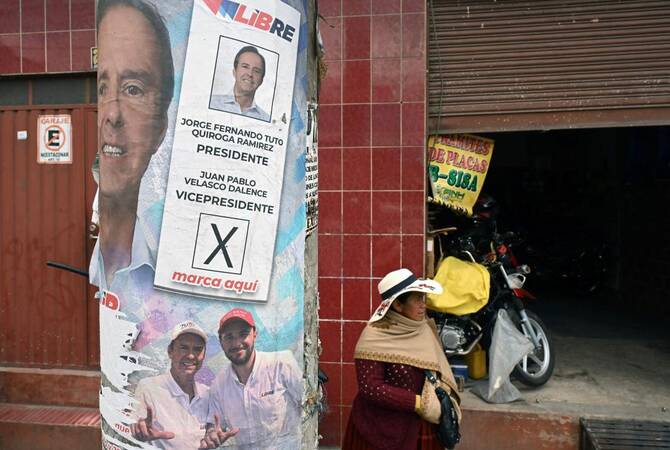
A woman stands next to a poster with the image of a voting ballot for Bolivia’s presidential candidate Jorge Quiroga in El Alto. Bolivia will hold the runoff presidential election on October 19, 2025. (AFP)
Short Url
Updated 19 October 2025
Follow

Bolivia votes in runoff election, marking pro-market shift and US embrace

  • The race pits centrist Senator Rodrigo Paz against conservative former president Jorge Quiroga
  • Runoff between two pro-market candidates from privileged backgrounds signals an epochal shift for Bolivia

LA PAZ: Bolivians vote in a presidential runoff on Sunday that marks a decisive rejection of the socialist government and a likely foreign policy shift closer to the United States after decades of frosty relations. The race pits centrist Senator Rodrigo Paz against conservative former president Jorge “Tuto” Quiroga. Both candidates have pledged to strengthen diplomatic ties with Washington – strained since 2009 – and seek US-backed financial support to stabilize Bolivia’s fragile economy. The runoff between two pro-market candidates from privileged backgrounds signals an epochal shift for Bolivia, following two decades of dominance by the leftist Movement to Socialism party, founded by Evo Morales and once backed by the country’s Indigenous majority.
For some voters the finalists echo the conservative governments of the 1990s, which championed privatization and close relations with the United States. Morales, who took power in 2006 and was Bolivia’s first Indigenous leader, pursued alliances with Cuba, Venezuela and Russia, and nationalized the oil and gas industry.
“This election marks a political turning point,” said Glaeldys Gonzalez Calanche, analyst for the Southern Andes at International Crisis Group. Regardless of the outcome, “Bolivia is heading in a new direction,” she said.
Quiroga has promised “radical change,” including deep cuts to public spending and closing or privatizing loss-making state-owned companies. Paz favors a more gradual approach, maintaining social programs for the poor while promoting private-sector growth. Opinion polls show Quiroga with a narrow lead. A September Ipsos survey gave him 47 percent support to Paz’s 39 percent, though Paz outperformed expectations in the August first round.
Voting stations open at 8 a.m. local time (1200 GMT) and close at 4 p.m., with initial results expected after 9 p.m. The winner will take office on November 8.
Voters want economic change
Paz in late September announced plans for an economic cooperation deal worth $1.5 billion with US officials to ensure fuel supplies, while Quiroga is pushing for a $12 billion international bailout backed by multilateral lenders.
US Secretary of State Marco Rubio said this week that both presidential candidates “want stronger, better relations with the United States,” after decades of anti-American leadership. “This election is a transformative opportunity,” he said on Wednesday. Some Bolivians have voiced fears of austerity measures such as those seen in neighboring Argentina under President Javier Milei, though Paz has rejected drastic spending cuts and Quiroga insists his policies will benefit ordinary Bolivians. Support for the Movement to Socialism all but collapsed in the election’s first round.
Inflation has surged to 23 percent since the start of the year, while fuel and dollar shortages have crippled consumer demand. Natural gas exports – once Bolivia’s economic engine – have plummeted, straining the boliviano currency and limiting fuel imports.
In La Paz’s commercial district, appliance stores are shuttered and shops empty of customers. “There are months with zero sales,” said Mercedes Quisbert, head of the local Importers’ Association. Up until this year, shopkeepers and street-sellers had been just about managing to weather the crisis, she said – but not anymore.
Bolivia has one of Latin America’s highest rates of informal employment, with around 84 percent of the population working outside the formal labor market, according to official data. Millions rely on buying and selling goods to make a living.
“We’re basically surviving,” said Marcela Martinez, 52, as she compared prices at a market in La Paz. She was planning to vote for Paz on Sunday. “We need new people to come in.”


Pakistani fighter jet crashes in Jalalabad, pilot captured: Afghan military, police

Updated 28 February 2026
Follow

Pakistani fighter jet crashes in Jalalabad, pilot captured: Afghan military, police

  • Fighting between Pakistan and Afghanistan’s Taliban military entered its third day on Saturday
  • Pakistan’s strikes on Friday hit Taliban military installations and posts, including in Kabul and Kandahar

JALALABAD: A Pakistani jet has crashed in Jalalabad city and the pilot captured alive, the Afghan military and police said Saturday, with residents telling AFP the man parachuted from the plane before being detained.
"A Pakistani fighter jet was shot down in the sixth district of Jalalabad city, and its pilot was captured alive," police spokesman Tayeb Hammad said.
Wahidullah Mohammadi, spokesman for the military in eastern Afghanistan, confirmed the Pakistani jet was downed by Afghan forces "and the pilot was captured alive".

The AFP journalist heard a jet overhead before blasts from the direction of the airport in Jalalabad, the capital of Nangarhar province, which sits on the road between Kabul and the Pakistani border.

Fighting between Pakistan and Afghanistan’s Taliban military entered its third day on Saturday, following overnight clashes as the international community expressed increasing concern about the conflict and called for urgent talks.

Pakistan’s strikes on Friday hit Taliban military installations and posts, including in Kabul and Kandahar, in one of the deepest Pakistani incursions into its western neighbor in years, officials said.

Islamabad accuses the Taliban of harboring Tehreek-e-Taliban Pakistan (TTP) militants, who it claims are waging an insurgency inside Pakistan, a charge the Taliban denies.

Pakistan described its actions as a response to cross-border assaults, while Kabul denounced them as a breach of its sovereignty, saying it remained open to dialogue but warned any wider conflict would result in serious consequences.

The fighting has raised ‌the risk ‌of a protracted conflict along the rugged 2,600-kilometer frontier.

Diplomatic efforts gathered ‌pace ⁠late on Friday ⁠as Afghanistan said its foreign minister, Amir Khan Muttaqi, spoke by telephone with Saudi Arabia’s Prince Faisal bin Farhan about reducing tensions and keeping diplomatic channels open.

The European Union called for both sides to de-escalate and engage in dialogue, while the United Nations urged an immediate end to hostilities.

Russia urged both sides to halt the clashes and return to talks, while China said it was deeply concerned and ready to help ease tensions.

The United States supports Pakistan’s right to defend itself against attacks by ⁠the Taliban, a State Department spokesperson said.

Border fighting continues

Exchanges of fire continued along ‌the border overnight.

Pakistani security sources said an operation dubbed “Ghazab Lil Haq” was ongoing and that Pakistani forces had destroyed multiple Taliban posts and camps in several sectors. Reuters could not independently verify the claims.

Both sides have reported heavy losses with conflicting tolls that Reuters could not verify. Pakistan said 12 of its ‌soldiers and 274 Taliban were killed while the Taliban said 13 of its fighters and 55 Pakistani soldiers died.

Taliban deputy spokesman Hamdullah Fitrat ⁠said 19 civilians were ⁠killed and 26 wounded in Khost and Paktika. Reuters could not verify the claim.

Pakistan’s Defense Minister Khawaja Muhammad Asif said “our cup of patience has overflowed” and described the fighting as “open war,” warning that Pakistan would respond to further attacks.

Taliban Interior Minister Sirajuddin Haqqani said in a speech in Khost province that the conflict “will be very costly,” and that Afghan forces had not deployed broadly beyond those already engaged.

He said the Taliban had defeated “the world, not through technology, but through unity and solidarity,” and through “great patience and perseverance,” rather than superior military power.

Pakistan’s military capabilities far exceed those of Afghanistan, with a standing army of hundreds of thousands and a modern air force.

In stark contrast, the Taliban lacks a conventional air force and relies largely on light weaponry and ground forces.

However, the Islamist group is battle-hardened after two decades of insurgency against US-led forces before returning to power in 2021.