

Pakistan, Afghanistan reach ceasefire agreement in Doha after fierce clashes

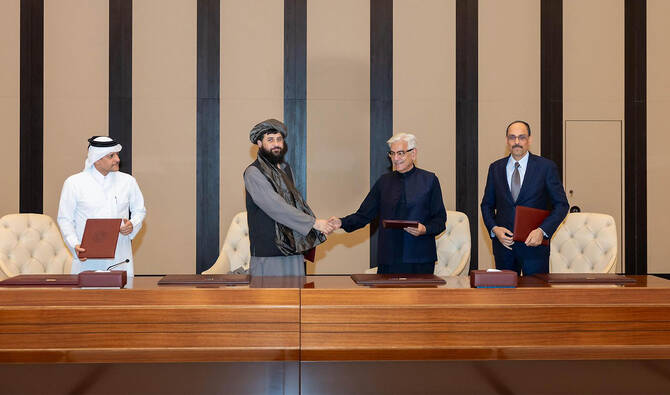
The picture shared by Qatar's Ministry of Foreign Affairs on October 19, 2025, shows Pakistani Defense Minister Khawaja Muhammad Asif (second right) shaking hand with Afghan government offiicial in Doha, Qatar. (Ministry of Foreign Affairs, Qatar)
Short Url
Updated 19 October 2025
Follow

Pakistan, Afghanistan reach ceasefire agreement in Doha after fierce clashes

  • Days of fierce clashes between Pakistan, Afghanistan left dozens dead in both countries, increased tensions
  • Both countries’ delegations will meet in Istanbul on Oct. 25 for detailed talks, says Pakistan’s defense minister

ISLAMABAD: Pakistan’s Defense Minister Khawaja Muhammad Asif announced on Sunday that Islamabad had reached a ceasefire agreement with Kabul in Doha, after days of fierce clashes between the two sides left dozens dead and increased tensions between the neighbors. 

Asif was leading a Pakistani delegation in Doha on Saturday for talks with Afghanistan after days of fierce battles between the two countries along their long and porous border, which led to the deaths of dozens of people on both sides. Pakistan also carried out airstrikes in Kandahar and Kabul before the two sides reached an uneasy truce that opened the window for bilateral talks arranged by Qatar.

Pakistan has long accused Afghanistan of sheltering militant groups like the Tehreek-e-Taliban Pakistan (TTP) and the separatist Baloch Liberation Army (BLA) and facilitating their attacks against its civilians and security forces. Kabul denies the allegation, though it has become a key sticking point between the two countries and has led more serious skirmishes than ever before.

“A ceasefire agreement has been reached between Pakistan and Afghanistan,” Asif wrote on social media platform X on Sunday. 

“The series of terrorist activities from Afghanistan on Pakistani soil will cease immediately. Both neighboring countries will respect each other’s territory — Alhamdulillah.”

The minister said delegations from Afghanistan and Pakistan will meet again in Istanbul on Oct. 25 in which detailed discussions will take place. Asif thanked Qatar and Turkiye for their mediation efforts. 

The development was also confirmed by Qatar’s foreign ministry in a statement, which said both Pakistan and Afghanistan have agreed to an “immediate ceasefire” after the Doha talks on Saturday. 

“During the negotiations, the two sides agreed to an immediate ceasefire and the establishment of mechanisms to consolidate lasting peace and stability between the two countries,” it said. 

Afghan government spokesperson Zabihullah Mujahid said the two sides had reaffirmed their commitment to peace, mutual respect and maintaining strong neighborly relations. He said both sides are committed to resolving their disputes through dialogue.

“It has been decided that neither country will undertake any hostile actions against the other, nor will they support groups carrying out attacks against the Government of Pakistan,” Mujahid wrote on X. 

He said both nations will refrain from targeting each other’s security forces, civilians or critical infrastructure. 

Tensions rose sharply on Friday when a militant attack on a Pakistani security compound in the northwestern Khyber Pakhtunkhwa province bordering Afghanistan killed at least seven soldiers. The attack elicited airstrikes from the authorities in Islamabad in an Afghan border town against the Hafiz Gul Bahadar group. 

The Afghanistan Cricket Board told AFP that three players who were in the region for a tournament were killed by the airstrikes, revising down an earlier toll of eight.

Afghanistan withdrew from the Twenty20 international tri-series in Pakistan next month in response, following which the Pakistan Cricket Board (PCB) announced Zimbabwe would take part in the series in its place. 

Information Minister Attaullah Tarar said on Saturday Pakistan had carried out “precision strikes” in which about 70 militants had been killed.

“All speculations and assertions being made regarding targeting of civilians are false and meant to generate support for terrorist groups operating from inside Afghanistan,” he added.


Pakistan says 177 militants killed in Balochistan counteroffensive after wave of attacks

Updated 7 sec ago
Follow

Pakistan says 177 militants killed in Balochistan counteroffensive after wave of attacks

  • Authorities say coordinated attacks last weekend killed 31 civilians, 17 security personnel
  • Separatist BLA group claimed responsibility as operations expanded across multiple districts

ISLAMABAD: Pakistan’s security forces have killed 22 more militants in overnight counteroffensive operations in the southwestern province of Balochistan, state media reported on Monday, taking the total number of insurgents killed over the past three days to 177 following a wave of coordinated separatist attacks.

Militants launched simultaneous assaults across multiple districts in Balochistan on Friday and Saturday, targeting security installations and government facilities. The attacks marked one of the deadliest escalations in recent years in the resource-rich but restive province, with at least 31 civilians and 17 members of law enforcement agencies killed.

The banned separatist group, the Baloch Liberation Army, claimed responsibility for the attacks, saying it had launched a coordinated operation dubbed Herof, or “black storm,” targeting security forces across the province. The assault included pre-dawn strikes on high-security installations in the cities of Quetta, Gwadar, Dalbandin, Pasni, Nushki, Kalat, Turbat and Mastung.

Local residents look at a damaged bank on the outskirts of Quetta on February 1, 2026 a day after an attack by Baloch separatists. (AFP)

On Monday, state broadcaster Radio Pakistan said security forces carried out the latest “sanitization operations” against what it described as “Fitna-al-Hindustan” in Balochistan late Sunday night. Pakistan’s military and civilian authorities use the term to describe separatist militants in the province whom Islamabad alleges are supported by India, a charge New Delhi denies.

“According to security sources, 22 more terrorists were killed last night during pursuit operations,” Radio Pakistan said. “At least 177 terrorists have been eliminated in the operations conducted over the last three days.”

People gather as others collect recyclable items beside a burnt vehicle along a road on the outskirts of Quetta on February 1, 2026 a day after an attack by Baloch separatists. (AFP)

Balochistan, Pakistan’s largest province by area, has long been gripped by a separatist insurgency that has intensified in recent years. Militants frequently target security forces, government officials, infrastructure projects, foreigners and non-local workers.

Balochistan is strategically significant for Pakistan due to its vast reserves of minerals and hydrocarbons and its role as a transit hub for the multibillion-dollar China-Pakistan Economic Corridor (CPEC), a flagship component of China’s Belt and Road Initiative. The province is home to the deep-sea Gwadar Port on the Arabian Sea, which Islamabad views as critical to regional trade and energy routes linking China, Central Asia and the Middle East. 

Local residents look at a damaged bank on the outskirts of Quetta on February 1, 2026, a day after an attack by Baloch separatists. (AFP)

Separatist groups accuse the central government of exploiting the province’s natural resources while neglecting local communities. Islamabad rejects the allegations, saying it is investing in development and security to stabilize the province.