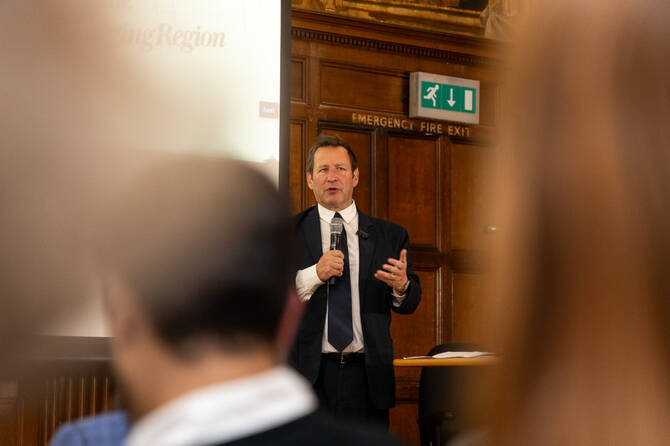

LONDON: Former UK culture minister Ed Vaizey, now a member of the UK’s House of Lords, praised Saudi Arabia’s growing investment in culture and creativity during an event hosted by Arab News at the University of Westminster on Oct. 17.
The evening, held at Fyvie Hall, featured a special screening of “Rewriting Arab News,” a documentary marking the Saudi newspaper’s 50th anniversary and chronicling its digital transformation.
Speaking after the screening, Vaizey said cultural understanding and partnership are key to building lasting connections between the UK and Saudi Arabia.
He described culture as “the soul of the country” and urged both nations to engage on “equal footing.”
He said: “For someone like me, who has been culture minister in the UK, where it’s a constant battle to get my colleagues in government to understand the power and value of culture, to understand that the investments you make in culture reap so many dividends — economic dividends, but also spiritual dividends — to see Saudi Arabia taking culture so seriously as part of its Vision 2030 is a wonder to behold.”

Friday’s event, held at Westminster’s Regent Street campus, included a panel discussion featuring Arab News Editor-in-Chief Faisal J. Abbas, left, and Dibyesh Anand, University of Westminster’s deputy vice-chancellor for global engagement and employability. (AN photo)
The former minister highlighted the strength of Saudi Arabia’s $20 billion creative industries sector, which is projected to grow to 3 percent of GDP and reach $48 billion by 2030. He called it one of the Kingdom’s fastest-growing non-oil sectors and a major opportunity for collaboration with the UK.
“The ties between the Kingdom of Saudi Arabia and the United Kingdom run long and deep, as you well know, and they’re only increasing,” he added.
Vaizey is currently involved in projects with cultural consulting firm BOP, Riyadh-based arts organization Edge of Arabia, and the Saudi-UK Creative Forum to strengthen cooperation between the two countries’ creative industries.
He said much of his work is intended to “bring Saudi changemakers together with British changemakers on an equal footing.”
He added: “In fact, it may well be long past (the point where we need to ask if) Saudi Arabia is able to sit at the table and teach cultural institutions in the UK about innovation and change and how to keep pushing forward in terms of cultural novelty and cultural invention.”
Vaizey, who served as culture and creative industries minister from 2010 to 2016, was part of a British delegation that attended the inaugural Cultural Investment Forum in Riyadh in September.

Former UK Culture Minister Ed Vaizey, now a member of the UK’s House of Lords, praised Saudi Arabia’s growing investment in culture and creativity during Friday’s event hosted by Arab News at the University of Westminster. (AN photo)
“I thought it was very telling that it was the (Saudi) minister of investment and the (Saudi) minister of planning that opened the conference to talk about how important culture is to the soul of their country,” he said. “But, to be blunt, it was also a cultural investment conference — a recognition that by investing in culture, you help grow your economy in so many different ways.
“The Middle East, and Saudi Arabia in particular, is possibly the most economically and culturally dynamic region in the world,” he added. “It’s really exciting. There is an element of confidence and ambition that is very hard to find anywhere else.”
The event, held at Westminster’s Regent Street campus — home to Britain’s oldest cinema, brought together academics, students, diplomats, and professionals from the UK and the Arab world.
It included a panel discussion featuring Faisal J. Abbas — Arab News’ editor-in-chief — and Dibyesh Anand, the university’s deputy vice-chancellor for global engagement and employability.
Anand described Westminster as “a global university with London energy,” noting that the evening celebrated values central to education, including open dialogue, diversity, and mutual respect.
“I don’t even need to tell you how challenging it is for universities to navigate tensions (that have) to do with conflict that can take place elsewhere,” Anand said. “We do that. We have to do it. We have to navigate. But we also understand societies have to navigate. Professionals have to navigate. Countries have to navigate.”
IN NUMBERS:
• 3% Share of Saudi GDP that will come from creative sector by 2030.
• SR81bn Kingdom’s investments in cultural infrastructure since 2016.
(Source: Saudi MoC)
Anand said institutions such as the university must teach students “the art of navigating complexity,” adding that Westminster’s values include “academic freedom” and “freedom to think differently.”
“That does imply that you may have different views from me,” Anand said. “You (may) have a similar view, you may have a completely contradictory view, (and that is fine) so long as we do not dehumanize each other.
“So, we want to have a space as a university where we talk about it,” he added.
Anand, who invited Westminster alumnus Abbas to return for the screening, said the partnership reflected the university’s longstanding global ethos.
In his remarks, Abbas — a 2009 Westminster graduate in marketing communications — reflected on Arab News’ evolution alongside the broader transformation of Saudi Arabia.
Echoing Vaizey’s comments, he said Vision 2030 — the Kingdom’s blueprint for economic diversification — “is, by default, an outward-looking plan” that requires strong international partnerships.
“The United Kingdom has the know-how, the experience, and the knowledge to help us reach where we can, in terms of cultural industries,” he said.
“My point is, whether it’s in culture, whether it’s in nuclear energy, whether it’s in defense, whether it’s in artificial intelligence, you need to go to the countries in the world that have the best practices and have the experience and have knowledge transfer and work with them.”

Friday’s event, held at Westminster’s Regent Street campus, included a panel discussion featuring Arab News Editor-in-Chief Faisal J. Abbas, left, and Dibyesh Anand, University of Westminster’s deputy vice-chancellor for global engagement and employability. (AN photo)
Abbas also spoke about Saudi Arabia’s growing diplomatic role, noting that it is leveraging its religious, political, and economic weight to help mediate regional and global conflicts.
“To quote the famous comic writer Stan Lee: ‘With great power comes great responsibility,’” he said. “This is why you see (Saudi) foreign policy focusing on things like trying to negotiate between the warring parties in Sudan; trying to get the rest of the world to recognize the Palestinian state, the two-state solution; trying our hand in mediating between Ukraine and Russia. That stems from that belief and that philosophy that a stable region and a stable world is better for our economy and better for our society.”
Abbas concluded by offering a glimpse into the newspaper’s future, confirming Arab News’ upcoming AI initiative. The project, developed with regional startup CAMB.AI, will be unveiled on Oct. 22 at the FIPP World Media Congress in Madrid.
The AI-powered translation system will make Arab News available in 50 languages, allowing it to reach nearly 80 percent of the world’s population — a fitting milestone as the publication enters its next 50 years.