

Pakistan tells India ‘no space for war’ in nuclearized environment, settle issues as per norms

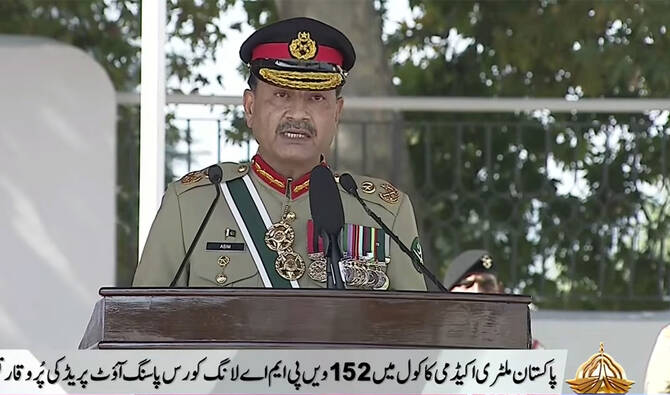
Pakistan's Army Chief Field Marshal Asim Munir is addressing a passing-out parade ceremony at the Pakistan Military Academy in Kakul on October 18, 2025. (PTV/Screengrab)
Short Url
Updated 18 October 2025
Follow

Pakistan tells India ‘no space for war’ in nuclearized environment, settle issues as per norms

  • The statement comes days after India’s army chief said Pakistan must stop ‘backing terror’ if it wanted to ‘remain on the world map’
  • Field Marshal Asim Munir says Pakistan’s military successfully displayed its capabilities, delivering a ‘decisive blow to the adversary’

ISLAMABAD: Pakistan’s army chief on Saturday said there is “no space for war” between two countries in a nuclearized environment, urging India to resolve all core issues with Pakistan as per globally recognized norms.

The statement came days after India’s army chief General Upendra Dwivedi told soldiers near the Pakistan border that Islamabad must stop “backing terror” if it wanted to “remain on the world map.”

Dwivedi said India would not show the restraint it exercised during a brief war with Pakistan in May. Recent Indian political and security rhetoric has included similar public statements and assertions of “bloodshed” narratives ahead of local elections.

Speaking at a passing-out ceremony at the Pakistan Military Academy, Field Marshal Asim Munir said Pakistan’s defense doctrine is predicated on credible deterrence and perpetual readiness, encompassing the full spectrum of capabilities.

“The battle-hardened Army which has fought for over two decades in the sub-conventional domain has successfully displayed its capabilities in conventional domain as well by delivering a swift and decisive blow to the adversary,” he said in a clear reference to India.

“I advise and firmly caution the Indian military leadership that there is ‘no space for war’ in a nuclearized environment. Settle the core issues with Pakistan as per the international norms, on the basis of equality and mutual respect.”

The disputed region of Kashmir has long been a flashpoint between Pakistan and India, with both claiming the territory in its entirety and fighting multiple wars for its control. The conflict in May was also triggered by an attack in Indian-administered Kashmir, which New Delhi blamed on Pakistan. Islamabad denied the allegation.

Munir said that India, having failed in its belligerence against Pakistan in May, continues with “state-sponsored terrorism” as a preferred policy.

“Our adversary’s use of Fitna Al-Hind [Baloch separatist groups] and Fitna-al-Khawarij [Pakistani Taliban] as hired guns, exposes its cowering, hypocritical and heinous face to the world,” he said.

“Equally disconcerting is the use of Afghan soil for terrorism in Pakistan. We urge the people of Afghanistan to choose mutual security over perpetual violence and progress over hard-line obscurantism. Taliban Regime must rein in the proxies, who have sanctuaries in Afghanistan and are using Afghan soil to perpetrate heinous attacks inside Pakistan.”

There was no immediate comment from New Delhi or the Taliban to the Pakistani army chief’s statement. It came amid ongoing hostilities between Islamabad and Kabul over a surge in militant attacks by the Pakistani Taliban in Pakistan’s western regions that border Afghanistan.

Pakistan has frequently accused Afghanistan of allowing the use of its soil and India of backing militant groups for attacks against Pakistan. Kabul and New Delhi both deny the allegation.


Pakistan’s army chief to get expanded powers under proposed reform

Updated 6 sec ago
Follow

Pakistan’s army chief to get expanded powers under proposed reform

  • Asim Munir, President Trump’s ‘favorite field marshal,’ to be head of all military forces, a new position
  • Constitutional cases to be taken away from Supreme Court, opposition raps changes as undemocratic

ISLAMABAD: Pakistan’s powerful army chief will be given an expanded role and the remit of the Supreme Court will be curbed under constitutional changes passed by the upper house of parliament this week, a move the opposition says will undermine democracy.

Pakistan, historically coup-prone, is seeing its longest period of elected government. But in recent years, after civilians have sought to assert more authority in governance, the military has taken tighter hold of the levers of power, while not staging an outright takeover.

The bill, passed on Monday by the Senate in about three hours, unusually fast for a constitutional change, after the opposition boycotted the debate, is now before the lower house before it can become law.

Army chief Asim Munir, described by US President Donald Trump as his “favorite Field Marshal,” would take overall command of the military — including air and naval forces — with the new position of Chief of Defense Forces under the proposed amendment. After completion of his term, he would retain his rank and have legal immunity for life.

While the military has long wielded extensive power, the reforms would give it greater constitutional backing that would not be easily reversed. Hitherto the army chief was the equal of the air force and navy chiefs, with a chairman of the joint chiefs sitting above him, a post that would be eliminated.

Constitutional cases would no longer be heard by the Supreme Court but by a new Federal Constitutional Court, with judges appointed by the government. In recent years, the Supreme Court has, at times, blocked government policies and ousted prime ministers.

Critics say handpicked judges would now hear the most politically sensitive cases impacting the government, with the Supreme Court dealing with civil and criminal matters.

Under the reforms, President Asif Zardari would also get immunity for life from prosecution.

“All these amendments are for governance, and the federal government’s coordination with the provinces, and to strengthen defense capability after winning a war,” Information Minister Attaullah Tarar said, referring to clashes with India in May.

The government said it was confident it had the numbers in parliament to approve the constitutional changes, which were unusually introduced to the Senate over the weekend. A two-thirds majority is required in the two houses that make up the parliament, the Senate and National Assembly.

The biggest opposition party, founded by jailed ex-prime minister Imran Khan, said it was not consulted. After a noisy protest, opposition parties walked out on Monday when the amendment was introduced to the Senate floor for debate.

Khan’s party PTI condemned the proposed changes.

“The amendment serves as a tool for the ruling coalition to bulldoze institutional checks and balances, silence the opposition, restrict fundamental rights, and concentrate power in its own hands,” PTI’s spokesman for international media, Zulfi Bukhari, told Reuters.

Munir was promoted from General to Field Marshal after the May conflict with India. Law Minister Azam Tarar said on Saturday the rank would be given constitutional protection “because he is the hero of the whole nation.”

The military did not immediately respond to a request for comment. Security officials said the changing nature of modern war, where land troops do not necessarily play the paramount role, requires unified command of all the armed forces.

The government says the court reforms are necessary because hearing constitutional cases takes up too much of the Supreme Court’s time, creating a case backlog.