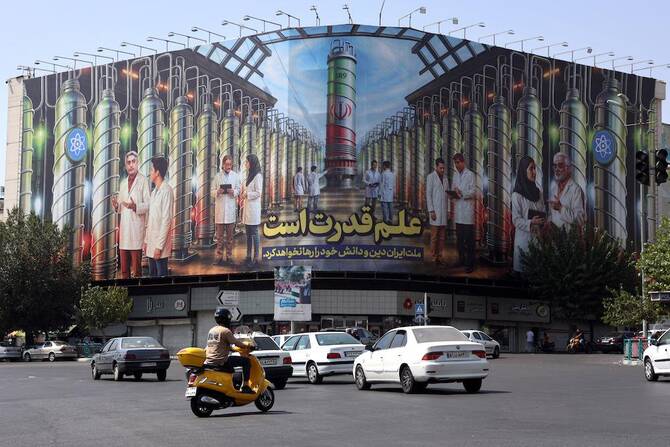
TEHRAN: Iran said on Saturday that it was no longer bound by restrictions on its nuclear program as a landmark 10-year deal between it and world powers expired, though Tehran reiterated its “commitment to diplomacy.”
The 2015 deal — signed in Vienna by Iran, China, Britain, France, Germany, Russia and the United States — saw the lifting of international sanctions against the Islamic republic in exchange for restrictions on its nuclear program.
But the pact had already been in tatters after Washington unilaterally withdrew during President Donald Trump’s first term, with Iran later pulling back from its commitments.
The reimposition last month of UN sanctions at the urging of three of the deal’s European signatories rendered the accord effectively moot.
From now on, “all of the provisions (of the deal), including the restrictions on the Iranian nuclear program and the related mechanisms are considered terminated,” Iran’s foreign ministry said in a statement on the day of the pact’s expiration.
“Iran firmly expresses its commitment to diplomacy,” it added.
Western powers have long accused Iran of secretly seeking nuclear weapons — something it has repeatedly denied, insisting its nuclear program is solely for civilian purposes such as energy production.
The deal’s “termination day” was set for October 18, 2025, exactly 10 years after it was enshrined in the UN’s Security Council resolution 2231.
The accord capped Iran’s uranium enrichment at 3.67 percent in exchange for sanctions relief and provided for strict supervision of its nuclear activities by the UN’s nuclear watchdog, the International Atomic Energy Agency (IAEA).
But Washington left the deal in 2018 and reinstated sanctions, after which Tehran began stepping up its nuclear program.
According to the IAEA, Iran is the only country without a nuclear weapons program to enrich uranium to 60 percent. That is close to the threshold of 90 percent required for a bomb, and well above the level needed for civilian nuclear use.
‘Irresponsible actions’
In July, Iran suspended cooperation with the IAEA following the war with Israel, with Tehran pointing to the agency’s failure to condemn Israeli and US strikes on its nuclear facilities.
The unprecedented bombing campaign by Israel and the retaliation by Iran during the 12-day war derailed ongoing nuclear negotiations between Tehran and Washington.
At the initiative of France, Britain and Germany, widespread UN sanctions against Iran returned into force in late September for the first time in a decade.
Iranian Foreign Minister Abbas Araghchi said in a letter addressed to the United Nations on Saturday that the expiration of the 2015 deal renders the sanctions “null and void.”
Britain, France and Germany accuse Iran of not cooperating with the IAEA and would like it to return to negotiations with the United States.
“Iran’s efforts to revive the exchanges (with the IAEA) that led to the agreement in Cairo were also sabotaged by the irresponsible actions of the three European countries,” the Iranian foreign ministry said in Saturday’s statement, referring to a recent framework to resume cooperation.


Iran says no longer bound by ‘restrictions’ on its nuclear program
https://arab.news/y2fjw
Iran says no longer bound by ‘restrictions’ on its nuclear program

- The 2015 deal saw the lifting of international sanctions against the Tehran in exchange for restrictions on its nuclear program
- But the pact had already been in tatters after Washington unilaterally withdrew during President Donald Trump’s first term


US lawmakers press Israel to probe strike on reporters in Lebanon
- “The IDF has made no effort, none, to seriously investigate this incident,” Welch said
- Collins called for Washington to publicly acknowledge the attack in which an American citizen was injured
WASHINGTON: Several Democratic lawmakers called Thursday for the Israeli and US governments to fully investigate a deadly 2023 attack by the Israeli military on journalists in southern Lebanon.
The October 13, 2023 airstrike killed Reuters videographer Issam Abdallah and wounded six other reporters, including two from AFP — video journalist Dylan Collins and photographer Christina Assi, who lost her leg.
“We expect the Israeli government to conduct an investigation that meets the international standards and to hold accountable those people who did this,” Senator Peter Welch told a news conference, with Collins by his side.
The lawmaker from Collins’s home state of Vermont said he had been pushing for answers for two years, first from the administration of Democratic president Joe Biden and now from the Republican White House of Donald Trump.
The Israeli government has “stonewalled at every single turn,” Welch added.
“With the Israeli government, we have been extremely patient, and we have done everything we reasonably can to obtain answers and accountability,” he said.
“The IDF has made no effort, none, to seriously investigate this incident,” Welch said, referring to the Israeli military, adding that it has told his office its investigation into the incident is closed.
Collins called for Washington to publicly acknowledge the attack in which an American citizen was injured.
“But I’d also like them to put pressure on their greatest ally in the Middle East, the Israeli government, to bring the perpetrators to account,” he said, echoing the lawmakers who called the attack a “war crime.”
“We’re not letting it go,” Vermont congresswoman Becca Balint said. “It doesn’t matter how long they stonewall us.”
AFP conducted an independent investigation which concluded that two Israeli 120mm tank shells were fired from the Jordeikh area in Israel.
The findings were corroborated by other international probes, including investigations conducted by Reuters, the Committee to Protect Journalists, Human Rights Watch, Amnesty International and Reporters Without Borders.
Unlike Welch’s assertion Thursday that the Israeli probe was over, the IDF told AFP in October that “findings regarding the event have not yet been concluded.”