

ICC rejects Israel appeal bid over arrest warrants

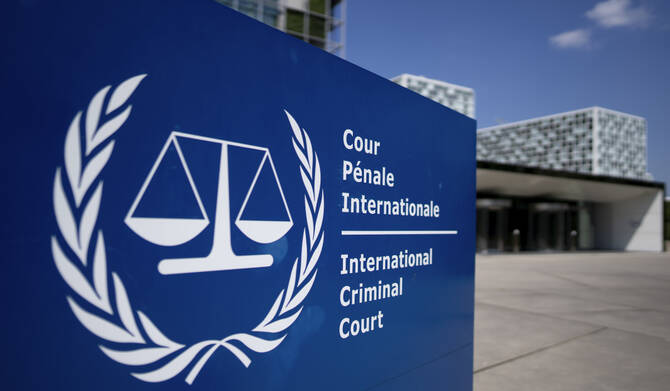
A view of the International Criminal Court in The Hague, Netherlands, Wednesday, June 26, 2024. (AP)
Short Url
Updated 18 October 2025
Follow

ICC rejects Israel appeal bid over arrest warrants

  • In a ruling that made headlines around the world, the ICC in November found "reasonable grounds" to believe Netanyahu and Gallant bore "criminal responsibility" for alleged war crimes and crimes against humanity in Gaza

THE HAGUE: The International Criminal Court Friday rejected Israel's bid to appeal against arrest warrants for its Prime Minister Benjamin Netanyahu and former defence minister Yoav Gallant over the Gaza war.
In a ruling that made headlines around the world, the ICC in November found "reasonable grounds" to believe Netanyahu and Gallant bore "criminal responsibility" for alleged war crimes and crimes against humanity in Gaza.
The ICC also issued arrest warrants for three top leaders from the Palestinian militant movement Hamas but dropped these after their deaths.
The warrants against Netanyahu and Gallant sparked outrage in Israel and also in the United States, which has since slapped sanctions on top ICC officials.
Netanyahu described it as an "anti-Semitic decision" and the then US president Joe Biden slammed it as "outrageous".
Israel had asked the court in May to dismiss the warrants while it weighed a separate challenge over whether the ICC had jurisdiction in the case.
The court rejected this on July 16, saying there was "no legal basis" for quashing the warrants while the jurisdiction challenge was pending.
A week later, Israel asked for leave to appeal that ruling, but judges ruled on Friday that "the issue, as framed by Israel, is not an appealable issue."
"The Chamber therefore rejects the request," said the ICC in a complex, 13-page ruling.
ICC judges are still weighing a wider Israeli challenge over jurisdiction.
When the court originally issued the arrest warrants in November, it simultaneously rejected an Israeli appeal against its jurisdiction.
However, in April, the ICC's Appeals Chamber ruled the Pre-Trial Chamber was wrong to dismiss the challenge and ordered it to look again in detail at Israel's arguments.
It is not clear when it will hand down a ruling on that issue.


The UN aid coordination agency cuts its funding appeal after Western support plunges

Updated 09 December 2025
Follow

The UN aid coordination agency cuts its funding appeal after Western support plunges

  • The UN aid coordinator sought $47 billion for this year and aimed to help 190 million people worldwide. Because of the lower support, it and humanitarian partners reached 25 million fewer people this year than in 2024

GENEVA: The UN’s humanitarian aid coordination office is downsizing its appeal for annual funding in 2026 after support this year, mostly from Westerngovernments, plunged to the lowest level in a decade.
The United Nations Office for the Coordination of Humanitarian Affairs said Monday it was seeking $33 billion to help some 135 million people cope with fallout from wars, climate disasters, earthquakes, epidemics and food shortages. This year, it took in $15 billion, the lowest level in a decade.
The office says next year it wants more than $4.1 billion to reach 3 million people in Palestinian areas, another $2.9 billion for Sudan — home to the world’s largest displacement crisis — and $2.8 billion for a regional plan around Syria.
“In 2025, hunger surged. Food budgets were slashed — even as famines hit parts of Sudan and Gaza. Health systems broke apart,” said OCHA chief Tom Fletcher. “Disease outbreaks spiked. Millions went without essential food, health care and protection. Programs to protect women and girls were slashed, hundreds of aid organizations shut.”
The UN aid coordinator sought $47 billion for this year and aimed to help 190 million people worldwide. Because of the lower support, it and humanitarian partners reached 25 million fewer people this year than in 2024.
The donor fatigue comes as many wealthy European countries face security threats from an increasingly assertive Russia on their eastern flank and have experienced lackluster economic growth in recent years, putting new strains on government budgets and the consumers who pay taxes to sustain them.
“I know budgets are tight right now. Families everywhere are under strain,” Fletcher said. “But the world spent $2.7 trillion on defense last year – on guns and arms. And I’m asking for just over 1 percent of that.”
The UN system this year has slashed thousands of jobs, notably at its migration and refugee agencies, and Secretary-General António Guterres’ office has launched a review of UN operations — which may or may not produce firm results.
Fletcher, who answers to Guterres, has called for “radical transformation” of aid by reducing bureaucracy, boosting efficiency and giving more power to local groups. Fletcher cited “very practical, constructive conversations” almost daily with the Trump administration.
“Do I want to shame the world into responding? Absolutely,” Fletcher said. “But I also want to channel this sense of determination and anger that we have as humanitarians, that we will carry on delivering with what we get.”