

Hague Group members call on world to deny Israel ‘tools of genocide’

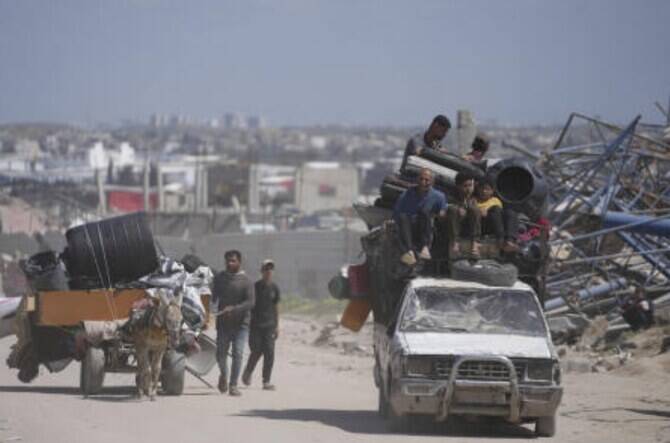
A group of countries has called on the international community to deny Israel “the tools of genocide.” (AP/File Photo)
Short Url
Updated 27 September 2025
Follow

Hague Group members call on world to deny Israel ‘tools of genocide’

  • Organization aims to isolate Israel politically, economically, culturally in bid to end Gaza war
  • ‘We must turn indignation into action,’ Brazil FM says on sidelines of UN General Assembly

LONDON: A group of countries has called on the international community to deny Israel “the tools of genocide.”

The Hague Group, an alliance of states dedicated to putting pressure on Israel, met in New York on the sidelines of the UN General Assembly.

They discussed ways to alleviate suffering in Gaza, and to prevent Israel from committing further violence in the enclave and the occupied West Bank.

Members called for a block on exports to the country, a ban on participation in international cultural events, and support for an aid flotilla currently approaching Gaza in the Mediterranean.

The group is co-chaired by Colombia and South Africa, whose government brought a case accusing Israel of genocide in Gaza to the International Court of Justice in December 2023.

Last week, South Africa’s ICJ case was joined by Brazil, which said Israel has no right to claim that its actions in Gaza constitute self-defense as an occupying power.

Brazil’s Foreign Minister Mauro Vieira told the group: “We must turn indignation into action, law into justice, and justice into peace.”

His government has also called for an international mission to be sent to Gaza, similar to the one established by the UN in 1962 to oversee the end of apartheid in South Africa.

“International law requires a state not only to refrain from genocide but also to prevent it. Failure to do so may give rise to state responsibility including complicity with genocide,” Vieira said.

“The time has come for states to fulfill their obligations under the Genocide Convention by adopting effective measures to ensure that they don’t, directly or indirectly, collaborate with its perpetrators.”

Malaysian Foreign Minister Mohamad Hasan said it is essential that international corporations complicit in the occupation are identified. Chile, another member of the group, recently withdrew its ambassador to Israel.

Zane Dangor, director general of South Africa’s Department of International Relations and Cooperation, said preventing genocide is a duty, despite the difficulty in proving it legally, in the aftermath of a UN report earlier this month that found reasonable grounds to conclude that Israel is committing genocide in Gaza.

Riyad Mansour, Palestinian envoy to the UN, told The Guardian: “The Hague Group represented an inflection point in the struggle to secure accountability and to prevent Israel receiving arms and services. Much more needs to be done, and fast.”


Trump says Zelensky ‘isn’t ready’ yet to accept US-authored proposal to end Russia-Ukraine war

Updated 08 December 2025
Follow

Trump says Zelensky ‘isn’t ready’ yet to accept US-authored proposal to end Russia-Ukraine war

  • Trump said he was “disappointed” and suggested that the Ukrainian leader is holding up the talks from moving forward
  • He also claimed Russia is “fine with it” even though Putin last week had said that aspects of Trump’s proposal were unworkable

KYIV, Ukraine: President Donald Trump on Sunday claimed Ukrainian President Volodymyr Zelensky “isn’t ready” to sign off on a US-authored peace proposal aimed at ending the Russia-Ukraine war.
Trump was critical of Zelensky after US and Ukrainian negotiators completed three days of talks on Saturday aimed at trying to narrow differences on the US administration’s proposal. But in an exchange with reporters on Sunday night, Trump suggested that the Ukrainian leader is holding up the talks from moving forward.
“I’m a little bit disappointed that President Zelensky hasn’t yet read the proposal, that was as of a few hours ago. His people love it, but he hasn’t,” Trump claimed in an exchange with reporters before taking part in the Kennedy Center Honors. The president added, “Russia is, I believe, fine with it, but I’m not sure that Zelensky’s fine with it. His people love it it. But he isn’t ready.”
To be certain, Russian President Vladimir Putin hasn’t publicly expressed approval for the White House plan. In fact, Putin last week had said that aspects of Trump’s proposal were unworkable, even though the original draft heavily favored Moscow.
Trump has had a hot-and-cold relationship with Zelensky since riding into a second White House term insisting that the war was a waste of US taxpayer money. Trump has also repeatedly urged the Ukrainians to cede land to Russia to bring an end to a now nearly four-year conflict he says has cost far too many lives.
Zelensky said Saturday he had a “substantive phone call” with the American officials engaged in the talks with a Ukrainian delegation in Florida. He said he had been given an update over the phone by US and Ukrainian officials at the talks.
“Ukraine is determined to keep working in good faith with the American side to genuinely achieve peace,” Zelensky wrote on social media.
Trump’s criticism of Zelensky came as Russia on Sunday welcomed the Trump administration’s new national security strategy in comments by the Kremlin spokesman published by Russia’s Tass news agency.

Dmitry Peskov said the updated strategic document, which spells out the administration’s core foreign policy interests, was largely in line with Moscow’s vision.
“There are statements there against confrontation and in favor of dialogue and building good relations,” he said, adding that Russia hopes this would lead to “further constructive cooperation with Washington on the Ukrainian settlement.”
The document released Friday by the White House said the US wants to improve its relationship with Russia after years of Moscow being treated as a global pariah and that ending the war is a core US interest to “reestablish strategic stability with Russia.”
Speaking on Saturday at the Reagan National Defense Forum, Trump’s outgoing Ukraine envoy, Keith Kellogg, said efforts to end the war were in “the last 10 meters.”
He said a deal depended on the two outstanding issues of “terrain, primarily the Donbas,” and the Zaporizhzhia Nuclear Power Plant.
Russia controls most of Donbas, its name for the Donetsk and neighboring Luhansk regions, which, along with two southern regions, it illegally annexed three years ago. The Zaporizhzhia Nuclear Power Plant is in an area that has been under Russian control since early in Moscow’s invasion of Ukraine and is not in service. It needs reliable power to cool its six shutdown reactors and spent fuel, to avoid any catastrophic nuclear incidents.
Kellogg, who is due to leave his post in January, was not present at the talks in Florida.
Separately, officials said the leaders of the United Kingdom, France and Germany would participate in a meeting with Zelensky in London on Monday.
As the three days of talks wrapped up, Russian missile, drone and shelling attacks overnight and Sunday killed at least four people in Ukraine.
A man was killed in a drone attack on Ukraine’s northern Chernihiv region Saturday night, local officials said, while a combined missile and drone attack on infrastructure in the central city of Kremenchuk caused power and water outages. Kremenchuk is home to one of Ukraine’s biggest oil refineries and is an industrial hub.
Kyiv and its Western allies say Russia is trying to cripple the Ukrainian power grid and deny civilians access to heat, light and running water for a fourth consecutive winter, in what Ukrainian officials call “weaponizing” the cold.
Three people were killed and 10 others wounded Sunday in shelling by Russian troops in Ukraine’s Kharkiv region, according to the regional prosecutor’s office.