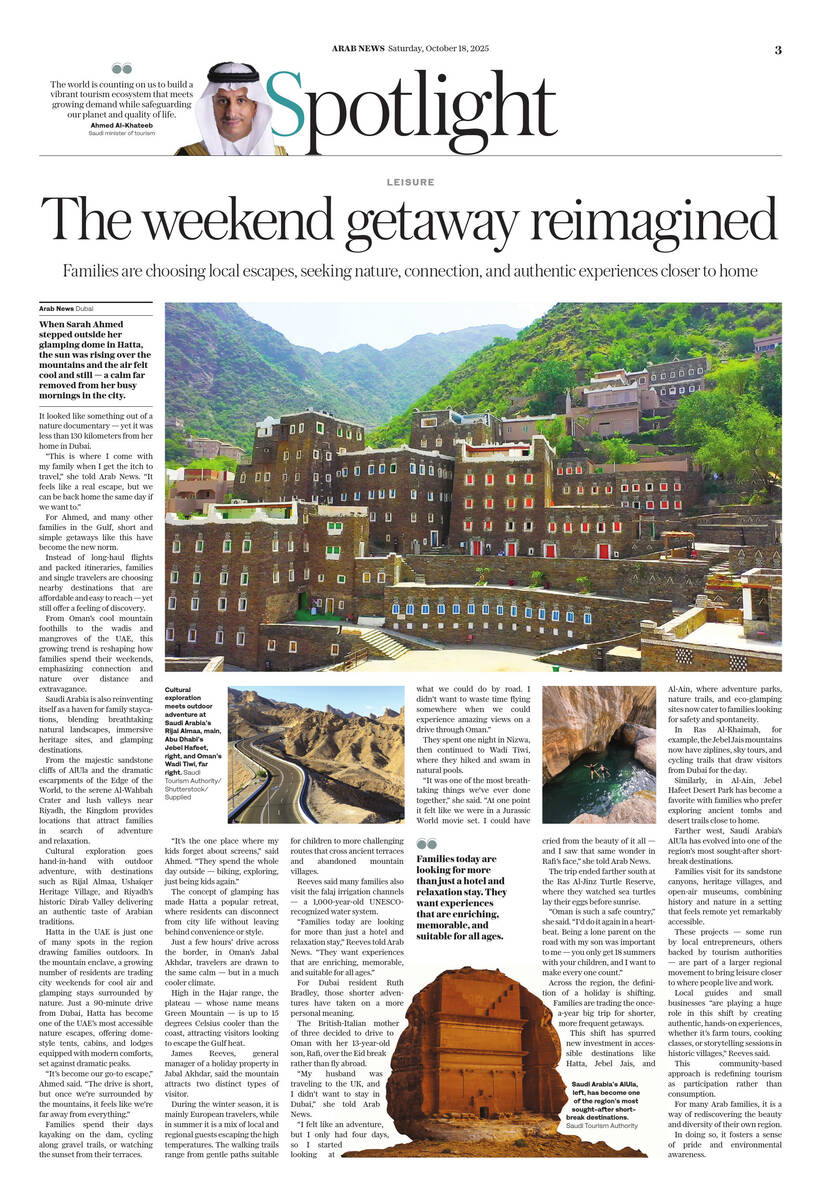
DUBAI: When Sarah Ahmed stepped outside her glamping dome in Hatta, the sun was rising over the mountains and the air felt cool and still — a calm far removed from her busy mornings in the city.
It looked like something out of a nature documentary — yet it was less than 130 kilometers from her home in Dubai.
“This is where I come with my family when I get the itch to travel,” she told Arab News. “It feels like a real escape, but we can be back home the same day if we want to.”
For Ahmed, and many other families in the Gulf, short and simple getaways like this have become the new norm.

Kayaking in Dubai's Hatta tourist resort. (Photo courtesy of hattawadiadventure.com)
Instead of long-haul flights and packed itineraries, families and single travelers are choosing nearby destinations that are affordable and easy to reach — yet still offer a feeling of discovery.
From Oman’s cool mountain foothills to the wadis and mangroves of the UAE, this growing trend is reshaping how families spend their weekends, emphasizing connection and nature over distance and extravagance.
Saudi Arabia is also reinventing itself as a haven for family staycations, blending breathtaking natural landscapes, immersive heritage sites, and glamping destinations.
From the majestic sandstone cliffs of AlUla and the dramatic escarpments of the Edge of the World, to the serene Al-Wahbah Crater and lush valleys near Riyadh, the Kingdom provides locations that attract families in search of adventure and relaxation.
Cultural exploration goes hand-in-hand with outdoor adventure, with destinations such as Rijal Almaa, Ushaiqer Heritage Village, and Riyadh’s historic Dirab Valley delivering an authentic taste of Arabian traditions.

Thadiq, a heritage city located 165 kilometers northwest of Riyadh, is one excellent escape for people on staycation in the Kingdom. (SPA)
Hatta in the UAE is just one of many spots in the region drawing families outdoors. In the mountain enclave, a growing number of residents are trading city weekends for cool air and glamping stays surrounded by natural scenery.
Just a 90-minute drive from Dubai, Hatta has become one of the UAE’s most accessible nature escapes, offering dome-style tents, cabins, and lodges equipped with modern comforts, set against a backdrop of dramatic peaks.
“It’s become our go-to escape,” Ahmed said. “The drive is short, but once we’re surrounded by the mountains, it feels like we’re far away from everything.”
Families spend their days kayaking on the dam, cycling along gravel trails, or watching the sunset from their terraces.
“It’s the one place where my kids forget about screens,” said Ahmed. “They spend the whole day outside — biking, exploring, just being kids again.”
The concept of glamping — camping with comforts — has made Hatta a popular cool-season retreat, where residents can disconnect from city life without leaving behind convenience or style.
Just a few hours’ drive across the border, in Oman’s Jabal Akhdar, travelers are drawn to the same calm — but in a much cooler climate.

Amazing hiking trip to the stunning deserted historical Wadi Bani Habib Village in Jabal Akhdar in Oman. (Shutterstock)
igh in the Hajar range, the plateau — whose name means Green Mountain — is up to 15 degrees Celsius cooler than the coast, attracting visitors looking to escape the Gulf heat.
James Reeves, general manager of a holiday property in Jabal Akhdar, said the mountain attracts two distinct types of visitor.
During the winter season, it is mainly European travelers exploring Oman, while in summer it is a mix of local and regional guests escaping the high temperatures.
He described the area as offering “families the perfect balance of escape and convenience,” with many especially drawn to the region’s cultural and natural diversity.
The walking trails range from gentle paths suitable for children to more challenging routes that cross ancient terraces and abandoned mountain villages.
Reeves said many families also visit the falaj irrigation channels — a 1,000-year-old UNESCO-recognized water system that still nourishes farms in the area.

James Reeves, general manager of a holiday property in Oman’s Jabal Akhdar. (Supplied)
“Families today are looking for more than just a hotel and relaxation stay,” Reeves told Arab News. “They want experiences that are enriching, memorable, and suitable for all ages.”
The mountain helps visitors reconnect with the past and discover a more authentic side of Oman, he said.
While convenience plays a role, Reeves said the shift also reflects something deeper — a growing desire for presence.
After years of fast-paced travel and screen-heavy routines, families are seeking experiences that feel more rooted in place and culture.
It is a pattern emerging throughout the Gulf, as more residents look for adventures close by that combine discovery, nature, and connection.
For Dubai resident Ruth Bradley, those shorter adventures have taken on a more personal meaning.
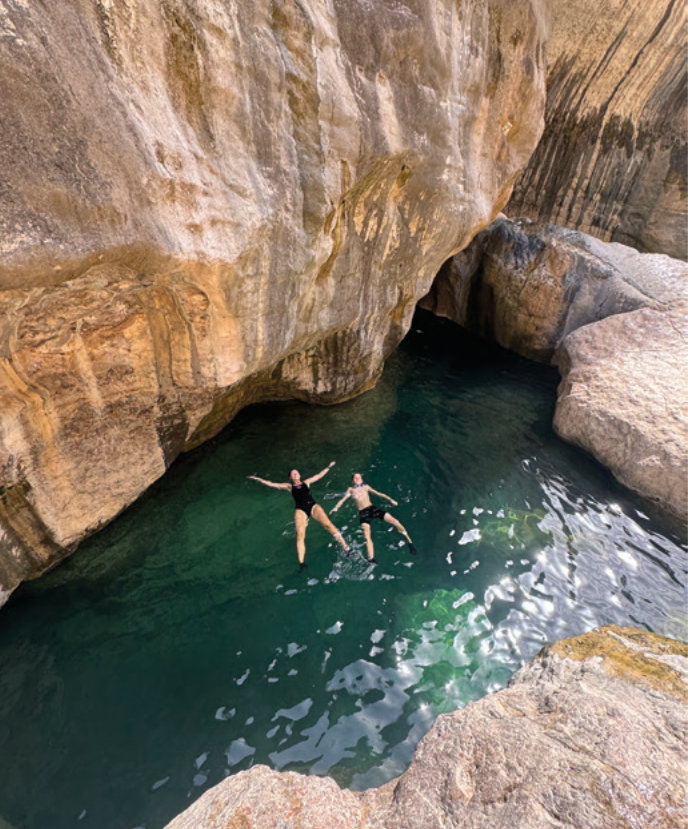
For Dubai resident Ruth Bradley and her 13-year-old son, Rafi, in Oman’s Wadi Tiwi. (Supplied)
The British-Italian mother of three decided to drive to Oman with her 13-year-old son, Rafi, over the Eid break rather than fly abroad.
“My husband was traveling to the UK, and I didn’t want to stay in Dubai,” she told Arab News.
“I felt like an adventure, but I only had four days, so I started looking at what we could do by road. I didn’t want to waste time flying somewhere when we could experience amazing views on a drive through Oman.”
They spent one night in Nizwa, then continued to Wadi Tiwi, where they hiked, swam in natural pools, and jumped from cliffs surrounded by green valleys.
“It was one of the most breathtaking things we’ve ever done together,” she said. “At one point it felt like we were in a Jurassic World movie set. I could have cried from the beauty of it all — and I saw that same wonder in Rafi’s face,” she told Arab News.
The trip ended farther south at the Ras Al-Jinz Turtle Reserve, where they watched sea turtles lay their eggs before sunrise.

Ras Al Jinz beach, also known as the 'Turtle Beach,' is one of the most popular tourist spots in Oman. (Wikimedia Commons: hotshoe!)
Bradley described the journey as safe, affordable, and easy to manage.
The guesthouses she booked — part of the Nomad Inn Oman group — cost less than 500 Emirati dirhams ($136) a night, while the biggest expense was petrol for more than 24 hours of driving.
“Oman is such a safe country,” she said. “I’d do it again in a heartbeat. Being a lone parent on the road with my son was important to me — you only get 18 summers with your children, and I want to make every one count.”
Bradley said the region’s mix of landscape and hospitality makes short road-trip adventures especially rewarding.
She is already planning to return to Wadi Tiwi in December so her husband and older children can experience it too. She hopes more destinations in the Gulf region will offer affordable options for families and adventure seekers.
The Arabian Peninsula is “especially beautiful,” said Bradley, who hopes to show her son “every inch of it — from Oman’s wadis to AlUla, Petra, and even Socotra one day.”
Across the region, the definition of a holiday is shifting. Families are trading the once-a-year big trip for shorter, more frequent getaways.
This shift has spurred new investment in accessible destinations like Hatta, Jebel Jais, and Al-Ain, where adventure parks, nature trails, and eco-glamping sites now cater to families looking for safety and spontaneity.
In Ras Al-Khaimah, for example, the Jebel Jais mountains now have ziplines, sky tours, and cycling trails that draw visitors from Dubai for the day.
Similarly, in Al-Ain, Jebel Hafeet Desert Park has become a favorite with families who prefer exploring ancient tombs and desert trails close to home.

General view of the ancient city of AlUla in western Saudi Arabia. (SPA)
Farther west, Saudi Arabia’s AlUla has evolved into one of the region’s most sought-after short-break destinations.
Families visit for its sandstone canyons, heritage villages, and open-air museums, combining history and nature in a setting that feels remote yet remarkably accessible.
These projects — some run by local entrepreneurs, others backed by tourism authorities — are part of a larger regional movement to bring leisure closer to where people live and work.
Local guides and small businesses “are playing a huge role in this shift by creating authentic, hands-on experiences, whether it’s farm tours, cooking classes, or storytelling sessions in historic villages,” Reeves said.
This community-based approach is redefining tourism as participation rather than consumption.

A view of Al-Wahbah crater near Taif. From stark black cones to craters that plunge deep into the Earth, Saudi Arabia’s volcanic landscape offers some of the most breathtaking geological sights in the region. (SPA photo)
This increase in local travel has also had ripple effects beyond leisure. For many Arab families, it is a way of rediscovering the beauty and diversity of their own region — from the mangroves of Abu Dhabi to the volcanic landscapes of Yemen’s Socotra.
In doing so, it fosters a sense of pride and environmental awareness.
Reeves said travelers are now staying longer — sometimes beyond 10 days — using Jabal Akhdar as a base to explore Oman’s wider natural and cultural heritage.
“People are realizing how much there is to see within a few hours’ drive. And because they’re saving on flights, they’re investing more time in exploring.”
As new destinations across the GCC continue to emerge, the message is the same: “Adventure doesn’t have to mean far away.”
Sometimes, the best memories begin just a short drive from home.