

US, Pakistan resolve to strengthen maritime cooperation, defense engagements

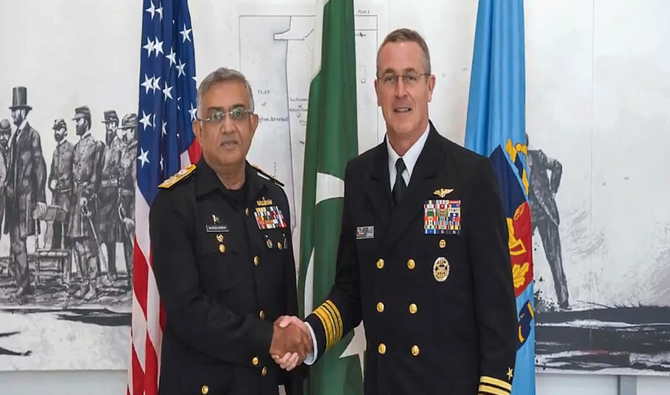
Screengrab taken on October 17, 2025 from a video shared by Director General Public Relations of Navy on X showing Pakistan's Naval Chief Admiral Naveed Ashraf (left) shaking hands with President of National Defense University US, Vice Admiral Peter A. Garvin,
Short Url
Updated 17 October 2025
Follow

US, Pakistan resolve to strengthen maritime cooperation, defense engagements

  • The development comes after Pakistani Naval Chief Admiral Naveed Ashraf's visit to the US, where he held meetings with top officials
  • US-Pakistan ties have seen significant ups and downs, but both countries have come closer since Trump brokered an India-Pakistan ceasefire

ISLAMABAD: Pakistan and the United States (US) have resolved to deepen their maritime cooperation and strengthen defense engagements, Pakistan Navy said on Friday.

The statement by Pakistan Navy's Directorate General of Public Relations (DGPR) came after Pakistani Naval Chief Admiral Naveed Ashraf's visit to the US as part of ongoing efforts to strengthen cooperation between the two sides.

Relations between the US and Pakistan have seen significant ups and downs, but the two countries have come closer in recent months after President Donald Trump brokered a ceasefire between Pakistan and India after their four-day military conflict in May.

Pakistani civilian and military leaders have gained favor with Trump since publicly endorsing him for a Nobel Peace Prize for the ceasefire, with the US president significantly lowering trade tariffs on Pakistan to 19 percent in July this year.

"Admiral Naveed Ashraf visited United States of America as part of ongoing efforts to further strengthen bilateral maritime cooperation and defense engagements. During the visit, the Naval Chief called on US Deputy Chief of Naval Operations, Vice Admiral Yvette Davids, and Acting Vice Commandant of the US Coast Guard, Vice Admiral Thomas G. Allan Jr.," the DGPR said in a statement.

"Matters of professional interest, regional security dynamics, and avenues for professional training and maritime cooperation were discussed during these meetings."

The Pakistani naval chief visited the US National Defense University (NDU) and met its president, Vice Admiral Peter A. Garvin as well as Deputy Assistant Secretary of State for Political-Military Affairs, Stanley L. Brown, on a visit to the US State Department.

"The engagements encompassed deliberations on politico-military cooperation, maritime security, capacity-building initiatives, and shared maritime interests," the DGPR said.

The Pakistani naval chief also addressed a gathering of US scholars, at which he highlighted regional maritime security challenges and Pakistan Navy’s contributions towards collaborative maritime efforts.

"The visit of the Naval Chief reflects the enduring defense ties between Pakistan and the United States, reaffirming the mutual commitment to promoting maritime security in the region and beyond," the DGPR added.


Pakistan offers Kyrgyzstan Arabian Sea access as two states sign 15 cooperation accords

Updated 05 December 2025
Follow

Pakistan offers Kyrgyzstan Arabian Sea access as two states sign 15 cooperation accords

  • Pakistan and Kyrgyzstan sign MOUs spanning trade, energy, agriculture, ports, education, security cooperation
  • Kyrgyz president is on first visit to Pakistan in 20 years as both sides push connectivity and CASA-1000 power links

ISLAMABAD: Pakistan on Thursday offered Kyrgyzstan the shortest and most economical route to the Arabian Sea as the two countries signed 15 agreements and memoranda of understanding aimed at boosting cooperation across trade, energy, agriculture, education, customs data-sharing and port logistics.

The accords were signed during a visit to Islamabad by President Sadyr Zhaparov, the first by a Kyrgyz head of state to Pakistan in two decades, and part of Islamabad’s renewed push to link South Asia with landlocked Central Asian economies through ports, power corridors and transport routes.

For Pakistan, Kyrgyzstan offers access to hydropower through CASA-1000, a $1.2 billion regional electricity transmission project designed to carry surplus summer electricity from Kyrgyzstan and Tajikistan through Afghanistan into Pakistan. For Bishkek, Pakistan provides overland access to warm-water ports on the Arabian Sea, creating a shorter commercial route to global markets.

“President Asif Ali Zardari has reiterated Pakistan’s readiness to offer Kyrgyzstan the shortest and most economical route to the Arabian Sea,” Radio Pakistan reported after Zhaparov met the Pakistani president. 

The two leaders also discussed expanding direct flights to deepen business, tourism and people-to-people ties.

Zardari welcomed Kyrgyzstan’s completion of its segment of the CASA-1000 project and “reaffirmed Pakistan’s commitment to completing its part of the project, which is now at an advanced stage,” the state broadcaster said. 

Zhaparov thanked Islamabad for supporting Bishkek’s candidacy for a non-permanent UN Security Council seat and invited Zardari to visit Kyrgyzstan at a time of his convenience. Both sides expressed satisfaction with progress under the Quadrilateral Traffic in Transit Agreement, designed to facilitate road movement between Pakistan, Kyrgyzstan, Kazakhstan and China.

Earlier, both governments exchanged 15 sectoral cooperation documents covering commerce, mining, geosciences, power, agriculture, youth programs, the exchange of convicted persons, customs electronic data systems and a sister-city linkage between Islamabad and Bishkek.

According to APP, the MOUs were signed by ministers representing foreign affairs, commerce, economy, energy, power, railways, interior, culture, health and tourism. Agreements also covered cooperation between Pakistan’s Foreign Service Academy and the Diplomatic Academy of Kyrgyzstan, as well as collaboration between universities, youth ministries and cultural institutions.

“Our present mutual trade, comprising of about $15–16 million will be enhanced to $200 million in the next two years,” Prime Minister Shehbaz Sharif said after the agreements were signed, calling them “a framework for structured, result-oriented engagement and closer institutional linkages.”

Sharif said Pakistan was ready to serve as a maritime outlet for the landlocked Central Asian republic, offering access to Karachi, Port Qasim and Gwadar to help Kyrgyz goods reach regional and global markets.