LIMA: Peru’s new President José Jerí refused to resign on Thursday following the death of a protester during a massive demonstration led by Gen Z activists demanding he step down.
About 100 people were also injured, including 80 police officers and 10 journalists, according to authorities, who said they were investigating the shooting and killing of the protester.
“My responsibility is to maintain the stability of the country; that is my responsibility and my commitment,” Jerí told the local press after visiting Peru’s Parliament, where he said he would request powers to combat crime.
The protests began a month ago calling for better pensions and wages for young people and expanded to capture the woes of Peruvians tired of crime, corruption and decades of disillusion with their government.
After Jerí, the seventh president in less than a decade, was sworn in on Oct. 10, protesters called for him and other lawmakers to resign.
Protests turn violent
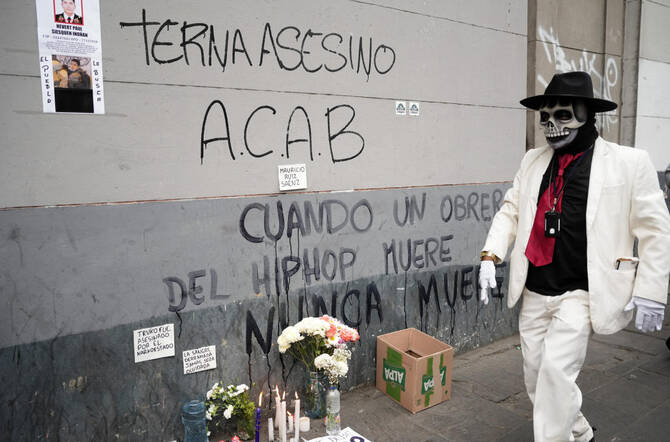
Peru’s prosecutor’s office announced Thursday that it was investigating the death of 32-year-old protester and hip-hop singer Eduardo Ruíz, who prosecutors said was shot by firearm during the mass demonstration of thousands of young people. It wrote on the social media platform X that it has ordered the removal of Ruíz’s body from a Lima hospital and the “collection of audiovisual and ballistic evidence in the area where the incident occurred, in the context of serious human rights violations.”
Local media and security cameras showed video of Ruíz collapsing in a Lima street after a man fleeing from several protesters fired a shot. Witnesses said the shooter was running away because he was accused of being a plainclothes police officer infiltrated among the demonstrators.
At least 24 protesters and 80 police officers were injured in the demonstrations, according to Peru’s Ombudsman’s Office. Six journalists were struck by pellets and another four were assaulted by police, according to the National Association of Journalists.
The president expressed regret over the protester’s death.
Global trend
The Peruvian protests comes amid a wave of protests unfolding across the world, driven by generational discontent against governments and anger among young people. Protests have broken out in Nepal, the Philippines, Indonesia, Kenya, Peru and Morocco, with protesters often carrying black flags with the “One Piece” anime symbol — a pirate skull wearing a straw hat.
In Lima’s main plaza 27-year-old electrician David Tafur said he decided to join the demonstration after learning about it on TikTok.
“We’re fighting for the same thing — against the corrupt — who here are also killers,” he said, referring to violent 2022 protests and government crackdown in which 50 people were killed.
Controversial new president
The escalating tensions come just days after Peru’s Congress ousted President Dina Boluarte, was known as one of the least popular presidents in the world for repressing protests and failing to control crime.
Jerí, the 38-year-old president of Congress, then took office, promising to get a recent crime wave under control. He swore in Ernesto Álvarez, a ultraconservative former judge active on social media, as prime minister.
Álvarez has not yet commented on it, but previously claimed said that Peru’s Gen Z is a “gang that wants to take democracy by storm” and does not represent “the youth who study and work.”
Criticisms of Jerí and his government quickly emerged because he previously faced an investigation after being accused of a woman of raping her. The prosecutor’s office dismissed the case in August, though authorities continue to investigate another man who was with Jerí the day of the alleged rape. Protesters also condemned Jerí because as a legislator he voted in favor of six laws that experts say weaken the fight against crime.
Protesters demanded Jerí and other lawmakers resign and repeal the laws they say benefit criminal groups.
During the protest, more than 20 women shouted “The rapist is Jerí” or “Jerí is a violin” — a slang expression in Peru where “violin” means rapist. Protesters launched fireworks at police, who responded with tear gas and rubber pellets.
Frustrations grow
That anger was built upon decades of frustration by Peruvians, who have seen their leaders, year after year, plagued by corruption scandals, fueling a feeling of cynicism and deception in many of Peru’s youth.
“After the pension issue, other frustrations followed — linked to insecurity, the erosion of state capacity in Peru, and corruption,” said Omar Coronel, a sociology professor at the Pontifical Catholic University of Peru, who studies social movements.
Violent scenes from the protest drew back memories of violent protests in the early months of Boluarte’s government, when 50 protesters were killed.
Protesters held signs reading “Protesting is a right, killing is a crime.” One woman carried a poster that read “From a murderess to a rapist, the same filth,” criticizing the change in government.
“For me, it’s about outrage over abuse of power, corruption and killings,” said Tafur, the protester.


![]()

Peru’s president refuses to resign after Gen Z protests leave at least 1 dead, 100 injured
Short Url
https://arab.news/vatsu
Peru’s president refuses to resign after Gen Z protests leave at least 1 dead, 100 injured
- Peru’s president refuses to resign after Gen Z protests turned violent overnight, prompting investigations by authorities into at least one civilian death
- The protests began a month ago, initially focusing on better pensions and wages for young people, but have expanded to address broader issues like crime and corruption


Latest updates


© 2026 SAUDI RESEARCH & PUBLISHING COMPANY, All Rights Reserved And subject to Terms of Use Agreement.