

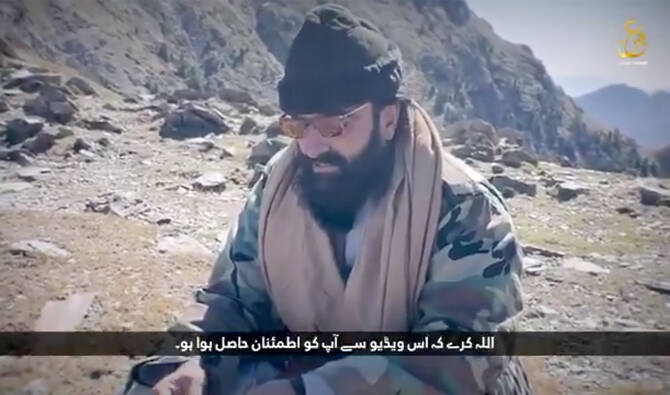

ISLAMABAD: The leader of the Pakistani Taliban appeared in a video Thursday to prove he was still alive, a week after an apparent attempt to assassinate him with an airstrike in Afghanistan provoked the most serious clash between the neighbors in decades.
The airstrike on October 9 hit an armored Toyota Land Cruiser believed to be carrying Noor Wali Mehsud in the Afghan capital, Kabul, according to Pakistani security officials.
After days of deadly violence, an uneasy ceasefire took hold on Wednesday. But with confirmation that Mehsud is still alive, Pakistan’s main grievance against its neighbor endures: Islamabad accuses Afghanistan of sheltering a militant leader and his senior lieutenants it blames for directing near-daily attacks in Pakistan.
Mehsud said in the video that he was appearing to refute reports of his death. Pakistani security officials and militants had previously assessed that he had probably survived.
“Jihad brings nations freedom and dignity; otherwise they remain slaves,” Mehsud said.
Pakistan has not officially claimed responsibility for the airstrike, the first in Kabul since the successful 2022 US targeting of Al Qaeda leader, Ayman Al-Zawahiri.
The Afghan Taliban deny harboring Pakistani militants and, in turn, accuse Islamabad of sheltering the local branch of Daesh, their main armed rival.
Mehsud, in the video, said he was in Pakistan. The footage was shot on a hilltop; Reuters could not verify the location.
REVIVAL UNDER HIS LEADERSHIP
Mehsud took over the leadership of Tehreek-e-Taliban Pakistan (TTP) in 2018 after his three predecessors were killed by US drone strikes. By then, Pakistani army operations had largely driven the group out of their former strongholds and into Afghanistan.
He has revived the group, transformed its strategy and united warring factions with diplomatic skill, analysts say. Trained as a religious scholar, he also took up an ideological battle.
The Taliban’s 2021 takeover in Afghanistan gave the TTP freer movement and greater access to weapons, Islamabad says, and attacks inside Pakistan escalated — especially in the northwest bordering Afghanistan.
In the past, the TTP struck civilian targets, like mosques and markets, including killing more than 130 children in a 2014 school assault. Mehsud, concerned these attacks caused public revulsion in Pakistan, directed the group to target only military and police.
In a rare video speech released earlier this year, he portrayed Pakistan’s army as anti-Islam, criticized its role in politics, and said the generals had “hijacked the people of Pakistan for the last 78 years.”
Pakistan’s military says that the TTP has perverted Islam and that it is supported by the country’s adversary India, a charge that New Delhi denies.
TRIBAL INSURRECTION
Mehsud fuses religious justification with nationalism. He is the author of at least three books, including a 700-page treatise that traces the origins of the group’s insurrection to the struggle against British colonial rule.
Abdul Sayed, an independent expert on the region’s militancy, said Mehsud claims to speak for the Pashtun ethnic group that lives in northwest Pakistan and Afghanistan.
“Mehsud continues his efforts to reshape the group into an armed movement fighting, as he claims, for the rights of Pashtun tribespeople,” said Sayed. “In pursuit of a government system similar to that of the Afghan Taliban.”
Yet the TTP has negligible public support in the northwest or elsewhere in the country, analysts say.
In unofficial talks with the Pakistani authorities in recent days, held through tribal intermediaries, the militants demanded the imposition of their brand of Islamic law in the part of Pakistan bordering Afghanistan, the exit of the army from that region, and their return there.
The authorities refused.


