

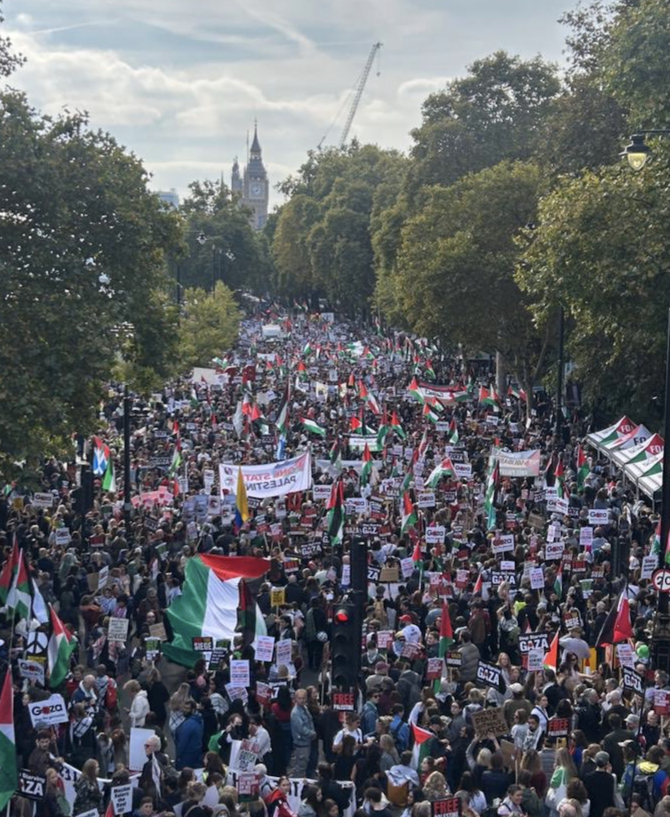
UK pro-Palestine groups vow to continue protests amid new curbs on right to demonstrate

Pro-Palestine organizations in the UK have condemned British government plans to give police greater powers over repeated demonstrations, calling it a “draconian assault” on the right to protest, and have vowed to continue mobilizing despite the measures. (X/@LindseyAGerman)
Short Url
Updated 16 October 2025
Follow

UK pro-Palestine groups vow to continue protests amid new curbs on right to demonstrate

  • UK Home Secretary Shabana Mahmood announced earlier this month that police will be granted new powers to impose tougher conditions on demonstrations

LONDON: Pro-Palestine organizations in the UK have condemned British government plans to give police greater powers over repeated demonstrations, calling it a “draconian assault” on the right to protest, and have vowed to continue mobilizing despite the measures.

UK Home Secretary Shabana Mahmood announced earlier this month that police will be granted new powers to impose tougher conditions on demonstrations by taking into account the “cumulative impact” of previous similar events.

Ben Jamal, director of the Palestine Solidarity Campaign, or PSC, told The Independent that the move represented “a further draconian assault on the fundamental right to protest.”

He continued: “This potentially has enormous implications. It could mean, for example, ‘you have already protested once, you can’t protest again.’”

Jamal said that police had previously invoked “cumulative impact” to block protest routes near synagogues, and that the Palestine Coalition, a network of six groups behind recent pro-Palestine marches, was prepared to challenge the new rules in court.

“The implications are really broad but they are specifically aimed at targeting our movement,” he said.

“We also know what’s happened in the past two years is extraordinary, there has not been a body of consistent protests like this in the numbers that we’ve been able to galvanize since the suffragette movement. It’s been responding to a fairly unique circumstance, which is a livestreamed genocide, and a continuing complicity by our government in that,” he said.

Israel has denied accusations of genocide in Gaza.

Tens of thousands of demonstrators marched through central London on Saturday, a day after a ceasefire between Israel and Hamas came into effect.

The PSC has announced further actions, including a mass student walkout on Thursday and a boycott of Barclays bank on Saturday.

Mahmood said that the proposed changes to the Public Order Act would not amount to a blanket ban on protests but were “about restrictions and conditions,” insisting that repeated large-scale demonstrations had caused “considerable fear” within the Jewish community.

No timeline has been set for when the new rules might take effect, though Mahmood said the ongoing review of protest legislation included consideration of powers to ban demonstrations outright.

Lindsey German, national convener of the Stop the War Coalition, argued that the reasoning behind the measures “did not make sense.”

She said: “The whole question of cumulative impact, if you think about a demonstration, they are meant to have an impact, they are meant to be effective, they are meant to keep highlighting the issue that hasn’t been resolved.”

German added: “We are assuming that we will continue demonstrating over the next few months, we are very concerned about the rules to restrict the law further … we fear it’s going to be increasingly difficult to protest in London. This is, either way, a denial of our right to protest.”

The Home Office has been approached for comment by The Independent.


Treason trial of South Sudan’s suspended VP is further eroding peace deal, UN experts say

Updated 5 sec ago
Follow

Treason trial of South Sudan’s suspended VP is further eroding peace deal, UN experts say

  • The experts said forces from both sides are continuing to confront each other across much of the country
  • “Years of neglect have fragmented government and opposition forces alike,” the experts said

UNITED NATIONS: The treason trial of South Sudan’s suspended vice president is further eroding a 2018 peace agreement he signed with President Salva Kiir, UN experts warned in a new report.
As Riek Machar’s trial is taking place in the capital, Juba, the experts said forces from both sides are continuing to confront each other across much of the country and there is a threat of renewed major conflict.
UN peacekeeping chief Jean-Pierre Lacroix told the UN Security Council last month that the crisis in South Sudan is escalating, “a breaking point” has become visible, and time is running “dangerously short” to bring the peace process back on track.
There were high hopes when oil-rich South Sudan gained independence from Sudan in 2011 after a long conflict, but the country slid into a civil war in December 2013 largely based on ethnic divisions, when forces loyal to Kiir, an ethnic Dinka, battled those loyal to Machar, an ethnic Nuer.
More than 400,000 people were killed in the war, which ended with the 2018 peace agreement that brought Kiir and Machar together in a government of national unity. But implementation has been slow, and a long-delayed presidential election is now scheduled for December 2026.
The panel of UN experts stressed in a report this week that the political and security landscape in South Sudan looks very different today than it did in 2018 and that “the conflict that now threatens looks much different to those that came before.”
“Years of neglect have fragmented government and opposition forces alike,” the experts said, “resulting in a patchwork of uniformed soldiers, defectors and armed community defense groups that are increasingly preoccupied by local struggles and often unenthused by the prospect of a national confrontation. ”
With limited supplies and low morale, South Sudan’s military has relied increasingly on aerial bombings that are “relatively indiscriminate” to disrupt the opposition, the experts said.
In a major escalation of tensions in March, a Nuer militia seized an army garrison. Kiir’s government responded, charging Machar and seven other opposition figures with treason, murder, terrorism and other crimes.
The UN experts said Kiir and his allies insist that, despite having dismissed Machar, implementation of the peace agreement is unaffected, pointing to a faction of the opposition led by Stephen Par Kuol that is still engaged in the peace process.
Those who refused to join Kuol and sided with Machar’s former deputy, Natheniel Oyet, “have largely been removed from their positions, forcing many to flee the country,” the experts said in the report.
The African Union, regional countries and the Intergovernmental Authority on Development, or IGAD, have all called for Machar’s release and stressed their strong support for implementation of the 2018 agreement, the panel said.
According to the latest international assessment, 7.7 million people — 57 percent of the population — face “crisis” levels of food insecurity, with pockets of famine in some communities most affected by renewed fighting, the panel said.