

Gaza academics in Islamabad appeal for global support to rebuild universities damaged in Israel’s war

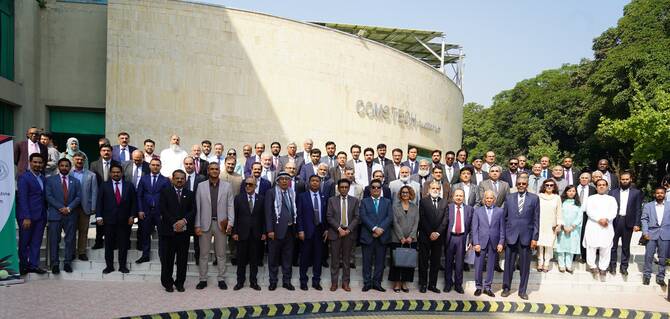
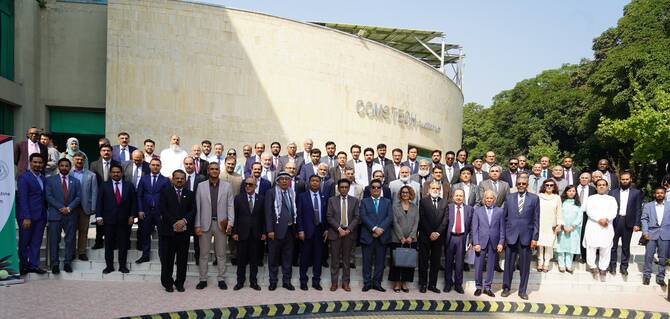
Officials gesture for a group photograph at the COMSTECH in Islamabad on October 16, 2025. (Handout)
Short Url
Updated 16 October 2025
Follow

Gaza academics in Islamabad appeal for global support to rebuild universities damaged in Israel’s war

  • A seven-member Palestinian university delegation is visiting Pakistan to explore academic collaborations
  • Pakistan had announced 5,000 fellowships for Palestinian students while the war in Gaza was continuing

ISLAMABAD: A group of Palestinian academics from Gaza on Thursday appealed for urgent international support, calling for volunteer lecturers, student scholarships, research funding and essential educational resources after widespread destruction of universities during two years of Israel’s war.

The call was made at the first-ever Palestine-Pakistan Rectors’ Forum, titled “Higher Education and Scientific Research in Gaza: The Way Forward,” held in Islamabad.

Organized by COMSTECH — the Organization of Islamic Cooperation’s Standing Committee on Scientific and Technological Cooperation — the forum aimed to strengthen academic collaboration between Palestinian and Pakistani institutions.

A seven-member Palestinian delegation is on a week-long visit to Pakistan, where it will visit leading universities in Islamabad, Faisalabad and Lahore.

“We urgently need support to cover student tuition fees, volunteer lecturers to deliver online classes, provide research opportunities for faculty members and support the financial needs of research projects,” Dr. Ayman Sobh, President of Al Aqsa University Gaza, said while addressing the ceremony.

He termed it a call for academic solidarity while pointing out that Gaza was witnessing a systematic attempt to dismantle Palestinian society by targeting its institutions.

“Scholarships are needed for postgraduate students and for supporting the universities with laptops, desktops, internet access points and all other e-learning requirements such as solar energy systems, servers and internet access,” he said, adding that virtual laboratories for practical and science-based courses were also needed.

In Gaza Strip, he said, seven universities, served about 90,000 students in medicine, engineering, IT, science, arts and many other disciplines.

“During the war, all universities sustained severe damage affecting academic buildings, laboratories, IT centers, infrastructure and administrative facilities,” Sobh said, adding that despite the destruction and uncertainty, Palestinian universities in the Gaza Strip have remained steadfast in their mission to educate, research and serve society.

Dr. Noha Nijim from Al Azhar University Gaza thanked Pakistan for hosting over 300 Palestinian students on scholarships.

“Those students who were displaced and had their education interrupted by the war were able to resume their studies in Pakistan, which was greatly beneficial given the psychological impact of the war and the consequences of losing a year of academic education,” she told Arab News.

“The Pakistani government has assisted us and supported the resilience of the Palestinian people by providing financial and technical support for higher education,” she added.

Palestinian Ambassador to Pakistan, Dr. Zuhair Mohammad Hamadallah Zaid, said Pakistan had contributed to state-building through education and training, empowering Palestinians to manage their own affairs.

“Many Palestinians graduated from institutions in Pakistan, some became ministers, others secretaries of ministries and many became doctors and engineers,” he told Arab News.

Addressing the ceremony, Pakistan’s Education Minister, Dr. Khalid Maqbool Siddiqui, expressed his deep appreciation for the initiative by COMSTECH, terming it an important step toward rebuilding Gaza’s educational and research landscape.

“Pakistan has already announced 5,000 fellowships for Palestinian youth, which is a remarkable initiative that will empower a new generation of scientists, innovators and leaders from Palestine,” he added.

"Pakistan stands shoulder to shoulder with Palestine in this journey, offering not just solidarity in words, but cooperation through research, innovation and higher education,” he said, expressing confidence that this forum would pave the way for joint research, faculty exchanges, scholarships and innovative academic partnerships between the two nations.

In his welcome remarks, Prof. Dr. Muhammad Iqbal Choudhary, Coordinator General, OIC-COMSTECH, said the forum seeks to formulate a comprehensive roadmap for assisting in the rehabilitation and restructuring of Gaza’s higher education and scientific institutions after two years of educational genocide.

"The systematic destruction of universities, research centres, and schools in Gaza has not only targeted infrastructure but has deeply affected the intellectual and developmental foundations of an entire generation,” he added.

Chaudhary said through joint academic planning, knowledge transfer and institutional support, OIC-COMSTECH, together with partner universities from Pakistan and other OIC member states, aims to restore the academic life of Gaza, rebuild its universities and reignite the flame of learning, research and innovation that no war can extinguish,” he added.


UAE-Pakistan trade pact in ‘final stage of signing,’ envoy says in address to Lahore chamber 

Updated 11 February 2026
Follow

UAE-Pakistan trade pact in ‘final stage of signing,’ envoy says in address to Lahore chamber 

  • UAE ambassador tells business leaders Comprehensive Economic Partnership Agreement near signing
  • Chamber cites $7.8 billion remittances from UAE in 2024, urges broader cooperation beyond petroleum trade 

ISLAMABAD: The Lahore Chamber of Commerce & Industry (LCCI) on Wednesday quoted the UAE’s ambassador as saying the Emirates and Pakistan were in the “final stage” of signing a Comprehensive Economic Partnership Agreement (CEPA) to enhance trade and remove obstacles. 

Pakistan and the UAE maintain close economic ties, with the Gulf state serving as one of Islamabad’s largest trading partners and a major source of remittances. Trade between the two countries currently stands at around $8–10 billion, according to figures from the LCCI, while millions of Pakistanis live and work in the UAE. A Comprehensive Economic Partnership Agreement, a broad trade framework aimed at reducing tariffs, easing market access and strengthening investment flows, would formalize and potentially deepen those ties.

Speaking at the Lahore Chamber, UAE Ambassador Salem Mohammed Al Zaabi said the CEPA would help remove business obstacles and deepen economic ties between the two countries.

“Pakistan and the UAE are at the final stage of signing a Comprehensive Economic Partnership Agreement, which would significantly boost bilateral trade and remove business obstacles between the two countries,” Al Zaabi was quoted as saying in a statement issued by the Lahore Chamber.

He added that the existing trade volume of around $8–10 billion did not reflect the full potential of the relationship and his government had a “clear directive” to double the figure as soon as possible.

Al Zaabi said the UAE was expanding investments in Pakistan in sectors including infrastructure, ports, aviation, agriculture, minerals and railways.

He said discussions with Pakistan’s Railway Ministry were progressing and that new agreements related to supply chain connectivity from northern regions to Karachi, including the possibility of a dry port, would be announced soon. He added that the Joint Business Council between the two countries was being activated and efforts were underway to convene its meeting to enhance institutional cooperation.

The UAE ambassador also outlined steps being taken to streamline visa procedures and improve skilled labor mobility.

Referring to the visa process, Al Zaabi said both countries were working to streamline procedures through digital systems and appreciated the efforts of Pakistan’s Ministry of Interior, according to the LCCI statement. He said discussions were underway with the Punjab Skilled Labor Authority to enhance cooperation in skilled workforce mobility.

He added that he was “personally working at operational and technical levels to ensure that all signed agreements, including CEPA and other trade frameworks, are fully implemented.”

The envoy said the UAE was rapidly shifting toward an artificial intelligence-driven and digitized economy, with nearly 99 percent of government services available online.

Highlighting his country’s focus on information technology, digital banking and innovation, the ambassador invited the Lahore Chamber to share a comprehensive document outlining challenges and investment opportunities. He said the UAE Embassy would consider recommendations from the business community and extend facilitation to investors from both sides, adding that special consideration would be given to visa recommendations forwarded by the Chamber for genuine business cases.

He also acknowledged the contribution of the Pakistani community to the UAE’s development, particularly in aviation and finance, and noted that the UAE economy had diversified, reducing oil dependence to below 25 percent.

LCCI President Faheem Ur Rehman Saigol described the UAE as one of Pakistan’s most important trading partners in the Middle East and a major source of remittances.

He said remittances from the UAE reached $7.8 billion in 2024, while Pakistan’s exports to the UAE stood at $2.1 billion in the 2024–25 fiscal year. Imports from the UAE were around $8 billion, largely consisting of petroleum products, according to the Chamber’s statement.

The figures highlight a persistent trade imbalance, with Pakistan importing significantly more from the UAE than it exports, even as millions of Pakistani workers live and work in the Gulf state.

Saigol said there was “vast untapped potential” for cooperation in renewable energy, agriculture and food processing, information technology, logistics, construction, tourism, health care and mining. He proposed establishing dedicated display centers for Pakistani products in the UAE, leveraging the country’s role as a global re-export hub, and called for stronger engagement through trade delegations, business-to-business meetings and joint ventures.