TORONTO: The leader of Canada’s most populous province called for economic retaliation on the US after auto company Stellantis said it was moving planned production of its Jeep Compass from Canada to the US
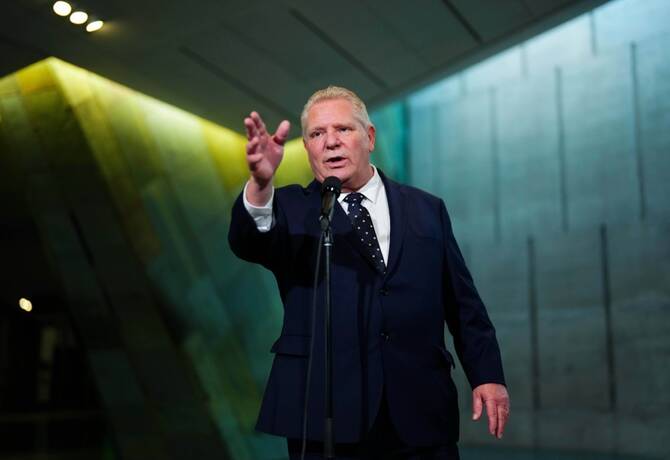
Ontario Premier Doug Ford blamed US President Donald Trump for the company’s decision this week to shift production of the SUV from Brampton, Ontario, to Illinois as part of plan to invest $13 billion to expand its manufacturing capacity in the United States.
The comments come as Canada is negotiating to reduce tariffs. Trump has been urging the Big 3 American automakers to move production to the US
“That guy, President Trump, he’s a real piece of work,” Ford said. “I’m sick and tired of rolling over. We need to fight back.”
Ford said Canada needs to hit back with tariffs if Prime Minister Mark Carney can’t reach a trade deal with Trump.
Dominic LeBlanc, the minister responsible for Canada-US trade, is in Washington this week for talks to reduce tariffs on certain sectors. Carney left Washington last week without a deal.
Carney said the move by the world’s fourth-largest carmaker was a direct consequence of tariffs and his government would work with Stellantis to create new opportunities in the Brampton area. Carney added that Ottawa expects Stellantis to fulfill its commitment to Brampton workers. The federal government threatened legal action against the company.
Federal Industry Minister Mélanie Joly said the production shift is “unacceptable” and warned Stellantis made commitments to Canadian production in exchange for substantial financial support.
“Anything short of fulfilling that commitment will be considered as default under our agreements,” Joly wrote in a letter to the company chief executive.
Fear has spread in Ontario over what will happen to Canada’s auto sector. Autos are Canada’s second-largest export and Carney has noted the sector employs 125,000 Canadians directly and almost another 500,000 in related industries.
“Stellantis is bowing at the Trump administration with this pledge of massive investments in the US,” Brampton Mayor Patrick Brown told the Canadian Broadcasting Corporation.
“If this bullying tactic works with Stellantis I expect it to be replicated to every other automaker that has a presence in Canada and frankly other sectors that the US has an interest in.”
Workers at the Stellantis assembly plant in Brampton were greeted Wednesday with a robocall from their employer that said work they’d been waiting for wouldn’t be coming back. The company closed the factory in 2023 and laid off its roughly 3,000 workers as it retooled the facility.
Stellantis said it would reopen its Belvidere Assembly Plant in Illinois to expand US Jeep production, creating thousands of new jobs there.
Vito Beato, president of Unifor Local 1285, which represents the Brampton plant workers, said the news came as a surprise because Stellantis had said previously it was committed to producing its Jeep Compass in Brampton.
Stellantis said it continues to invest in Canada, including adding a third shift to the Windsor, Ontario assembly plant, and that it is in talks with the government on the future of the Brampton facility.
Carney won the country’s election earlier this year fueled by Trump’s annexation threats and trade war, but has tried to improve relations ahead of a review of the free trade deal next year. More than 75 percent of Canada’s exports go to the US and Canada recently dropped many of its retaliatory tariffs to match US tariff exemptions for goods covered under the United States-Mexico-Canada trade pact.
Ford said Canada should start responding to Trump’s tariffs with its own harsh measures.
“That’s the only thing that this person understands,” Ford said of Trump. Ford is scheduled to meet with Carney this week.

Ontario premier criticizes Trump after Stellantis says it will move production from Canada to the US
Short Url
https://arab.news/ypsft
Ontario premier criticizes Trump after Stellantis says it will move production from Canada to the US
- “That guy, President Trump, he’s a real piece of work,” Ford said
’Weak by design’ African Union gathers for summit
ADDIS ABABA: The African Union (AU) holds its annual summit in Ethiopia this weekend at a time of genocide, myriad insurgencies and coups stretching from one end of the continent to the other, for which it has few answers.
The AU, formed in 2002, has 55 member states who are often on opposing sides of conflicts. They have routinely blocked attempts to hand real enforcement power to the AU that could constrain their action, leaving it under-funded and under-equipped.
It has missed successive deadlines to make itself self-funding — in 2020 and 2025. Today, it still relies for 64 percent of its annual budget on the United States and European Union, who are cutting back support.
Its chairman, Mahmoud Ali Youssouf, is reduced to expressing “deep concern” over the continent’s endless crises — from wars in Sudan and the Democratic Republic of Congo to insurgencies across the Sahel — but with limited scope to act.
“At a time when the AU is needed the most, it is arguably at its weakest since it was inaugurated,” said the International Crisis Group (ICG) in a recent report.
- Ignoring own rules -
With 10 military coups in Africa since 2020, the AU has been forced to ignore the rule in its charter that coup-leaders must not stand for elections. Gabon and Guinea, suspended after their coups, were reinstated this past year despite breaking that rule.
Meanwhile, there has been no “deep concern” over a string of elections marred by rigging and extreme violence.
Youssouf was quick to congratulate Tanzania’s President Samia Suluhu Hassan after she won 98 percent in a vote in October in which all leading opponents were barred or jailed and thousands of protesters were killed by security forces.
The AU praised the “openness” of an election in Burundi in June described by Human Rights Watch as “dominated by repression (and) censorship.”
The problem, said Benjamin Auge, of the French Institute of International Relations, is that few African leaders care about how they are viewed abroad as they did in the early days after independence.
“There are no longer many presidents with pan-African ambitions,” he told AFP.
“Most of the continent’s leaders are only interested in their internal problems. They certainly don’t want the AU to interfere in domestic matters,” he added.
- AU ‘supports dialogue’ -
AU representatives point out that its work stretches far beyond conflict, with bodies doing valuable work on health, development, trade and much more.
Spokesman Nuur Mohamud Sheekh told AFP that its peace efforts went unnoticed because they were measured in conflicts that were prevented.
“The AU has helped de-escalate political tensions and support dialogue before situations descend into violence,” he said, citing the work done to prevent war between Sudan and South Sudan over the flashpoint region of Abyei.
But African states show little interest in building up an organization that might constrain them.
Power remains instead with the AU Assembly, made up of individual heads of state, including the three longest-ruling non-royals in the world: Teodoro Obiang Nguema of Equatorial Guinea (46 years), Paul Biya of Cameroon (44) and Yoweri Museveni of Uganda (40).
“The African Union is weak because its members want it that way,” wrote two academics for The Conversation last year.
This weekend, the rotating presidency of the AU assembly passes to Burundi’s President Evariste Ndayishimiye, fresh from his party’s 97-percent election victory.
Coups, conflicts and rights abuses may get discussed, but the main theme is water sanitation.
The AU, formed in 2002, has 55 member states who are often on opposing sides of conflicts. They have routinely blocked attempts to hand real enforcement power to the AU that could constrain their action, leaving it under-funded and under-equipped.
It has missed successive deadlines to make itself self-funding — in 2020 and 2025. Today, it still relies for 64 percent of its annual budget on the United States and European Union, who are cutting back support.
Its chairman, Mahmoud Ali Youssouf, is reduced to expressing “deep concern” over the continent’s endless crises — from wars in Sudan and the Democratic Republic of Congo to insurgencies across the Sahel — but with limited scope to act.
“At a time when the AU is needed the most, it is arguably at its weakest since it was inaugurated,” said the International Crisis Group (ICG) in a recent report.
- Ignoring own rules -
With 10 military coups in Africa since 2020, the AU has been forced to ignore the rule in its charter that coup-leaders must not stand for elections. Gabon and Guinea, suspended after their coups, were reinstated this past year despite breaking that rule.
Meanwhile, there has been no “deep concern” over a string of elections marred by rigging and extreme violence.
Youssouf was quick to congratulate Tanzania’s President Samia Suluhu Hassan after she won 98 percent in a vote in October in which all leading opponents were barred or jailed and thousands of protesters were killed by security forces.
The AU praised the “openness” of an election in Burundi in June described by Human Rights Watch as “dominated by repression (and) censorship.”
The problem, said Benjamin Auge, of the French Institute of International Relations, is that few African leaders care about how they are viewed abroad as they did in the early days after independence.
“There are no longer many presidents with pan-African ambitions,” he told AFP.
“Most of the continent’s leaders are only interested in their internal problems. They certainly don’t want the AU to interfere in domestic matters,” he added.
- AU ‘supports dialogue’ -
AU representatives point out that its work stretches far beyond conflict, with bodies doing valuable work on health, development, trade and much more.
Spokesman Nuur Mohamud Sheekh told AFP that its peace efforts went unnoticed because they were measured in conflicts that were prevented.
“The AU has helped de-escalate political tensions and support dialogue before situations descend into violence,” he said, citing the work done to prevent war between Sudan and South Sudan over the flashpoint region of Abyei.
But African states show little interest in building up an organization that might constrain them.
Power remains instead with the AU Assembly, made up of individual heads of state, including the three longest-ruling non-royals in the world: Teodoro Obiang Nguema of Equatorial Guinea (46 years), Paul Biya of Cameroon (44) and Yoweri Museveni of Uganda (40).
“The African Union is weak because its members want it that way,” wrote two academics for The Conversation last year.
This weekend, the rotating presidency of the AU assembly passes to Burundi’s President Evariste Ndayishimiye, fresh from his party’s 97-percent election victory.
Coups, conflicts and rights abuses may get discussed, but the main theme is water sanitation.
© 2026 SAUDI RESEARCH & PUBLISHING COMPANY, All Rights Reserved And subject to Terms of Use Agreement.


