

Pakistan, US agree to expand joint research on hybrid, disease-resistant crops, livestock productivity

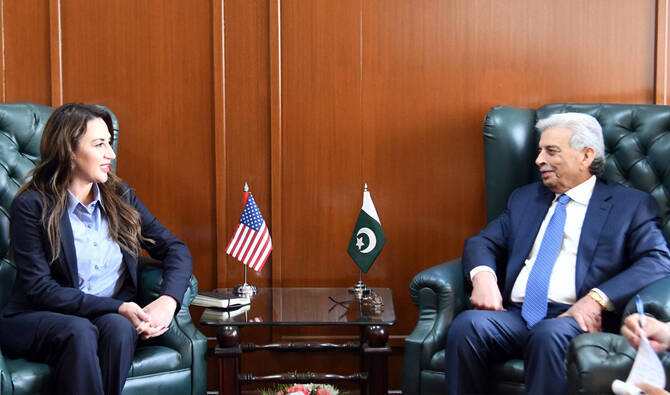
Federal Minister for National Food Security and Research Rana Tanveer Hussain meeting with Acting US Ambassador to Pakistan Natalie A. Baker (left) in Islamabad, Pakistan, on October 15, 2025. (Government of Pakistan)
Short Url
Updated 15 October 2025
Follow

Pakistan, US agree to expand joint research on hybrid, disease-resistant crops, livestock productivity

  • Meeting between food security minister and acting US envoy focus on expanding research collaboration in agriculture
  • Both sides agree to cooperate on digital farming, export compliance for mangoes, horticultural products to US market

ISLAMABAD: Pakistan and the United States agreed on Wednesday to deepen collaboration in agriculture through joint research on hybrid and disease-resistant crop varieties, local vaccine production and livestock breed improvement to boost productivity and exports, Pakistan’s food security ministry said.

Both sides reviewed ongoing projects and future priorities during a meeting between Federal Minister for National Food Security Rana Tanveer Hussain and Natalie A. Baker, the Acting US Ambassador to Pakistan, in Islamabad.

The discussions focused on advancing bilateral cooperation in agricultural trade, technology transfer and research partnerships under long-standing Pak-US agricultural frameworks.

“Pakistan is committed to advancing a resilient, sustainable and technology-driven agriculture sector through continued collaboration with the United States,” Hussain said after the meeting, expressing confidence that the partnership would open new avenues for agricultural innovation, investment and trade.

The minister highlighted the country’s growing dairy and livestock sectors, saying Pakistan was among the largest importers of Holstein cows from the United States.

He said efforts were underway to enhance animal health and productivity through a Foot and Mouth Disease (FMD)-free zone in Bahawalpur and a new traceability system aligned with international standards.

The US side expressed interest in collaborating on genetic improvement programs for dairy and beef cattle to strengthen export competitiveness.

Hussain acknowledged the role of US-funded programs such as the Agricultural Linkages Program (ALP) and the Wheat Productivity Enhancement Project (WPEP), saying they improved Pakistan’s agricultural resilience and research capacity.

The WPEP alone has helped develop 36 improved wheat varieties, increasing yields by up to 20 percent and improving resistance to rust diseases.

The minister also credited the Agricultural Innovation Project (AIP), a $30 million USAID-funded initiative, with introducing modern seed varieties, farm machinery and value-chain development across crops, dairy and horticulture.

The two sides agreed to strengthen cooperation in precision agriculture, digital farming and compliance mechanisms for the export of mangoes and horticultural products to the US market.


Pakistan unveils world’s ‘largest’ Markhor sculpture in Kaghan Valley

Updated 3 sec ago
Follow

Pakistan unveils world’s ‘largest’ Markhor sculpture in Kaghan Valley

  • Massive structure, standing 105 feet high and 38 feet wide, took five years to complete
  • Authorities aim to draw tourists to mountainous north, raise awareness about species

ISLAMABAD: Pakistan has unveiled the world’s “largest” sculpture of the Markhor, the country’s national animal, in the scenic Kaghan Valley, Radio Pakistan reported on Friday, highlighting cultural pride, wildlife heritage and the country’s growing focus on tourism. 

By immortalizing the Markhor in stone, authorities aim to draw tourists to the mountainous north and raise awareness about the species, a symbol of national identity and a conservation-success story.

“The massive structure, standing 105 feet high and 38 feet wide, took five years to complete,” Radio Pakistan reported. “The Kaghan Valley, known for its breath-taking landscapes, now hosts this record-breaking tribute, attracting visitors from across the country and beyond.”

The Markhor, a wild mountain goat native to the high-altitude regions of northern Pakistan, including Gilgit-Baltistan and Khyber Pakhtunkhwa, has distinctive corkscrew-shaped horns and remarkable agility on rocky terrain. 

Once heavily threatened by overhunting and habitat loss, the Markhor’s fortunes have rebounded in recent decades thanks to conservation efforts and community protection programs. Its increasing population has led to its conservation status being downgraded from “Endangered” to “Near Threatened.” 

Local tourism officials say the new sculpture is expected to draw significant numbers of visitors to Kaghan Valley, giving a boost to local economies while reinforcing interest in wildlife conservation and Pakistan’s natural heritage.