

Riyadh hosts European Night of Languages to celebrate cultural exchange

1 / 5
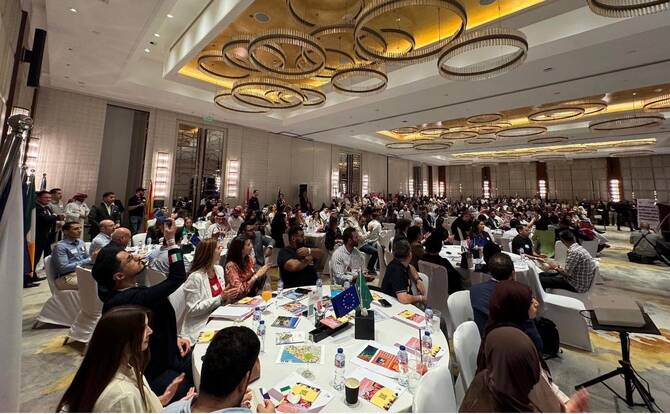
More than 250 guests joined the European Night of Languages on Tuesday, an annual celebration of Europe’s rich linguistic heritage. (AN photo)
2 / 5
Among the evening’s highlights was a talk by Saudi-based British media personality John Bin London, who shared his journey learning Arabic. (AN photo)
3 / 5
More than 250 guests joined the European Night of Languages on Tuesday, an annual celebration of Europe’s rich linguistic heritage. (AN photo)
4 / 5
More than 250 guests joined the European Night of Languages on Tuesday, an annual celebration of Europe’s rich linguistic heritage. (Supplied)
5 / 5
More than 250 guests joined the European Night of Languages on Tuesday, an annual celebration of Europe’s rich linguistic heritage. (AN photo)
Short Url
Updated 15 October 2025
Follow

Riyadh hosts European Night of Languages to celebrate cultural exchange

  • EU delegation’s annual event highlights power of language in building bridges, fostering dialogue

RIYADH: Languages and laughter filled the Hyatt Regency Riyadh on Tuesday night as more than 250 guests joined the European Night of Languages, an annual celebration of Europe’s rich linguistic heritage and its growing cultural exchange with Saudi Arabia.

Now in its fifth year, the event was organized by the delegation of the EU to Saudi Arabia in partnership with the Language Exchange Club, a Saudi nonprofit that promotes intercultural understanding and multilingualism.

Christophe Farnaud, the EU’s ambassador to Saudi Arabia, told Arab News: “The EU has always been in favor of the diversity of languages and to promote exchanges … in the context of this new Saudi Arabia, that is now happening thanks to Vision 2030, culture is a very important element of it.”

The evening offered guests a chance to practice European languages, interact with ambassadors and diplomatic staff from the EU delegation, and see displays from EU member states’ embassies.

Language stations featured mini-lessons in Bulgarian, Czech, Danish, English, Finnish, French, German, Greek, Hungarian, Italian, Portuguese, Romanian, Spanish, Ukrainian and Swedish.

As part of the cultural exchange, expats were also invited to try their hand at Arabic in a dedicated learning booth. The event also featured live performances, including an oud recital and a concert by a Portuguese band Almanata.

Farnaud added: “It’s a way to trigger or strengthen an interest for other cultures, other languages, which nowadays are very much needed. We live in a world where globalization makes exchanges bigger, stronger, permanent, but then the risk of misunderstanding is also bigger.

“So, if you speak the language, if you accept to have this kind of intellectual discipline to try and understand other people better, who do not always speak your own language, then you will take this globalization as something very positive, with less risks.”

Guests took part in language-themed games, trivia and quizzes, with free language courses offered as prizes.

Among the evening’s highlights was a talk by Saudi-based British media personality John Bin London, who shared his journey learning Arabic.

Known for his fluent Najdi dialect and social media presence celebrating Arab culture, he spoke about the deeper human connections that language learning fosters.

He told Arab News: “I think by getting people together in one room, for them to be able to speak together, to talk — not just Saudis and English people, but people from Lithuania, Romania, France, Portugal, from wherever — they get that opportunity to sit down with people and really get to know them.

“This may start off as a brief introduction, but what then happens there on, giving them those real life experiences, taking it past the basics of Saudi culture, of Saudi coffee and sadu … people are a bit more nuanced than that, so having events like this is really important.”

The event was supported by Alliance Francaise, Goethe-Institut, Education First, SEK International School Riyadh, Teach Me Arabic Academy and Hyphen.

Inspired by the annual European Day of Languages, celebrated on Sept. 26 and jointly organized by the European Commission and the Council of Europe, the Riyadh event reflected the shared goal of promoting linguistic diversity, strengthening intercultural understanding and encouraging lifelong language learning.


Rebuilding lives: Saudi initiative gives fresh hope to amputees

Updated 08 December 2025
Follow

Rebuilding lives: Saudi initiative gives fresh hope to amputees

  • Baitureh Health Association has provided life-changing support to more than 1,000 people
  • Prosthetic limbs can cost up to $76,000

MAKKAH: The Baitureh Health Association for the Care of Amputees has quickly become one of Saudi Arabia’s most impactful humanitarian initiatives, transforming support for people with lost limbs.

Established in 2020, the association deals with people’s physical, psychological and social needs and fills a long-standing gap in the national health system.

CEO Badr bin Alyan told Arab News that the initiative was created in response to a growing need, driven by amputations linked to accidents, blood disorders, occupational injuries and other causes.

Its operations were “based on service integration rather than fragmentation, enabling beneficiaries to return to their lives with confidence, ability and independence,” he said.

This holistic process covers everything from initial evaluations to psychological and physical rehabilitation, family support, prosthetic fitting and ongoing maintenance.

Its psychological support programs include group sessions led by certified mentors who have undergone similar experiences, as well as field visits to support patients before and after amputation.

More than 1,000 people across the Kingdom have so far benefitted from the association’s work, about 10 percent of them children, whom Alyan said were “the most sensitive and the most in need of intensive psychological and family support.”

Its specialist programs for children — My First Step and Therapeutic Entertainment — help young people adapt to prosthetics, overcome trauma and build confidence in a safe and supportive setting.

The association has completed more than 300 prosthetic fittings, including silicone cosmetic limbs, mechanical, hydraulic, electronic and 3D-printed models. 

Alyan said the type of prosthetic selected depended on a number of factors, such as age, lifestyle, type of amputation, activity level and psychological readiness.

Children also have to undergo frequent adjustments to their new limbs to account for their growth.

Each prosthetic cost between SR20,000 ($5,300) and SR285,000, Alyan said.

The association funds its work through sponsorships, community contributions and strategic partnerships.

Despite its success, Alyan said there were still challenges to be faced, including the lack of a consolidated base for the provision of psychological support and therapy services and prosthetics development and maintenance.

There was also a shortage of local experts, he said.

In response, the association set up a rehabilitation center, which Alyan said would help to localize prosthetics manufacturing, reduce costs and accelerate fitting processes and create opportunities for local experts to develop their knowledge and experience.

But providing prosthetics was only part of the association’s work, he said.

“Rebuilding a human life is the deeper goal.”