

Who’s afraid of the big bad wolf? Not Rami, the Saudi who has seven as pets

1 / 9
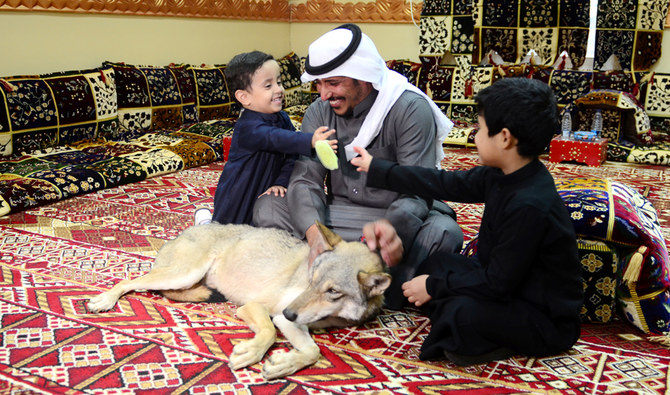
Rami Al-Sarhan, an employee of a money transfer company, sits with his sons and his wolf ‘Adeem’ in the traditional majlis at his farm in Al-Jouf. (Reuters)
2 / 9
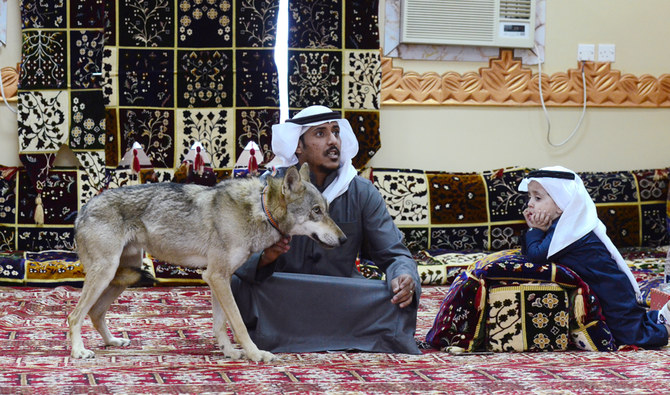
The carnivores as being kept as family pets. (Reuters)
3 / 9
The carnivores as being kept as family pets. (Reuters)
4 / 9
The carnivores as being kept as family pets. (Reuters)
5 / 9
The carnivores as being kept as family pets. (Reuters)
6 / 9
The carnivores as being kept as family pets. (Reuters)
7 / 9
The carnivores as being kept as family pets. (Reuters)
8 / 9
The carnivores as being kept as family pets. (Reuters)
9 / 9
The carnivores as being kept as family pets. (Reuters)
Updated 23 January 2020
Follow

Who’s afraid of the big bad wolf? Not Rami, the Saudi who has seven as pets

  • At home with the Saudi man who has four young children … and a pack of ferocious carnivores as the family pets

AL-JOUF: Guests visiting Rami Al-Sarhan’s home in Al-Jouf are understandably concerned when he asks if they would like to stroke the family pets.

These “pets” are not Tiddles the cat and Fido the dog — they are seven fully grown adult wolves.

The normally ferocious creatures make ideal domestic companions, Rami, 30, assured Arab News. And he has no fears for the safety of his young children, aged 8, 6, 4 and 3.

“The wolves literally live with us in the same home,” he said. “They eat with us and follow us when we go to the farm, and even sit with us in the same room when we have guests over.

“They have grown accustomed to our life and do not attack anyone who sits with us, even if they are a stranger.”

His friendship with wolves started about 11 years ago when an uncle started taking them into his home. Rami began studying them and their behavior, which he can now predict with considerable accuracy. The wolves are friendly and pose no danger to humans if handled properly with the correct precautions, he said.

Although they are wild animals, wolves can adapt to a domestic environment and one of the best ways to gain their trust was to share food and eat with them, Rami said.

FASTFACT

Food should be given to wolves without getting too close or interacting directly with them.

However, he is careful not to feed them raw meat, and he keeps his distance from the wolves during the winter mating season, which can last for two weeks.

Food should be given to wolves without getting too close or interacting directly with them, Rami said. “They are naturally ferocious but can be hostile and defensive if someone gets close to them. A wolf eats its prey but gets defensive if it gets attacked.”

Rami is also dismissive of the many superstitions that surround the animals, such as the one about wolves eating jinn. “What is funny is that many people come to me and ask me to give them strands of wolf hair so they can put it on the body of a ‘jinn-haunted’ person for healing” he said. “These are superstitions and do not make any sense.”

However tame a wolf might appear, Rami said, people should always remain cautious around them, study their every move, and avoid doing anything to scare them.

“Most importantly, show your respect to wolves and let them know that you recognize and respect them in order to be friends with you.”

Despite his assurances, if Rami ever invites you to his home “for dinner,” it might be as well to seek confirmation: “Am I eating … or am I the first course?”



King Abdulaziz Camel Festival sees unprecedented demand

Updated 5 sec ago
Follow

King Abdulaziz Camel Festival sees unprecedented demand

  • Has become a major economic engine for the camel breeding industry in Saudi Arabia and the wider Gulf
  • Auctioneer Mubarak Al-Ghannami said that around 200 camels are entered into the daily auction

RIYADH: The 10th annual King Abdulaziz Camel Festival held in Al-Sayahid, north of Riyadh, has seen unprecedented demand this year, according to the Saudi Press Agency.

It has become a major economic engine for the camel breeding industry in Saudi Arabia and the wider Gulf, with prices reaching over SR100,000 ($27,000) at auction for the best specimens.

Auctioneer Mubarak Al-Ghannami told the SPA that around 200 camels are entered into the daily auction, with prices starting at around SR4,000.

The festival supports economic activity beyond just the auctions, however, with job opportunities in camel transportation and related auxiliary sectors.

Veteran transporter Abu Naif Al-Mutairi highlighted the potential for seasonal profit and encouraged young Saudis to engage in the industry.

Organizers Saudi Camel Club have set up a 500-meter corridor of tents and pens for breeders and buyers.

High-stakes sales take place on specialized auction platforms and main exhibition areas, drawing global attention to the quality of Saudi livestock.

Industry experts and participants have reported a significant shift in market dynamics, with attendee Dr. Daghash Al-Masradi noting that the festival attracts buyers now seeking the highest-quality camels.

He noted that the organized environment allows owners to operate with greater freedom and energy.

The festival is a key initiative of Saudi Vision 2030, aiming to promote cultural tourism and showcase Saudi heritage to an international audience.

Featuring traditional crafts and cuisine, visitors are offered a glimpse into the Kingdom’s culture.

It also serves as an important platform to highlight the significance of the camel in the history of Saudi Arabia.

This year’s festival began on Dec. 1 and runs until Jan. 3, with prices for admission starting at SR500.