

Egypt inks BP-Valaris drilling deal to boost Mediterranean gas output 

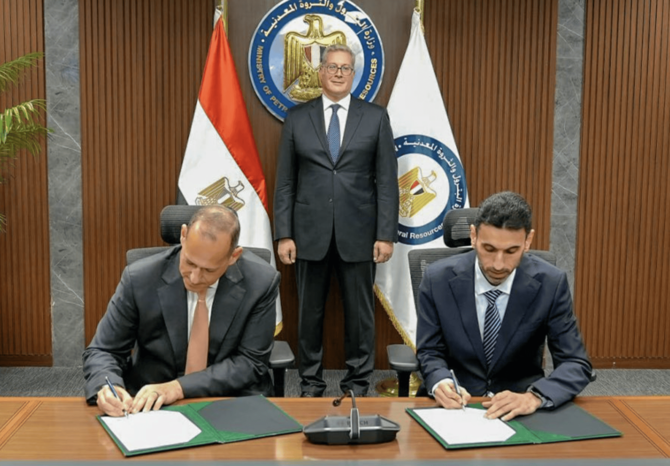
Petroleum Minister Karim Badawi witness the signing of the agreement. Facebook/EgyptMOP
Short Url
Updated 14 October 2025
Follow

Egypt inks BP-Valaris drilling deal to boost Mediterranean gas output 

JEDDAH: Egypt has signed a new offshore drilling contract with BP and US-based Valaris for five gas wells in the Mediterranean Sea, as it accelerates efforts to boost output and attract foreign investment. 

Petroleum Minister Karim Badawi witnessed the signing of the agreement, which marks the launch of BP’s latest drilling program in Egypt. The project will target five natural gas wells at depths ranging from 300 to 1,500 meters, using the Valaris 12-DS deepwater drilling rig, the ministry said in a statement. 

The initiative aligns with the Ministry of Petroleum and Mineral Resources’ strategy to boost international investment and broaden exploration efforts in the North African nation. It also continues BP’s more than 60-year partnership with Egypt’s petroleum sector as a major partner in oil and gas exploration and production. 

“BP is one of the petroleum sector’s most important strategic partners in natural gas production,” the ministry quoted Badawi as saying. 

He added that recent gas production projects in the Mediterranean have been “pivotal in increasing domestic gas production and securing new resources during peak summer consumption.” 

Badawi said the ministry is fully supporting new projects to accelerate their implementation, with the goal of adding fresh gas output over the coming year, discovering new reservoirs, and strengthening Egypt’s production capacity while reducing import dependence. 

The contract was signed in the presence of Mahmoud Abdel Hamid, CEO of the Egyptian Natural Gas Holding Co., following a memorandum of understanding last month in London between EGAS and BP that the minister had signed. 

Egypt’s oil and gas production has entered a phase of gradual growth since August, following a four-year decline, with natural gas output increasing by more than 200 million cubic feet per day, the ministry said. 

This boost has helped the government reduce the fuel import bill by $3.6 billion and settle $1 billion in arrears owed to international partners. 

“The new drilling program is scheduled to begin in 2026 and covers a mix of appraisal, development, and exploration wells aimed at accelerating the development and production of gas reserves in the region, while leveraging existing onshore and offshore infrastructure in the West Nile Delta area,” the statement added. 

Nader Zaki, BP’s regional president for the Middle East and North Africa, said the signing strengthens the company’s long-standing partnership with Egypt and is a strategic step to develop more gas resources in the Nile Delta and bring them online quickly to meet local demand. 


Education spending surges 251% as students return from autumn break: SAMA

Updated 12 December 2025
Follow

Education spending surges 251% as students return from autumn break: SAMA

RIYADH: Education spending in Saudi Arabia surged 251.3 percent in the week ending Dec. 6, reflecting the sharp uptick in purchases as students returned from the autumn break.

According to the latest data from the Saudi Central Bank, expenditure in the sector reached SR218.73 million ($58.2 million), with the number of transactions increasing by 61 percent to 233,000.

Despite this surge, overall point-of-sale spending fell 4.3 percent to SR14.45 billion, while the number of transactions dipped 1.7 percent to 236.18 million week on week.

The week saw mixed changes between the sectors. Spending on freight transport, postal and courier services saw the second-biggest uptick at 33.3 percent to SR60.93 million, followed by medical services, which saw an 8.1 percent increase to SR505.35 million.

Expenditure on apparel and clothing saw a decrease of 16.3 percent, followed by a 2 percent reduction in spending on telecommunication.

Jewelry outlays witnessed an 8.1 percent decline to reach SR325.90 million. Data revealed decreases across many other sectors, led by hotels, which saw the largest dip at 24.5 percent to reach SR335.98 million. 

Spending on car rentals in the Kingdom fell by 12.6 percent, while airlines saw a 3.7 percent increase to SR46.28 million.

Expenditure on food and beverages saw a 1.7 percent increase to SR2.35 billion, claiming the largest share of the POS. Restaurants and cafes retained the second position despite a 12.6 percent dip to SR1.66 billion.

Saudi Arabia’s key urban centers mirrored the national decline. Riyadh, which accounted for the largest share of total POS spending, saw a 3.9 percent dip to SR4.89 billion, down from SR5.08 billion the previous week.

The number of transactions in the capital settled at 74.16 million, down 1.4 percent week on week.

In Jeddah, transaction values decreased by 5.9 percent to SR1.91 billion, while Dammam reported a 0.8 percent surge to SR713.71 million.

POS data, tracked weekly by SAMA, provides an indicator of consumer spending trends and the ongoing growth of digital payments in Saudi Arabia. 

The data also highlights the expanding reach of POS infrastructure, extending beyond major retail hubs to smaller cities and service sectors, supporting broader digital inclusion initiatives. 

The growth of digital payment technologies aligns with the Kingdom’s Vision 2030 objectives, promoting electronic transactions and contributing to the nation’s broader digital economy.