



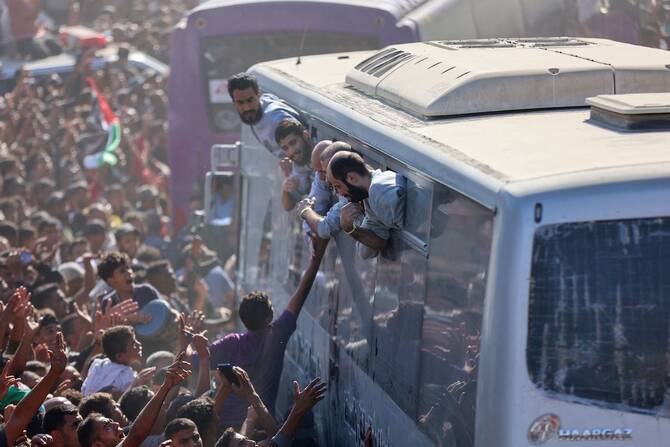


KHAN YOUNIS: Thousands of Palestinians erupted with joy in the southern Gaza city of Khan Younis on Monday, as Red Cross buses brought back nearly 1,700 former prisoners.
Some climbed the sides of the slowly moving buses as they weaved through the dense crowds gathered at Nasser Hospital to hug or kiss a loved one they recognized.
“The greatest joy is seeing my whole family gathered to welcome me,” said Yusef Afana, a 25-year-old released prisoner from north Gaza.
“I spent 10 months in prison — some of the hardest days I’ve ever lived. The pain in prison isn’t only physical; it’s pain in the soul,” he said, adding, like many of his comrades, that he hoped for all other prisoners in Israeli jails to be released soon.
At Nasser Hospital, men in military fatigues and black balaclavas struggled to keep order as the prisoners wearing the Israel Prison Service’s grey jumpsuits came off the buses.
Patriotic music blared on speakers, while Palestinian flags flew alongside those of Hamas or the Popular Front for the Liberation of Palestine.
Shadi Abu Sidu, a 32-year-old from Gaza City’s Rimal neighborhood, alleged that he and other prisoners were mistreated in jail.
“Even right before our release, they continued to mistreat and humiliate us,” he said
“But now, we hope to erase those painful memories and begin life anew.”
Among the Palestinians released under a US-brokered Gaza ceasefire deal, about 1,700 were detained by the Israeli army in Gaza during the war, while 250 are security detainees, including many convicted of killing Israelis.
Israel agreed to free them in exchange for the release of hostages held in Gaza, under the first phase of US President Donald Trump’s plan to end a war that was sparked by the attack on Israel on Oct. 7, 2023.
In the occupied West Bank city of Ramallah, too, a large crowd had gathered to greet another group of roughly 100 prisoners released under the deal.
Some threw victory signs while others struggled to walk without assistance as they got off the bus and were met by a crowd cheering their return.
“It’s an indescribable feeling, a new birth,” Mahdi Ramadan told AFP, flanked by his parents, with whom he said he would spend his first evening out of jail.
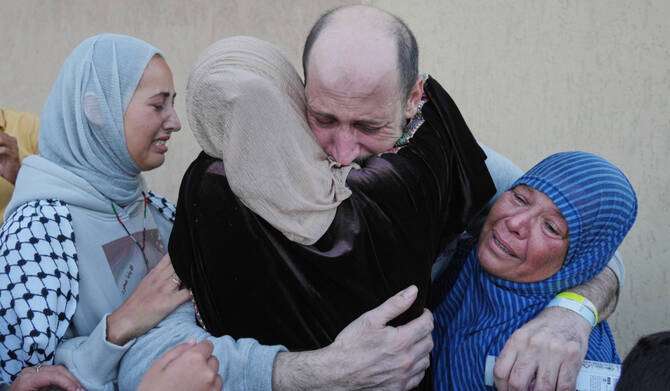
Nearby, relatives exchanged hugs, young men in tears pressed their foreheads against each other — some even fainting from the emotion of seeing loved ones again after years, and sometimes decades, in jail.
Nour Soufan, now 27, was due to meet his father, Moussa, who had been jailed a few months after his birth, outside the jail for the first time.
Soufan and half a dozen relatives came to Ramallah from Nablus, in the north of the West Bank, and spent the night in their vehicle.
“I have never seen my father, and this is the first time I will see him. This is a very beautiful moment,” Soufan said.
Like him, many had defied the travel restrictions that punctuate daily life in the Palestinian territory, with Israeli army checkpoints proliferating in two years of war.
Palestinian media reported on Sunday that families of detainees had been contacted by Israeli authorities, asking them not to organize mass celebrations.
“No reception is allowed, no celebration is allowed, no gatherings,” said Alaa Bani Odeh, who came from the northern town of Tammun to find his 20-year-old son, who had been jailed for four years.
Several prisoners said they would return home and stay with their families in their first hours of freedom.
During previous releases, mass gatherings had flooded entire streets in Ramallah, with people waving Palestinian flags as well as those of political factions, including Hamas.
Many prisoners wore a black-and-white keffiyeh around their necks — the traditional scarf that has become synonymous with the Palestinian cause.
Some of the newly released prisoners happily let themselves be carried away on relatives’ shoulders.
“Prisoners live on hope ... Coming home, to our land, is worth all the gold in the world,” said one freed detainee, Samer Al-Halabiyeh.
“God willing, peace will prevail, and the war in Gaza will stop,” Halabiyeh added.
“Now I just want to live my life.”
Journalists rushed to talk to the prisoners, but many declined to engage, sometimes explaining that, before their release, they were advised not to speak.


