


JERUSALEM: Anticipation built across Israel, the Gaza Strip and the West Bank on Sunday as the ceasefire between Israel and Hamas held before a critical day for all sides and the region.
Preparations appeared underway for the freeing of the 48 hostages — both alive and dead — still in Gaza, and for the release of hundreds of Palestinian prisoners. More ramped-up aid was being readied for Gaza, much in ruins after two years of war that began when Hamas-led militants attacked Israel on Oct. 7, 2023 killing some 1,200 people and taking about 250 hostage. In Israel’s ensuing offensive, more than 67,600 Palestinians were killed in Gaza, according to Gaza’s Health Ministry.
US President Donald Trump was scheduled to arrive in Israel on Monday, staying a few hours before heading to Egypt.
What we know and what remains unknown:
737 days since hostages taken
Sunday was day 737 since the hostages were taken — a number many Israelis have updated daily on strips of adhesive tape worn in national commemoration.
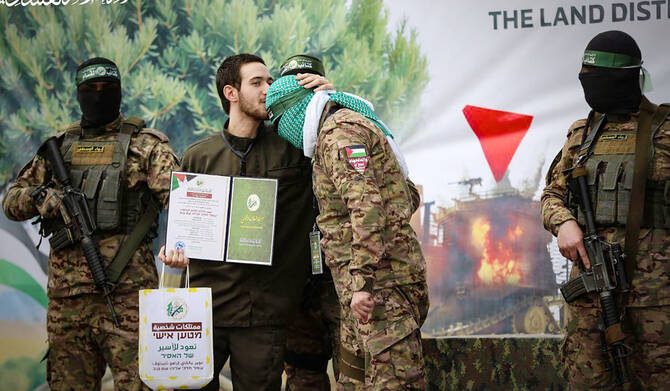
Israel said Sunday that it expects the 20 living hostages to be released together on Monday. They were then to be handed to the International Committee of the Red Cross, and to the Israeli military, which planned to take them to the Reim military base in southern Israel to be reunited with their families.
Israel then planned to take the hostages to centers around Israel but asked the Red Cross to have ambulances ready in case a hostage needs immediate care after more than two years in captivity.
It appeared unlikely that the remains of up to 28 others will be returned at the same time. Medical experts and advocates say that would be crucial to begin the healing process for many families, and for society at large, but one ceasefire document contains stipulations for remains that aren’t returned within 72 hours.
On Sunday, Israel said “an international body” will help locate the remains if they are not released tomorrow.
Palestinian prisoners slated for release
As part of the ceasefire deal, Israel is to release around 2,000 Palestinians. Among them are some 1,700 people that troops seized from Gaza during the war and have held without charge since.
Also among those being released are some 250 Palestinians serving prison sentences.
Many are members of Hamas and the Fatah faction who were imprisoned over shootings, bombings or other attacks that killed or attempted to kill Israelis, as well as others convicted on lesser charges. They’ll return to the West Bank or Gaza or be sent into exile.
It is unclear who will be among the prisoners released back into Gaza, and whether any will be deported.
Aid expected to surge in Gaza
Humanitarian organizations said they’re preparing to surge aid into the Gaza Strip, especially food that’s been in short supply in many areas.
That includes some 400 trucks from Egypt on Sunday that will have to undergo Israeli inspection before being allowed into the strip. The Israeli defense body in charge of humanitarian aid in Gaza said around 600 trucks of aid per day will be entering soon, as stipulated in the ceasefire agreement.
The world’s leading authority on food crises said in August that the Gaza Strip’s largest city was gripped by a famine that was likely to spread across the territory without a ceasefire and an end to restrictions on humanitarian aid.
The Integrated Food Security Phase Classification said famine was devastating Gaza City — home to hundreds of thousands of people. That famine was expected to spread south to the cities of Deir Al-Balah and Khan Younis by around now if the situation did not change.
The larger task of rebuilding Gaza is daunting, as much of it is in rubble and most of its two million residents displaced.
Trump to travel to Israel and Egypt
Trump, who pushed to clinch the ceasefire deal, is scheduled to arrive in Israel on Monday morning.
A giant US flag enveloped a building in Jerusalem’s City Hall complex, and US and Israeli flags were projected onto the Old City’s walls on Saturday night.
The White House schedule has Trump meeting with families of hostages and speaking at the Knesset, Israel’s parliament, before traveling to Egypt for a “peace summit” attended by regional and international leaders later on Monday. From there, he was slated to return to the White House, arriving overnight Tuesday.
Daunting issues remain unsolved
The ceasefire and release of hostages is the first step in the proposed peace plan. Competing demands remain on the next steps, casting uncertainty on whether the conflict is indeed over.
Israel wants Hamas to disarm, and Hamas wants Israel to pull its troops out of all of Gaza. The future of Gaza’s government, which has been in Hamas’ hands for two decades, also remains to be worked out.
Gaza’s Health Ministry doesn’t differentiate between civilians and combatants but says around half the 67,600 deaths were women and children. The ministry is part of the Hamas-run government, and the UN and many independent experts consider its figures to be the most reliable estimate of wartime casualties


