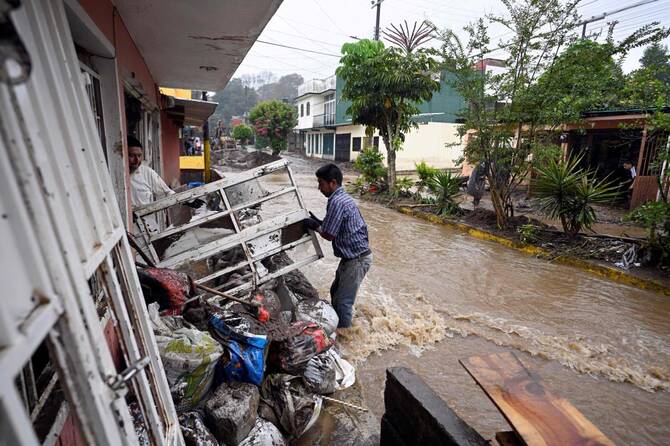

HUAUCHINANGO: Standing near the lifeless body of her sister, Rosalia Ortega is grateful to have found her in the river of mud that suddenly swept away her house as torrential rains pounded this Mexican mountain town.
At least 44 people have died since Thursday as floods wreaked a trail of destruction in the hardest-hit states of Hidalgo, Puebla, Queretaro and Veracruz.
“We’re sad, but at least we’re going to give her a Christian burial,” Ortega, 76, told AFP in the town of Huauchinango, in Puebla, a state east of Mexico City that according to official reports saw nine deaths and substantial damage.
The disaster zone is the Sierra Madre Oriental, a mountain range that runs parallel to Mexico’s east coast and is dotted with villages.
On Thursday, well after dark, a rain-swollen mountain river overflowed its banks in Huauchinango and within minutes robbed local residents of their homes and, in some cases, their loved ones.
That’s what happened to Maria Salas, a 49-year-old cook who is sheltering from the rain with an umbrella, watching two soldiers guarding the entrance to her neighborhood.
Salas lost five relatives when their house collapsed, and her own home was destroyed by a landslide.
“I can’t get my belongings, I can’t sleep there,” she said. “I have nothing.”
The grieving families are struggling to pay for funerals and, if anything is left over, to recuperate something from lost or damaged homes.
Huauchinango, with 100,000 residents, is one of the largest communities in the disaster zone and one of a very few that could be accessed Saturday.
Rivers of mud
The floodwaters swept away everything in their path, forming heavy rivers of mud that also rendered uncollapsed homes unusable.
“It was knee-deep,” says Petra Rodriguez, a 40-year-old domestic worker whose house was surrounded by water on both sides.
She and her husband and two sons managed to escape, holding hands so that if the water took one of them, “it would take us all,” she said.
In another part of town, teacher Karina Galicia, 49, showed AFP her mud-damaged, musty house. She and her family were able to run out; had they not, “we would have been buried,” she said.
In less damaged houses, neighbors are trying to remove water with plastic bottles, brooms and shovels.
Adriana Vazquez, 48, climbed a rough path strewn with stones and mud to see if anything was left of a relative’s house.
What she found was a jumble of wood and tin houses levelled by a landslide. Soldiers were using a backhoe to remove a pile of debris from the street.
Her relative “answered the telephone,” Vasquez said, but she could hardly hear anything and hopes that was due to a poor connection.
About 100 small communities are incommunicado due to road closures and power outages that have made telephone contact and travel difficult.
Mexico has been hit by particularly heavy rains throughout 2025, with a rainfall record set in the capital, Mexico City.
Meteorologist Isidro Cano told AFP that the intense rainfall since Thursday was caused by a seasonal shift and cloud formation as warm, humid air from the Gulf of Mexico rises to the mountaintops.