

Pakistan faces worsening hunger crisis as floods devastate Punjab crops, Islamic Relief warns

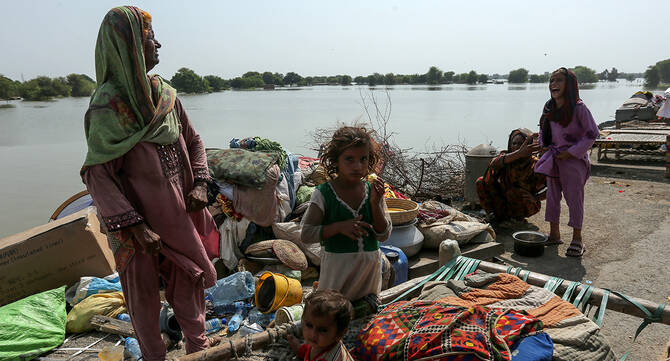
A flood-affected family gathers in a safer place near a closed motorway damaged by floodwater in Jalalpur Pirwala, in the Multan district of Punjab province on September 17, 2025, after the Chenab River overflowed following heavy monsoon rains. (AFP/ file)
Short Url
Updated 09 October 2025
Follow

Pakistan faces worsening hunger crisis as floods devastate Punjab crops, Islamic Relief warns

  • NGO says floods have destroyed up to 70 percent of Punjab’s farmland, threatening national food supplies
  • Over 4.5 million people affected across Pakistan, nearly 1,000 killed since monsoon season began in June 

ISLAMABAD: A hunger crisis is looming in Pakistan as catastrophic floods have wiped out vast stretches of farmland in Punjab province, which produces around half of the country’s staple crops, the aid agency Islamic Relief warned on Thursday.

The charity said the floods, which began in June, have inundated about 1.8 million acres of agricultural land across Punjab, affecting up to 70 percent of the province, and are likely to disrupt at least two crop cycles, raising fears of severe food shortages and surging prices nationwide.

Nationwide, over 1,000 people have been killed and more than 4.5 million people affected since the monsoon season began on June 26. Many farmers in Punjab have lost all their crops, grain stocks and livestock — their only source of income — while some remain in damaged or flooded homes to protect surviving cattle.

“Punjab province is the most important food-producing region in Pakistan, but 70 percent of it has been flooded and crops and livelihoods have been washed away. It will have an impact across Pakistan and national food shortages are now looming,” said Raza Narejo, acting country director of Islamic Relief Pakistan.

“Many people here depend on agriculture, but now they have almost nothing. They are now completely dependent on government and humanitarian support. They urgently need food, water and sanitation services, and when they can return to their homes they will need seeds, fertilizer and further support to re-establish their crops on their land once more,” Narejo added.

Islamic Relief said it has so far provided assistance to more than 140,000 flood-affected people across Pakistan, distributing food, water, tents and hygiene supplies, and helping farmers to replant through seeds and other agricultural support.

Abdul Rehman, a 55-year-old farmer from Muradabad in Punjab province, said the floods came at night and left his family destitute.

“The floods came at night and we had to run away in a hurry. We couldn’t grab anything to take with us because we were in fear. In the morning everything was destroyed,” he told Islamic Relief. “We had two goats and two sheep but they all drowned.”

Pakistan, among the world’s most climate-vulnerable countries, has seen repeated bouts of destructive monsoon flooding. 

In 2022, similar deluges killed more than 1,700 people and caused economic losses exceeding $30 billion, according to government and UN estimates.


Pakistan, global crypto exchange discuss modernizing digital payments, creating job prospects 

Updated 05 December 2025
Follow

Pakistan, global crypto exchange discuss modernizing digital payments, creating job prospects 

  • Pakistani officials, Binance team discuss coordination between Islamabad, local banks and global exchanges
  • Pakistan has attempted to tap into growing crypto market to curb illicit transactions, improve oversight

ISLAMABAD: Pakistan’s finance officials and the team of a global cryptocurrency exchange on Friday held discussions aimed at modernizing the country’s digital payments system and building local talent pipelines to meet rising demand for blockchain and Web3 skills, the finance ministry said.

The development took place during a high-level meeting between Finance Minister Muhammad Aurangzeb, Pakistan Virtual Assets Regulatory Authority (PVARA) Chairman Bilal bin Saqib, domestic bank presidents and a Binance team led by Global CEO Richard Teng. The meeting was held to advance work on Pakistan’s National Digital Asset Framework, a regulatory setup to govern Pakistan’s digital assets.

Pakistan has been moving to regulate its fast-growing crypto and digital assets market by bringing virtual asset service providers (VASPs) under a formal licensing regime. Officials say the push is aimed at curbing illicit transactions, improving oversight, and encouraging innovation in blockchain-based financial services.

“Participants reviewed opportunities to modernize Pakistan’s digital payments landscape, noting that blockchain-based systems could significantly reduce costs from the country’s $38 billion annual remittance flows,” the finance ministry said in a statement. 

“Discussions also emphasized building local talent pipelines to meet rising global demand for blockchain and Web3 skills, creating high-value employment prospects for Pakistani youth.”

Blockchain is a type of digital database that is shared, transparent and tamper-resistant. Instead of being stored on one computer, the data is kept on a distributed network of computers, making it very hard to alter or hack.

Web3 refers to the next generation of the Internet built using blockchain, focusing on giving users more control over their data, identity and digital assets rather than big tech companies controlling it.

Participants of the meeting also discussed sovereign debt tokenization, which is the process of converting a country’s debt such as government bonds, into digital tokens on a blockchain, the ministry said. 

Aurangzeb called for close coordination between the government, domestic banks and global exchanges to modernize Pakistan’s payment landscape.

Participants of the meeting also discussed considering a “time-bound amnesty” to encourage users to move assets onto regulated platforms, stressing the need for stronger verifications and a risk-mitigation system.

Pakistan has attempted in recent months to tap into the country’s growing crypto market, crack down on money laundering and terror financing, and promote responsible innovation — a move analysts say could bring an estimated $25 billion in virtual assets into the tax net.

In September, Islamabad invited international crypto exchanges and other VASPs to apply for licenses to operate in the country, a step aimed at formalizing and regulating its fast-growing digital market.