Philippines accuses China of ramming vessel near disputed island as tensions soar

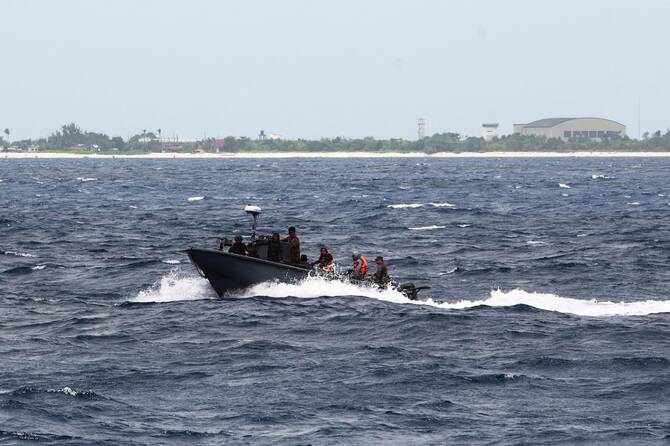
This photo taken on June 4, 2025, shows Philippine marines on a boat maneuvering through rough seas near the Philippine-occupied island of Thitu (known as Pag-asa in the Philippines) in the disputed South China Sea. (FILE/AFP)
Short Url
Updated 12 October 2025
Follow

Philippines accuses China of ramming vessel near disputed island as tensions soar

  • The Philippines accused Chinese maritime forces of using water cannon and ramming a Filipino vessel near the Philippine-occupied Thitu Island, calling the actions a “clear threat“

MANILA: The Philippines accused Chinese maritime forces of using water cannon and ramming a Filipino vessel near the Philippine-occupied Thitu Island, calling the actions a “clear threat” that escalates tensions in contested South China Sea waters.
The Philippines Coast Guard said three Filipino vessels, including the BRP Datu Pagbuaya, were anchored near Thitu Island, locally known as Pag-asa Island, early on Sunday as part of a government program to protect local fishermen when Chinese ships reportedly approached and used water cannon to intimidate them.
An hour later, a China coast guard ship allegedly fired its water cannon directly at the BRP Datu Pagbuaya before ramming its stern, causing minor damage but no injuries, the PCG said.
Manila’s coast guard and the Bureau of Fisheries and Aquatic Resources vowed to continue their operations in the area, saying their presence is essential to safeguarding the livelihood of Filipino fishermen.
Beijing blamed the Philippines for a boat collision Chinese coast guard spokesman Liu Dejun said the incident occurred when the Philippine ship “ignored repeated stern warnings from the Chinese side, and dangerously approached” the other ship.
“Full responsibility lies with the Philippine side,” Liu said in an online statement.
Tensions between China and the Philippines over the South China Sea have been rising through the year, particularly over the Scarborough Shoal, a prime fishing ground.
China claims nearly the entire South China Sea, a vital waterway for more than $3 trillion in annual ship-borne trade, parts of which are also claimed by Brunei, Indonesia, Malaysia, the Philippines, and Vietnam. (Reporting by Phuong Nguyen and Karen Lema; Editing by Raju Gopalakrishnan)


UNICEF warns of rise in sexual deepfakes of children

Updated 12 sec ago
Follow

UNICEF warns of rise in sexual deepfakes of children

  • The findings underscored the use of “nudification” tools, which digitally alter or remove clothing to create sexualized images

UNITED NATIONS, United States: The UN children’s agency on Wednesday highlighted a rapid rise in the use of artificial intelligence to create sexually explicit images of children, warning of real harm to young victims caused by the deepfakes.
According to a UNICEF-led investigation in 11 countries, at least 1.2 million children said their images were manipulated into sexually explicit deepfakes — in some countries at a rate equivalent to “one child in a typical classroom” of 25 students.
The findings underscored the use of “nudification” tools, which digitally alter or remove clothing to create sexualized images.
“We must be clear. Sexualized images of children generated or manipulated using AI tools are child sexual abuse material,” UNICEF said in a statement.
“Deepfake abuse is abuse, and there is nothing fake about the harm it causes.”
The agency criticized AI developers for creating tools without proper safeguards.
“The risks can be compounded when generative AI tools are embedded directly into social media platforms where manipulated images spread rapidly,” UNICEF said.
Elon Musk’s AI chatbot Grok has been hit with bans and investigations in several countries for allowing users to create and share sexualized pictures of women and children using simple text prompts.
UNICEF’s study found that children are increasingly aware of deepfakes.
“In some of the study countries, up to two-thirds of children said they worry that AI could be used to create fake sexual images or videos. Levels of concern vary widely between countries, underscoring the urgent need for stronger awareness, prevention, and protection measures,” the agency said.
UNICEF urged “robust guardrails” for AI chatbots, as well as moves by digital companies to prevent the circulation of deepfakes, not just the removal of offending images after they have already been shared.
Legislation is also needed across all countries to expand definitions of child sexual abuse material to include AI-generated imagery, it said.
The countries included in the study were Armenia, Brazil, Colombia, Dominican Republic, Mexico, Montenegro, Morocco, North Macedonia, Pakistan, Serbia, and Tunisia.