Tunisian protesters storm chemicals complex over health fears

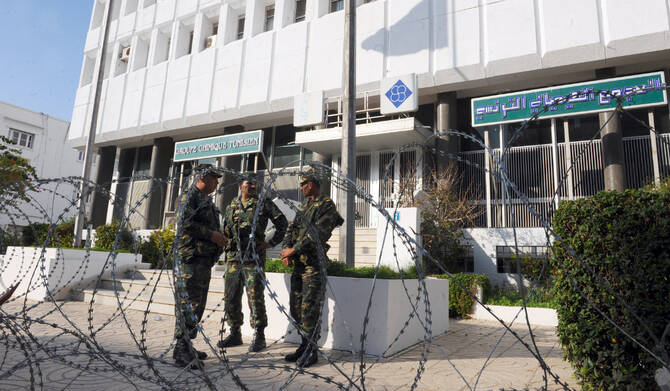
Tunisian soldiers stand guard in front of the headquarters of the Tunisian Chemical Group in Tunis on November 30, 2011. (AFP)
Short Url
Updated 11 October 2025
Follow

Tunisian protesters storm chemicals complex over health fears

  • “Gabes has turned into a city of death, people are struggling to breathe, many residents suffer from cancer or bone fragility due to the severe pollution,” Khaireddine Dbaya, one of the protesters, told Reuters

TUNIS: Residents entered the state-run Tunisian Chemical Group’s (CGT) phosphate complex in the southern city of Gabes on Saturday, demanding its closure to prevent environmental pollution and respiratory illnesses, witnesses said. The protest highlights the pressure on President Kais Saied’s government, already strained by a deep economic and financial crisis, to balance public health demands with the production of phosphate, Tunisia’s most valuable natural resource.
Demonstrators were walking inside the facility and chanting slogans calling for its closure and dismantling, witnesses said and videos on social media showed.

HIGHLIGHTS

• Protesters demand closure of Gabes phosphate complex over pollution

• President Saied blames old policies for Gabes’ environmental crisis, orders solutions

• Government plans to boost production of phosphate , a key export for Tunisia

Army soldiers and military vehicles were seen stationed inside the complex, though no clashes were reported.
“Gabes has turned into a city of death, people are struggling to breathe, many residents suffer from cancer or bone fragility due to the severe pollution,” Khaireddine Dbaya, one of the protesters, told Reuters.

GABES SUFFERING ENVIRONMENTAL CRISIS
CGT did not respond to Reuters’ attempts to seek comment on the situation in Gabes.
President Saied said last week that Gabes was suffering an “environmental assassination” due to what he called criminal old policy choices, blaming them for widespread illness and the destruction of local ecosystems.
He urged swift action and the adoption of youth-proposed solutions to address an ongoing environmental crisis. In 2017, authorities pledged to dismantle the Gabes complex and replace it with a facility that meets international standards, acknowledging that its emissions posed a danger to local residents. However, the plan has yet to be implemented.
Tons of industrial waste are discharged into Gabes’s Chatt Essalam sea daily. Environmental groups warn that marine life has been severely affected with local fishermen reporting a dramatic decline in fish stocks over the past decade, hitting a vital source of income for many in the region.
The latest wave of protests was triggered this week after dozens of schoolchildren suffered breathing difficulties caused by toxic fumes from the nearby plant.
Videos showed panicked parents and emergency crews assisting students struggling to breathe, further fueling public outrage and calls for the plant’s closure.
The government aims to revive the phosphate industry by increasing production fivefold to 14 million tons by 2030 to capitalize on rising global demand. 


MSF will keep operating in Gaza ‘as long as we can’: mission head

Updated 58 min 40 sec ago
Follow

MSF will keep operating in Gaza ‘as long as we can’: mission head

  • The head of Doctors Without Borders in the Palestinian territories told AFP the charity would continue working in Gaza for as long as possible

AMMAN:The head of Doctors Without Borders in the Palestinian territories told AFP the charity would continue working in Gaza for as long as possible, following an Israeli decision to end its activities there.
In early February, Israel announced it was terminating all the activities in Gaza by the medical charity, known by its French acronym MSF, after it failed to provide a list of its Palestinian staff.
MSF has slammed the move, which takes effect on March 1, as a “pretext” to obstruct aid.
“For the time being, we are still working in Gaza, and we plan to keep running our operations as long as we can,” Filipe Ribeiro told AFP in Amman, but said operations were already facing challenges.
“Since the beginning of January, we are not anymore in the capacity to get international staff inside Gaza. The Israeli authorities actually denied any entry to Gaza, but also to the West Bank,” he said.
Ribeiro added that MSF’s ability to bring medical supplies into Gaza had also been impacted.
“They’re not allowed for now, but we have some stocks in our pharmacies that will allow us to keep running operations for time being,” he said.
“We do have teams in Gaza that are still working, both national and international, and we have stocks.”
In December, Israel announced it would prevent 37 aid organizations, including MSF, from working in Gaza from March 1 for failing to submit detailed information about their Palestinian employees, drawing widespread condemnation from NGOs and the United Nations.
It had alleged that two MSF employees had links with Palestinian militant groups Hamas and Islamic Jihad, which the medical charity has repeatedly and vehemently denied.
MSF says it did not provide the names of its Palestinian staff because Israeli authorities offered no assurances regarding their safety.
Ribeiro warned of the massive impact the termination of MSF’s operations would have for health care in war-shattered Gaza.
“MSF is one of the biggest actors when it comes to the health provision in Gaza and the West Bank, and if we are obliged to leave, then we will create a huge void in Gaza,” he said.
The charity says it currently provides at least 20 percent of hospital beds in the territory and operates around 20 health centers.
In 2025 alone, it carried out more than 800,000 medical consultations, treated more than 100,000 trauma cases and assisted more than 10,000 infant deliveries.