



LONDON: There is a standard process for getting most books published. An author comes up with an idea, roughs out a brief outline, and sends it to their agent, who, after some back and forth, pitches it to some likely publishers.
That is not what happened with “We Are Still Here.” But then this newly published anthology of prose and poetry written by students trapped in Gaza is nothing like most books.
The idea for the book began with the narrowest of escapes from death.
Over the past two years, Al-Azhar University and the Islamic University of Gaza have both been reduced to rubble in repeated attacks by Israel.
In April 2024, with no sign of a ceasefire or a return to any kind of normality, let alone university life, academics at the universities began teaching their surviving students online.

A young Palestinian pulls a wheel cart past the heavily damaged building of Al-Azhar University in Gaza City on February 15, 2024, amid the continuing war between Israel and the Palestinian Hamas movement. (AFP)
A chance encounter put one Palestinian teacher in touch with Zahid Pranjol, associate dean of education and professor of biomedical science education at Sussex University, in the English south coast seaside town of Brighton, 3,500 kilometers and a world away from Gaza.
Pranjol and Jacob Norris, associate professor in Middle East history at Sussex, began sharing English-language teaching materials with their colleagues in Gaza.
“We got to know some academics, they put us in touch with students, and this year we decided to do more for them,” Pranjol said.
In May the two began delivering lessons in conversational English over WhatsApp and, when internet connectivity allowed, Zoom.
“And then the starvation started,” Pranjol said.
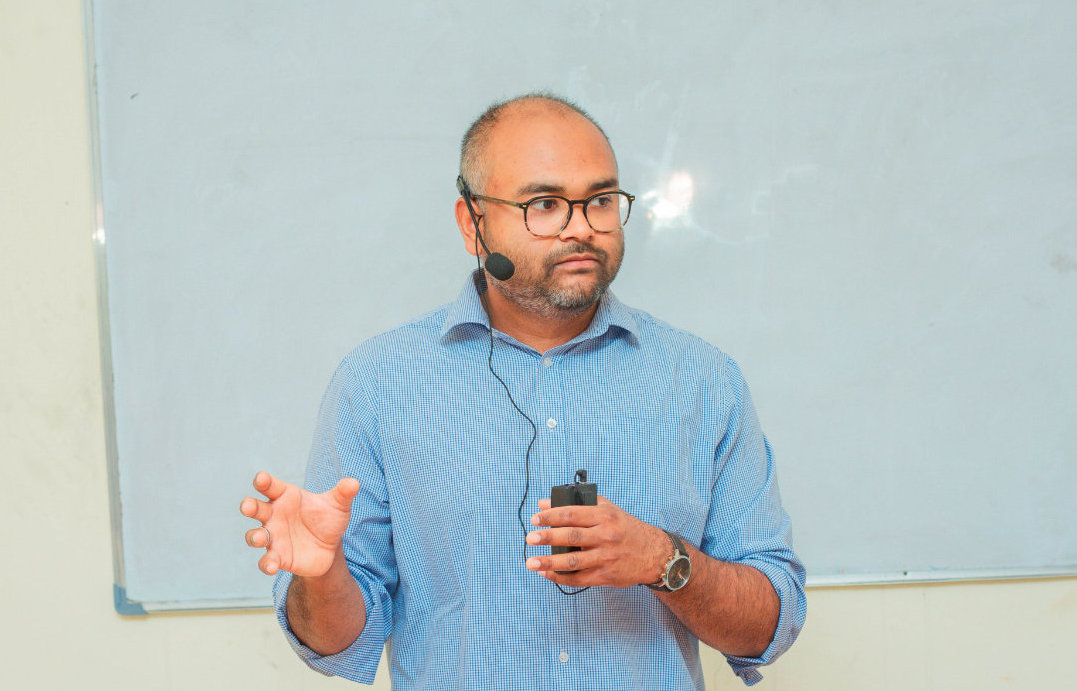
Professor Zahid Pranjol is professor in Biomedical Sciences at the University of Sussex. (Supplied: @BioRTCNig)
“One day, one student wrote to me on WhatsApp and said, ‘These might be my last words. My neighbors got killed. I’m going to get food from the aid center, and if I don’t come back, please get this message out to the world.’
“I was completely taken aback. I said: ‘Wait a second. What do you mean? What happened?’ And then we were disconnected.”
Two days later, communication was restored and the student sent Pranjol a piece of harrowing prose. In it, he revealed that his father had been killed earlier in the war.
Then he described what had happened when he had joined the line for food at the aid center. The man in front of him, and the one behind him, had both been shot dead. He had no idea how he was still alive.
“I thought his writing, and his story, was so powerful,” Pranjol said. “I’m not a writer, I’m a scientist. But this was so obviously extraordinary.”
Norris agreed. By now they were in touch with hundreds of students taking their online English courses, and they messaged them all to see if anyone else wanted to write anything.

Jacob Norris is associate professor in Middle East History at the University of Sussex. (Supplied)
Within two weeks they had more than 60 submissions, “and they just kept flooding in,” Norris said.
The result is an astonishingly powerful and heartbreaking collection of 44 poems and 56 pieces of prose, written by a group of young adults who ought to have been on the threshold of their futures, but instead found themselves teetering on a precipice.
“They’re not recognized writers,” Norris said.
“There are lots of amazing poets and writers celebrated in Gaza and in the Arabic-speaking world more broadly. But these are just everyday students, yet they have an amazing poetry of their own, raw and unfiltered, which gives the reader unique access to everyday life in Gaza.”
The book, as Omar Melad, president of Al Azhar University, writes in an epilogue, “is a mirror to their pain, a testimony to their resilience, and a plea for the world to listen.”
He added: “Their words reflect the unbearable suffering they endure — not only as students striving for knowledge, but as residents trapped in a relentless war of starvation and erasure.”
The book comes with an endorsement from the British writer Ian McEwan, the author of “Atonement” and “Enduring Love.”
“Surviving at the darkest extremes of suffering, of destruction and displacement, famine and the constant threat of maiming or death, these young writers speak to us with piercing lucidity,” he writes.
“Their resilience is their only form of optimism. Paradoxically, reading them lifts the heart.”

“We Are Still Here” is being translated into several languages, including Spanish, Portuguese, French, German, and Arabic. Such was the response from the students that work on a second volume is already under way.
“We Are Still Here — An Anthology of Resilience, Grief, and Unshattered Hope from Gaza’s University Students,” is published in English by Daraja Press. It will be launched at Housmans bookshop in London at 7 p.m. on Nov. 3. All proceeds will be used to support students in Gaza.
The following are extracts from students’ prose and poetry.
We Are Still Here
— The students
This book is not simply a collection of stories and poems.
It is a heartbeat.
A cry.
A testament.
We had visions of graduation ceremonies, of family celebrations,
of waking up to ordinary mornings. Instead, we woke up to war.
Starvation. Silence.
We live under siege, stripped not only of food and shelter, but of the
most basic elements of humanity, agency, and safety. In a world that
has turned its face away, where our stories are lost beneath the rubble
and the headlines, we write — because writing is resistance.
We write while hungry.
We write by candlelight, under the hum of drones.
We write without knowing whether we will survive the night.
This book gives us something the world has denied us: a voice.
Those I love have departed
— Dunia Raafat Shamia
My gentle uncle, Abu Riyad, killed by a treacherous missile.
I felt nothing. Just emptiness.
Will all my loved ones leave me?
How easy it is — for the innocent to be burned, shattered, erased —
at the click of a b
I once loved technology and progress. Now I loathe them — and those
who made the
utton.m.
Abu Riyad has gone to join my aunt and uncle.
They all left me — alone.
They left behind a trembling heart.

Palestinian students from al-Azhar University attend their graduation ceremony, in Gaza city on October 12, 2021. (NurPhoto via Getty Images)
Silence of shards
— Hada Mohammed Homaid
They endured.
Until June 4, 2025.
On that day, the sun did not rise for Hada and her family. Her eldest
brother — her guide, her second parent, her heart’s anchor — was killed
in a direct attack.
He was more than a brother. He was a father of five young children,
a devoted husband, a cherished son, a noble soul. His name was
Al-Hassan, meaning the virtuous — a name he lived up to in every way.
Honest. Gentle. Brave.
His death tore a hole through their world.
He left behind five children without a father, parents without their joy,
a wife without her partner, and siblings without their pillar.
Since that day, Hada and her family have struggled to rise. Grief has
made the ground beneath them unsteady.
Yet they keep moving.
Life under the occupation
— Alaa Eyad Saleh Khudier
Now I’m in my second year, second semester.
And the war still hasn’t stopped.
But I am still here. We are still here.
In the end, never give up on your dreams, no matter how difficult the
road. Hold on, and you will arrive.
I hope this war ends soon. I hope we rebuild Gaza. And I hope we
return to our classrooms — not through screens, but side by side — ready
to learn, grow, and live the futures we’ve been fighting for.
Our second displacement
— Nour Mohammed Abusultan
The men came:
“Trust in God. Walk in line. Hold the white flags. Follow Ahmad.”
Each of us strapped a bag to our backs, raised a flag in one hand,
and our index finger in the other.
“I bear witness that there is no god but Allah, and Muhammad is
His messenger.”
I tried to hold back my tears and steady my steps.
I don’t know how I walked, but I walked.
I scanned the crowd for my parents and sisters — then I saw my father
carrying my little sister on his shoulders, repeating the shahada.
He looked lost — my father, who had always been my strength, now
unsure of where to go, what to do.
Hope from beneath the rubble
Alaa Maher Al-Zebda
Imagine spending years building a future, working tirelessly,
striving to make your family proud — only to find yourself
back at zero, with nothing.
Everything you built — gone.
Everyone who supported you — disappeared.
Your home destroyed, leaving you in the streets.
Your friends killed — you’re left without a companion.
Your pet buried beneath the rubble.
Your university turned to ruins.
Your white coat, your dream of medicine, burned before your eyes.
You’ve lost everything — material and emotional — and you’re left
stunned, asking: What now?
And yet … despite it all, you carry the certainty that you’re still strong.
That this too shall pass.
That your will can create a miracle.

Palestinians ride in a horse-drawn carriage past the closed gate of al-Azhar University in Gaza City before the Gaza War. (AFP)
Our feelings when the war resumed on March 18, 2025
— Batol Nabeel Alkhaldy
I don’t understand how the whole world remains silent,
lips sealed shut.
Why?
We’re not asking for luxury.
We’re not searching for perfect lives.
We just want something simple —
to wake up to the sound of birds instead of warplanes,
to eat a meal without wondering if it will be our last.
I buried the future too soon
— Nour Ahmed Almajaida
My top priority right now?
To live in peace until the day I die.
I want a fresh start — a new life, in a new place, with new everything
Somewhere far from here.
I want to live freely, fully, without fear of what tomorrow will bring.
And honestly?
I have no idea how I’m going to make that happen.
Million broken hearts
— Rasha Essa Mohammed Abo Shirbi
When you see your warm home, your safe haven, reduced to dust,
you learn what real patience means.
When someone you love dies — your brother, your cousin, your
grandmother — you understand what it costs.
When you’re displaced to a place that resembles everything but a
home, living a life that feels hollow — you hold on to patience like it’s
the only thing left.
The question that haunts us: When?
— Farah Jeakhadib
My brother — his eye wounded, his vision slipping away — has been
waiting for five months for permission to leave Gaza, just to save what
remains of his sight.
Every morning, he wakes up early to go to a place ironically named
“Gaza Humanitarian Foundation.” A place far removed from anything
remotely humane.
You’ve seen Squid Game, haven’t you?
It mirrors our lives exactly.
You must fight, sacrifice, and endure
just to earn a bite of food.
All the while, my parents live with a gnawing fear:
will their son return holding bread —
or be carried back on shoulders, lifeless?
A letter to the dead
— Marah Alaa El-Hatoum
I don’t know who I’m speaking to.
I don’t know who to send this letter to.
What should I say?
All I know is this: I hope you’re okay.
And I hope no one else finds the path you took and follows it.
My condolences to those you left behind —
the broken pieces of loved ones who tried to convince death they
wanted to join you.
To the children who still carry you in memory,
never knowing your legacy,
only that you were once here.
Will words about you live on,
or will they die, like everything else around us?


