

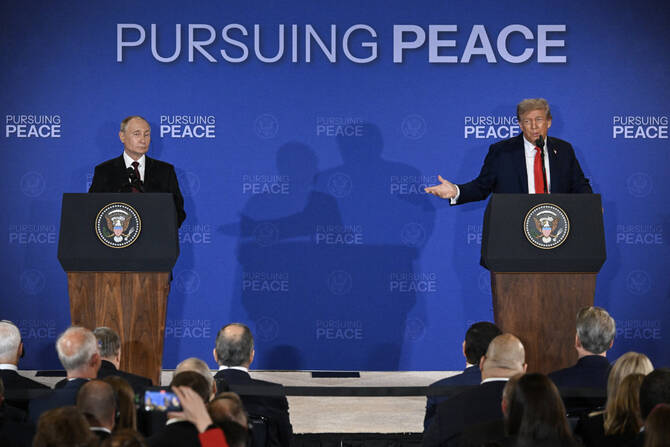

MOSCOW: Two months after a smiling Donald Trump and Vladimir Putin shook hands at a military base in Alaska in what looked like the start of a US-Russia rapprochement, a top Russian diplomat has raised doubts that the “spirit of Alaska” is still alive.
For Russia, the Anchorage summit on August 15 had two goals: to persuade President Trump to lean on Ukraine and Europe to agree to a peace settlement favorable to Moscow, and to encourage a rapprochement in US-Russia ties.
Russian Deputy Foreign Minister Sergei Ryabkov said this week there had been scant progress on either front and “powerful momentum” had been lost. Moscow had signalled it was ready to rebuild ties but Washington had not reciprocated, he said.
“We have a certain edifice of relations that has cracked and is collapsing,” Ryabkov said. “Now the cracks have reached the foundation.”
Putin says complex issues require more study
After Ryabkov spoke, a Kremlin aide and Putin’s spokesman underlined that contacts with Washington continue, and the Russian leader sounded more optimistic than Ryabkov when asked about Ukraine and ties with the US on Friday.
“These are complex issues that require further consideration. But we remain committed to the discussion that took place in Anchorage,” Putin told a press conference.
His aide later told the Kommersant newspaper that Russia had agreed to unspecified concessions at the Alaska summit it would be ready to make if Trump got certain things from Ukraine and the Europeans.
Such a contrast in tone among senior officials is rare in Moscow and highlights the delicacy and sensitivity of the twin-track approach Russia is taking — combining flattery and warnings to adapt to diplomatic reversals since the summit.
Trump’s frustration
While a Trump initiative has raised hopes of peace in Gaza, he is frustrated by his failure to broker an end to fighting in Ukraine and has soured, at least publicly, on Russia.
There is no new Trump-Putin meeting on the agenda, no date has been set for the next talks on improving ties, and Washington, without an ambassador in Moscow since June, has not sought Russia’s approval to send a successor.
Trump has spoken of possibly supplying Tomahawk cruise missiles to Ukraine, hitting a nerve with Putin, who said it would destroy what is left of US-Russia ties.
Trump has also said he wants Putin and Ukrainian President Volodymyr Zelensky to hold direct talks, but there appears no near-term prospect of that happening as the tempo of the war increases.
In a rhetorical U-turn, Trump has suggested Ukraine could win back all its lost territory, while dismissing Russia as “a paper tiger,” a snipe shrugged off by Moscow.
Music to Trump's ears
In response, Russia has tried playing good cop, bad cop — with officials at times appearing to threaten tough responses to US action and at others underlining shared values.
Putin offered to voluntarily maintain limits on deployed strategic nuclear weapons set out in the last arms control treaty with the US once it expires next year if Washington does the same.
Trump said “it sounds like a good idea,” but there has been no formal US response.
Putin on Friday praised Trump’s credentials as a potential Nobel Peace Prize laureate, saying his efforts to bring peace to Ukraine were sincere and that his Middle East mediation initiative was already an achievement and would be “a historic event” if he was able to see it through to the end.
Trump took to social media to show he had noted the praise: “Thank you to President Putin!” he wrote on Truth Social.
Melania Trump also disclosed on Friday that she had secured an open line of communication with Putin about repatriating Ukrainian children caught up in the war, and that some had been returned to their families with more to be reunited soon.
Kirill Dmitriev, Putin’s presidential envoy, said Moscow appreciated Melania Trump’s “humanitarian leadership.”
At a foreign policy conference this month, Putin also went out of his way to make a series of US-focused statements likely to appeal to Trump.
Putin praised Michael Gloss, the son of a CIA official killed in Ukraine fighting on Russia’s side, saying he represented “the core of the MAGA movement, which supports President Trump.”
He also condemned the murder of Trump ally Charlie Kirk, saying Kirk had defended the “traditional values” which he said Gloss and Russian soldiers in Ukraine were giving their lives to defend.
Pushback, warnings and disappointment
But warnings have continued, and pushback against Trump’s talk of supplying Tomahawk missiles to Ukraine was immediate.
Putin said such a step would require the direct involvement of US military personnel, destroy bilateral relations and usher in a new stage of escalation.
Andrei Kartapolov, who heads Russian parliament’s defense committee, said Moscow would shoot down Tomahawk missiles and bomb their launch sites if the US supplied them, and find a way to retaliate against Washington that hurts.
In other terse comments, Ryabkov said Russia would quickly carry out a nuclear test if the US did the same, and that Moscow would “get by” if Washington did not take up Putin’s nuclear arms control offer.
Ryabkov also backed off a Russian offer to discuss the fate of US nuclear fuel at a nuclear plant Moscow controls in southern Ukraine, and spoke of how Russia was withdrawing from an agreement with the US to destroy weapons-grade plutonium.
“After the summit in Alaska, there was hope that Trump was ready to continue dialogue with Russia and take our interests into account,” wrote Andrei Baranov, a commentator for pro-Kremlin newspaper Komsomolskaya Pravda.
“Donald has now thoroughly disappointed us with his trademark inconsistency.”


