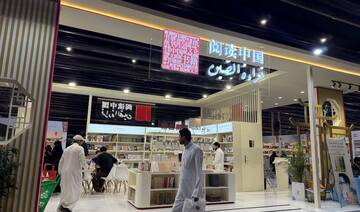

RIYADH: The Riyadh International Book Fair continues to be a showcase for ideas, culture, and innovation. At this year’s fair, which ended Friday, several booths stood out for their contributions to the literary and cultural scene.
One of the most eye-catching was Samawi, a Saudi platform looking to transform the publishing landscape through its print-on-demand model.

One of the most eye-catching booths this year was Samawi, a Saudi platform transforming the publishing landscape through its print-on-demand model. (AN photo by Jafar Saleh)
The platform allows authors to upload their books, which are then printed only when a customer places an order. This model significantly reduces costs for writers, who no longer need to stockpile large print runs. In addition, Samawi connects bookstores directly with authors, opening more channels for distribution and visibility.
“We serve writers, publishers, and readers by providing technical support for the publishing industry, whether it’s reading, writing, printing, or digital and audio books,” Khaled Bamohamad, CEO of Samawi, told Arab News.

Another notable presence at the fair was the Saudipedia booth. Launched in 2024, Saudipedia is a multilingual digital encyclopedia dedicated to documenting every aspect of Saudi Arabia — from culture, economy, and Vision 2030 to sports, entertainment, and politics. (AN photo by Jafar Saleh)
The platform offers flexible printing and distribution options. And the Samawi Reader app provides access to thousands of e-books and audiobooks.
“We started in 2022 with e-books. Today we have 20,000 e-books and more than 5,000 audiobooks,” Bamohamad said. “With each exhibition, we introduce new services such as reading-speed analysis and enhanced reading experiences.”

(AN photo by Jafar Saleh)
Another notable presence at the fair was the Saudipedia booth. Launched in 2024, Saudipedia is a multilingual digital encyclopedia dedicated to documenting every aspect of Saudi Arabia — from culture, economy, and Vision 2030 to sports, entertainment, and politics.
Hassan Al-Qarni, managing editor of Saudipedia, told Arab News: “We aim to provide reliable, original information to local, Arab, and international audiences.”
Available in Arabic, English, French, German, Russian, and Chinese, Saudipedia is billed as a comprehensive reference for anyone seeking to learn more about the country. Its presence at the book fair highlights the growing role of digital-knowledge platforms in promoting Saudi culture globally.
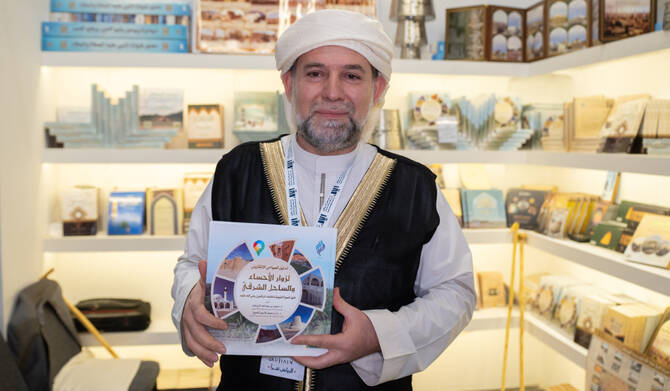
Another booth showcased the work of Nizar Al-Sheikh, a specialist in comparative jurisprudence and the landmarks of the Prophet’s biography.
Al-Sheikh has published around 35 works on the subject. His latest is “The Tourist Guide for Visitors to Al-Ahsa and the Eastern Province,” which explores Prophet Muhammad’s visit to the titular region on a trade journey before the revelation of the message.
“The work documents the villages and cities the Prophet passed through, the presence of the caliphs in the region, and the significance of its historical sites. It is comprehensive and covers many of the cities mentioned by the Prophet,” Al-Sheikh said.