

UK rules out sending troops to Gaza as US-led ceasefire takes hold

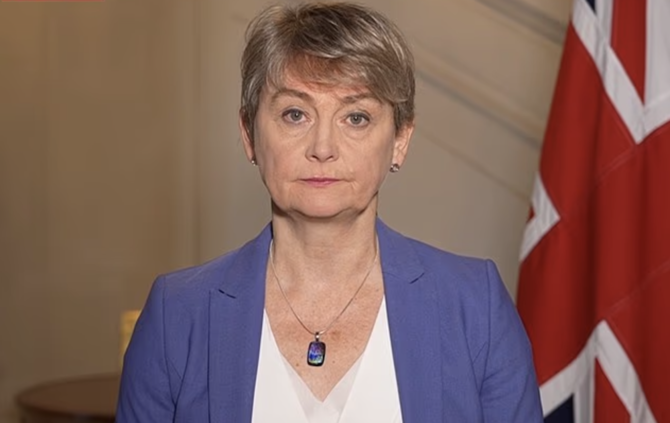
British Foreign Secretary Yvette Cooper (pictured) said Friday that the UK has no plans to deploy troops to the Middle East as part of a US-led ceasefire agreement between Israel and Hamas. (Screenshot/BBC News)
Short Url
Updated 10 October 2025
Follow

UK rules out sending troops to Gaza as US-led ceasefire takes hold

  • Around 200 American troops have been deployed to Israel to assist in monitoring and supporting the truce’s initial implementation

LONDON: British Foreign Secretary Yvette Cooper said Friday that the UK has no plans to deploy troops to the Middle East as part of a US-led ceasefire agreement between Israel and Hamas.

The announcement comes after US President Donald Trump brokered a deal earlier this week that includes a pause in the two-year war in Gaza and the release of hostages held by Hamas in exchange for Palestinian prisoners.

Around 200 American troops have been deployed to Israel to assist in monitoring and supporting the truce’s initial implementation.

Speaking to the BBC on Friday, Cooper said the US will take the lead in overseeing the ceasefire process and that Britain will not send personnel to join the effort.

“That’s not our plan, there are no plans to do that,” she said.

“The US will lead what is effectively a monitoring process to make sure that this happens on the ground, overseeing the hostage releases and ensuring aid gets in place.

“They’ve made clear they expect the troops on the ground to be provided by neighboring states, and that is something we do expect to happen,” she added.

Cooper confirmed that discussions were underway regarding an “international security force” but said the UK’s contribution would focus on financial and diplomatic support, including exploring private investment options for Gaza’s reconstruction.

She added that the British government hopes the ceasefire will come into effect “imminently.”

The foreign secretary made the comments after attending talks in Paris hosted by French President Emmanuel Macron, alongside her German counterpart Johann Wadephul and the foreign ministers of France and Saudi Arabia, Jean-Noel Barrot and Prince Faisal bin Farhan.

The ceasefire deal was reached just days after the second anniversary of the Oct. 7, 2023 attacks, when Hamas militants killed nearly 1,200 people and abducted around 250 others during incursions into Israel.

The assault prompted a major Israeli military campaign in Gaza that has since left more than 67,000 dead, according to the Hamas-run health ministry, and displaced much of the enclave’s population.

Prime Minister Sir Keir Starmer said the truce “would not have happened without” Trump’s leadership, while world leaders have cautiously welcomed the agreement as a potential step toward ending the conflict.


Ukraine faces military aid shortfall as Europe struggles to plug US gap

Updated 8 sec ago
Follow

Ukraine faces military aid shortfall as Europe struggles to plug US gap

  • The United States contributed, on average, €21.4 billion to the €41.6 billion annual mean for 2022-2024
  • France, Germany and the United Kingdom increased their allocations substantially this year
PARIS: Military aid for Ukraine plummeted in the second half of 2025 as falling European contributions failed to make up for the halt in US support, data from the Kiel Institute showed Wednesday.
As US President Donald Trump wound down US contributions at the beginning of the year, Europe stepped up with record pledges of almost €20 billion ($23 billion) between March and June, more than offsetting the overall shortfall.
But Europe was only able to muster fewer than €8 billion between July and October, meaning Ukraine overall received the second-lowest amount for a four-month period since Russia’s 2022 invasion began.
The overall total for the first 10 months of 2025 stands at €32.5 billion, meaning an additional €9.1 billion would be needed by the end of the year to maintain the €41.6 billion annual average from 2022 to 2024.
Ukraine’s allies would need to send another €5.1 billion before the end of the year to avoid the current-record annual low of €37.6 billion, set in 2022.
“Based on the data available through October, Europe has not been able to sustain the momentum of the first half of 2025,” said Professor Christoph Trebesch, head of Kiel’s Ukraine Support Tracker.
“If this slower pace continues in the remaining months, 2025 will become the year with the lowest level of new aid allocations ever for Ukraine since the outbreak of the full-scale invasion in 2022,” he added.
The United States contributed, on average, €21.4 billion to the €41.6 billion annual mean for 2022-2024, highlighting the scale of the task for Europe and other allies in filling the gap.
France, Germany and the United Kingdom increased their allocations substantially this year.
But Europe’s leaders are looking for ways to fund a loan to Kyiv that, under current proposals, would be paid back by any eventual Russian reparations to Ukraine.
The EU on Wednesday laid out a plan to use frozen Russian assets to help fund Ukraine with €90 billion over the next two years.
Belgium, home to international deposit organization Euroclear — which holds most of the Russian assets — has so far rejected the plan because of the potential legal repercussions.