MANILA, Philippines: An offshore earthquake with a preliminary magnitude of 7.6 hit off a southern Philippine province Friday morning, sending people out of houses and buildings in panic, knocking out power and prompting officials to order villagers to evacuate from the coastlines of nearby provinces due to a possible tsunami.
President Ferdinand Marcos Jr. said the potential damage was being assessed and rescue teams and relief operations were being prepared and would be deployed when it was safe to do so.
The Philippine Institute of Volcanology and Seismology said it was expecting damage and aftershocks from the earthquake, which was centered at sea about 62 kilometers (38 miles) southeast of Manay town in Davao Oriental province and was caused by movement in a fault at a shallow depth of 10 kilometers (6 miles).

US Geological Survey illustration map
“I was driving my car when it suddenly swayed and I saw powerlines swaying wildly. People darted out of houses and buildings as the ground shook and electricity came off,” Jun Saavedra, a disaster-mitigation officer of Gov. Generoso town in Davao Oriental, told The Associated Press by cellphone.
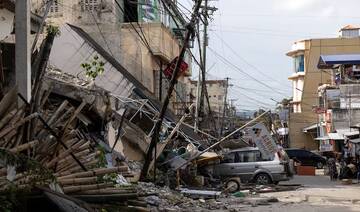
“We’ve had earthquakes in the past, but this was the strongest,” Saavedra said, adding that the intense ground swaying caused cracks in several buildings, including schools.
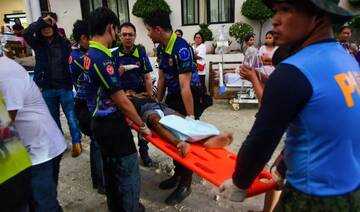
At least 50 students from a high school in his town were brought to a hospital by ambulance after either fainting or becoming dizzy due to the earthquake, Saavedra said.
Gov. Generoso is a town about 100 kilometers (62 miles) south of Manay, where classes in all levels were also suspended.
Children evacuated schools in Davao city, which has about 5.4 million people and is the biggest city near the epicenter, about 250 kilometers (155 miles) west of Davao Oriental province.
The Pacific Tsunami Warning Center in Honolulu said hazardous waves were possible within 300 kilometers (186 miles) of the epicenter. It said waves up to 3 meters (10 feet) above normal tides were possible on some Philippine coasts, and smaller waves were possible in Indonesia and Palau.

Google map showing Davao region nin Mindanao where the earthquake struck at 9:43 a.m., Philippine time.
Office of Civil Defense deputy administrator Bernardo Rafaelito Alejandro IV warned that tsunami waves could hit six nearby coastal provinces from Davao Oriental up to two hours after the earthquake struck at 9:43 a.m. He asked people to immediately move to higher ground or further inland away from coastal areas.
“We urge these coastal communities to be on alert and immediately evacuate to higher grounds until further notice,” Alejandro said in a video news briefing.
“Owners of boats in harbors and those in the coastal areas...should secure their boats and move away from the waterfronts,” he said.
Indonesia’s Meteorology, Climatology, and Geophysics Agency said small tsunami waves were detected in North Sulawesi province with heights ranging from 3.5 to 17 centimeters (1.3 to 6.7 inches) in Melonguane, Beo, Essang and Ganalo in Talaud Islands districts. People were warned to stay away from beaches and riverbanks.
The Philippines is still recovering from a Sept. 30 earthquake with a magnitude of 6.9 that left at least 74 people dead and displaced thousands of people in the central province of Cebu, particularly Bogo city and outlying towns.
One of the world’s most disaster-prone countries, the Philippines is often hit by earthquakes and volcanic eruptions because of its location on the Pacific “Ring of Fire,” an arc of seismic faults around the ocean.
The archipelago also is lashed by about 20 typhoons and storms each year, making disaster response a major task of the government and volunteer groups.