

Pakistan’s financial inclusion jumps to 67% as macroeconomic stability returns — SBP chief

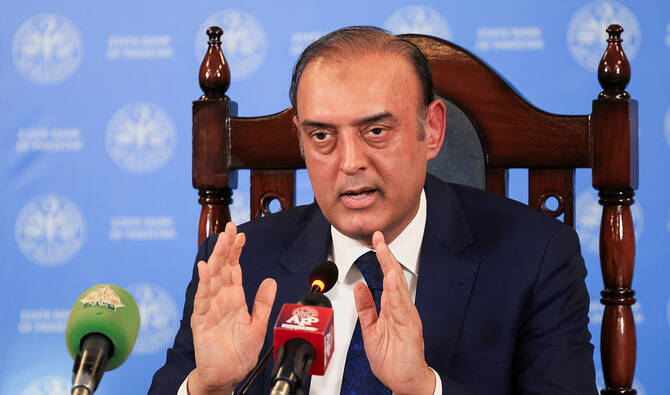
Jameel Ahmad, Governor of the State Bank of Pakistan (SBP), addresses a press conference in Karachi, Pakistan, on January 27, 2025. (REUTERS/File)
Short Url
Updated 09 October 2025
Follow

Pakistan’s financial inclusion jumps to 67% as macroeconomic stability returns — SBP chief

  • Governor Jameel Ahmed says gender gap in financial access has narrowed to 30% in Pakistan
  • He urges microfinance institutions to strengthen risk management, adopt digital credit tools

KARACHI: Pakistan’s financial inclusion rate has risen to 67% in 2025 from 47% in 2018, the top central bank official said on Thursday, crediting digital innovation and policy reforms for expanding access to financial services.

The rise comes as the government and the State Bank of Pakistan (SBP) have stepped up efforts to strengthen microfinance and digital banking amid a period of relative macroeconomic stability. Officials have also urged the public to use formal banking channels and digital platforms to help build resilience in the financial system.

“Governor Jameel Ahmad highlighted that the financial inclusion rose from 47% in 2018 to 67% in June 2025 while the gender gap in financial access narrowed from 47% to 30% over the same period,” the central bank said in a statement issued after his speech to the ninth Annual Microfinance Conference in Karachi.

“Governor Ahmad assured that the State Bank remains fully committed to working alongside the microfinance industry to strengthen resilience, safeguard customers and expand outreach,” it added.

The top SBP official told the conference that Pakistan’s economic recovery was gathering pace after tough policy measures helped stabilize inflation and foreign exchange reserves. He said inflation had declined sharply and was expected to stay within the government’s 5-7% target range over the medium term.

Ahmed also noted that foreign exchange reserves were now five times higher than in February 2023, reflecting “strategic interbank purchases” that helped the government meet debt repayments without excessive borrowing.

He outlined new principle-based regulations for microfinance banks, allowing greater flexibility and higher lending limits of up to Rs5 million ($17,500) for agriculture, microenterprise and housing loans, and Rs500,000 ($1,750) for general loans.

Ahmad urged microfinance institutions to adopt stronger risk management, enhance liquidity buffers, and use digital tools for credit scoring to prevent fraud and maintain sustainability.

“Together, we can ensure that microfinance continues to play its vital role in fostering inclusive, resilient, and sustainable growth,” he said.


Pakistan says illegal immigration to Europe down 47 percent amid major crackdown

Updated 6 sec ago
Follow

Pakistan says illegal immigration to Europe down 47 percent amid major crackdown

  • Over 1,700 human smugglers arrested nationwide this year, interior ministry says
  • EU praises Pakistan’s efforts as Brussels, Islamabad agree to deepen cooperation 

ISLAMABAD: Pakistan has achieved a 47 percent drop in illegal immigration to Europe this year, with more than 1,700 human smugglers arrested as part of an expanded nationwide crackdown, the interior ministry said on Thursday. 

The announcement followed Interior Minister Mohsin Naqvi’s meeting in Brussels with European Union Commissioner for Home Affairs and Migration Magnus Brunner, where both sides discussed efforts to curb human smuggling and strengthen migration cooperation.

Pakistan intensified action against illegal migration in 2023 after hundreds of migrants, including 262 Pakistanis, drowned when an overcrowded vessel sank off the Greek town of Pylos, one of the deadliest boat disasters in the Mediterranean. Authorities say they continue to target networks sending citizens abroad through dangerous routes, following heightened scrutiny at airports and a series of arrests involving forged documents.

“Commissioner Magnus Brunner paid strong tribute to the Government of Pakistan for achieving a 47 percent reduction in attempts to reach Europe through illegal ‘dunki’ routes during the past year and described Pakistan’s measures as exemplary,” the interior ministry said in a statement.

“Dunki routes” refer to irregular migration paths used by smugglers to move people across multiple borders toward Europe, the United Kingdom and the United States.

Pakistani authorities say the routes are controlled by transnational criminal networks that also engage in document fraud and other illicit activities.

“Mohsin Naqvi stated that 1,770 human smugglers and their agents have been arrested in Pakistan this year, which clearly reflects the government’s zero-tolerance policy against illegal immigration,” the interior ministry said. 

It added that Pakistan and the EU agreed to coordinate future strategies against illegal immigration, human smuggling and drug trafficking, including deeper information-sharing between law enforcement bodies. Brunner would soon visit Pakistan to acknowledge the country’s efforts and discuss next steps in reducing irregular migration flows, the statement said. 

It also quoted Naqvi as saying that the nexus between smuggling networks, drug mafias and militant groups posed a major challenge to Pakistan and required “international cooperation to confront it.”

Earlier in December, Pakistan announced it would roll out an AI-based immigration screening system in Islamabad from January next year to detect forged travel documents and prevent illegal departures.

In September, Pakistan’s Federal Investigation Agency released a list of more than 100 of the country’s “most wanted” human smugglers as part of its ongoing nationwide operation, identifying major hubs of trafficking activity across Punjab and the capital.