

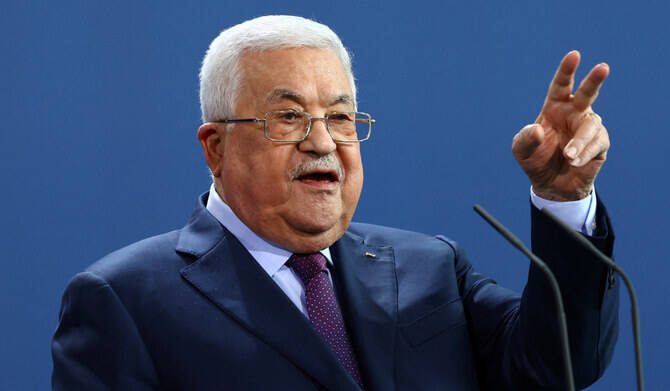
Palestinian president meets Israeli peace activists, speaks to Israeli media

Palestinian president Mahmud Abbas met with Israeli activists in Ramallah on Thursday to discuss long-term peace after Israel and Hamas agreed a Gaza ceasefire and hostage release deal. (Reuters/File)
Short Url
Updated 10 October 2025
Follow

Palestinian president meets Israeli peace activists, speaks to Israeli media

  • “I welcome the agreement signed today, the end of the war, and the release of the hostages,” Abbas told dozens of representatives from Israeli peace organizations
  • “Nevertheless, we will remain in our homeland and establish a Palestinian state in Gaza, the West Bank, and east Jerusalem”

RAMALLAH, Palestinian Territories: Palestinian president Mahmud Abbas met with Israeli activists in Ramallah on Thursday to discuss long-term peace after Israel and Hamas agreed a Gaza ceasefire and hostage release deal.
“I welcome the agreement signed today, the end of the war, and the release of the hostages,” Abbas told dozens of representatives from Israeli peace organizations assembled at the presidential palace in Ramallah in the occupied West Bank.
“A few months ago, (US President Donald) Trump had a plan to expel the Palestinians, but later he forgot about it,” he added.
“Nevertheless, we will remain in our homeland and establish a Palestinian state in Gaza, the West Bank, and east Jerusalem,” he said.
Speaking from a podium in the presence of Arab-Israeli Knesset member Ayman Odeh and the Palestinian Authority’s vice president Hussein Al-Sheikh, a jovial Abbas spoke to a friendly audience, sometimes exchanging smiles and jokes with activists.
Two power cuts momentarily left all attendees in the dark, an AFP journalist reported.
Among them was Iddo Ilam, an activist and refusnik who explained why he chose not to serve in the Israeli army, as Abbas gestured to him with two thumbs up.
“We are asking for a different future, peace between Jews and Palestinians,” said Rula Daoud, co-director of Standing Together, an Israeli grassroots movement aiming to bring together Palestinians and Jewish Israeli communities.
Absent from the conversation were the details of the ceasefire agreement struck early Thursday between Israel and Hamas — an adversary of Abbas’s Fatah party.

Abbas, in a rare interview with Israel’s Channel 12 network Thursday, expressed hope that peace would prevail between Palestinians and Israelis following the signing of a Gaza ceasefire agreement.
“What happened today is a historic moment. We have been hoping — and continue to hope — that we can bring an end to the bloodshed taking place in our land, whether in the Gaza Strip, the West Bank, or East Jerusalem,” Abbas said.
“Today, we are very happy that the bloodshed has ceased. We hope it remains this way, and that peace, security, and stability will prevail between us and Israel.”
The deal is expected to free the remaining living hostages still held in Gaza within days, in a major step toward ending the two-year war that has killed tens of thousands and unleashed a dire humanitarian crisis.
The deal would also see Israel release nearly 2,000 Palestinian prisoners and allow a surge of aid into Gaza.
Israeli Prime Minister Benjamin Netanyahu has all but rejected the option of the Ramallah-based Palestinian Authority (PA) ruling over post-war Gaza.
Nonetheless, its vice president Hussein Al-Sheikh said on X on Thursday that the PA had conducted all preparations to govern the post-war Gaza Strip and oversee its reconstruction.


Family of Palestinian-American shot dead by Israeli settler demand accountability

Updated 21 February 2026
Follow

Family of Palestinian-American shot dead by Israeli settler demand accountability

  • Relatives say Abu Siyam was among about 30 residents from the village of Mukhmas who confronted armed settlers attempting to steal goats from the community

LONDON: The family of a 19-year-old Palestinian-American man reportedly shot dead by an Israeli settler in the occupied West Bank have demanded accountability, amid mounting scrutiny over a surge in settler violence and a lack of prosecutions.

Nasrallah Abu Siyam, a US citizen born in Philadelphia, was killed near the city of Ramallah on Wednesday, becoming at least the sixth American citizen to die in incidents involving Israeli settlers or soldiers in the territory in the past two years.

Relatives say Abu Siyam was among about 30 residents from the village of Mukhmas who confronted armed settlers attempting to steal goats from the community. Witnesses said that stones were thrown by both sides before settlers opened fire, wounding at least three villagers.

Abu Siyam was struck and later died of his injuries.

Abdulhamid Siyam, the victim’s cousin, said the killing reflected a wider pattern of impunity.

“A young man of 19 shot and killed in cold blood, and no responsibility,” he told the BBC. “Impunity completely.”

The US State Department said that it was aware of the death of a US citizen and was “carefully monitoring the situation,” while the Trump administration said that it stood ready to provide consular assistance.

The Israeli embassy in Washington said the incident was under review and that an operational inquiry “must be completed as soon as possible.”

A spokesperson for the Israeli Defense Forces said troops were deployed to the scene and used “riot dispersal means to restore order,” adding that no IDF gunfire was reported.

The military confirmed that the incident remained under review and said that a continued presence would be maintained in the area to prevent further unrest.

Palestinians and human rights organizations say such reviews rarely lead to criminal accountability, arguing that Israeli authorities routinely fail to prosecute settlers accused of violence.

A US embassy spokesperson later said that Washington “condemns this violence,” as international concern continues to grow over conditions in the occupied West Bank.

Palestinians and human rights groups say Israeli authorities routinely fail to investigate or prosecute settlers accused of violence against civilians.

Those concerns were echoed this week by the UN, which warned that Israel’s actions in the occupied West Bank may amount to ethnic cleansing.

A UN human rights office report on Thursday said that Israeli settlement expansion, settler attacks and military operations have increasingly displaced Palestinian communities, with dozens of villages reportedly emptied since the start of the Gaza war.

The report also criticized Israeli military tactics in the northern West Bank, saying that they resembled warfare and led to mass displacement, while noting abuses by Palestinian security forces, including the use of unnecessary lethal force and the intimidation of critics.

Neither Israel’s foreign ministry nor the Palestinian Authority has commented on the findings.