

Author overcomes disability to inspire others at Riyadh book fair

1 / 4
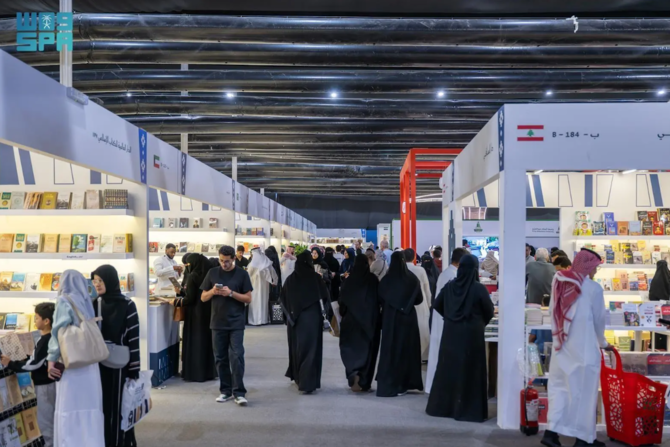
Riyadh International Book Fair runs until Saturday. (SPA)
2 / 4
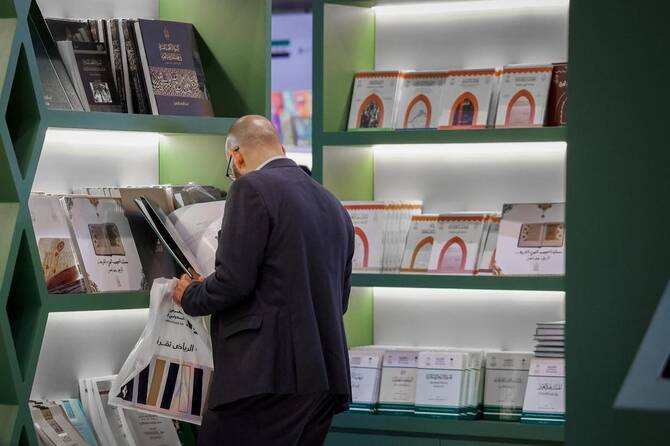
Riyadh International Book Fair runs until Saturday. (Supplied)
3 / 4
Riyadh International Book Fair runs until Saturday. (Supplied)
4 / 4
Riyadh International Book Fair runs until Saturday. (Supplied)
Short Url
Updated 08 October 2025
Follow

Author overcomes disability to inspire others at Riyadh book fair

  • Under Vision 2030, Saudi Arabia has emphasized culture as both a social and economic priority
  • This year’s Guest of Honor, Uzbekistan, adds depth to the international dialogue

RIYADH: A poignant moment at this year’s Riyadh International Book Fair was the book signing of Reema Al-Duraijan, author of “When Life Whispers.”

Living with Morquio syndrome, she has transformed her challenges into a source of inspiration.

Morquio syndrome means the body cannot break down certain sugar molecules, leading to their build-up and causing skeletal issues such as short stature and abnormal bone development, as well as heart and vision problems.

“I write to celebrate what comes after pain,” she said — a statement that reflects the fair’s purpose of highlighting human stories within the broader context of cultural reform.

The book fair, which runs until Saturday, extended its influence beyond literature through the Theater and Performing Arts Commission, which staged daily performances.

Exhibition spaces were transformed into stages for regional folktales and modern narratives.

Children’s productions such as “Sinbad and Yasmina’s Journey for the Lost Treasure” showcased how literature can be reimagined through performance.

Under Vision 2030, Saudi Arabia has emphasized culture as both a social and economic priority.

The atmosphere at this year’s book fair is vibrant, with journalists reporting live, educators exploring titles, and children engaged in storytelling sessions, exemplifying a dynamic learning environment.

This year’s Guest of Honor, Uzbekistan, adds depth to the international dialogue. Its pavilion showcases traditional patterns alongside modern displays and features musicians and artisans demonstrating their cultural heritage.

Uzbek cultural experts spoke on subjects such as gastronomy and tourism, illustrating how creative industries can bridge heritage and contemporary opportunities.

Despite its global reach, the fair remains rooted in Arabic and Islamic traditions. Exhibitions of calligraphy and Qur’an manuscripts showcased the artistic and spiritual dimensions of Arabic script.

Competitions in calligraphy connected historical techniques with modern design, emphasizing how heritage can adapt to contemporary contexts.

A notable speaking session at this year’s fair focused on the intersection of journalism and technology.

In the panel titled “Will You Believe the News Anymore? Artificial Intelligence and the Future of Journalism,” participants discussed how automation impacts information credibility.

The conversation between computer scientist Sarah Al-Homoud and AI expert Nuha Al-Hajji highlighted both opportunities, such as faster research and broader access, and challenges, such as misinformation and reduced editorial oversight.

Speakers called for ethical frameworks to maintain accuracy and trust in an era of rapid content production.


Trump designates Saudi Arabia as major non-NATO ally

Updated 19 November 2025
Follow

Trump designates Saudi Arabia as major non-NATO ally

  • Announcement came during black-tie White House dinner honoring crown prince
  • Mohamed bin Salman hails new phase in bilateral cooperation, economic ties

WASHINGTON: President Donald Trump on Tuesday announced that the US will formally designate Saudi Arabia a major non-NATO ally, marking a significant elevation in defense ties between the two countries.
He revealed the decision during a black-tie White House dinner honoring Crown Prince Mohammed bin Salman.
“Tonight, I’m pleased to announce that we’re taking our military cooperation to even greater heights by formally designating Saudi Arabia as a major non-NATO ally — something that’s very important to them,” Trump said.
“And I’m telling you now for the first time, because they wanted to keep a little secret for tonight.”
The new status paves the way for deeper military cooperation and carries strong symbolic weight, with Trump saying it will advance US-Saudi defense coordination “to even greater heights.”


The crown prince thanked Trump for a “warm and great welcome,” adding: “We feel home.” He referenced the historic foundations of the US-Saudi relationship, noting that the partnership dates back nearly nine decades to the meeting between President Franklin D. Roosevelt and King Abdulaziz, the founder of modern Saudi Arabia.

He also pointed to upcoming milestones for both nations, the US approaching its 250th anniversary and Saudi Arabia nearing its 300th, saying these celebrations underscore the long arc of shared cooperation.
Reviewing the history of the alliance, the crown prince highlighted joint efforts across the Second World War, the Cold War, and the long fight against extremism and terrorism.
Yet he stressed that today marks a new phase in bilateral cooperation, with economic ties expanding across unprecedented sectors.
“Today is a special day,” the crown prince said. “We think the horizon of economic cooperation between Saudi Arabia and America is bigger and wider in many areas.
“We’ve been signing a lot of agreements that can open the door to develop the relationship deeper in many areas, and we’re going to work on it.”
He added: “We believe the opportunities are huge, so we have to focus on implementation and keep increasing the opportunities between our two countries.”
Trump repeatedly expressed appreciation for the crown prince’s partnership and leadership, highlighting major agreements signed during the visit, including on civil nuclear energy, critical minerals and artificial intelligence, describing the scale of investment as unprecedented.
Trump emphasized that Saudi Arabia is undertaking a major expansion of its defense capabilities, referencing the Kingdom’s plans for nearly $142 billion in purchases of US military equipment and services, which he called “the largest arms purchase in history.”
He framed the acquisition as part of a broader strategy to enhance Middle East security and reinforce the Kingdom’s role as a stabilizing force.
In addition to the major non-NATO ally designation, Trump announced that the US and Saudi Arabia had signed a historic strategic defense agreement that would create “a stronger and more capable alliance” and support what he called the closest the Middle East has ever come to “truly everlasting peace.”
Trump thanked the crown prince “for all the help” in shaping what he described as a historic moment for regional peace and US-Saudi cooperation, and for playing a central role in recent diplomatic breakthroughs, including steps that contributed to ending the war in Gaza.
“Even the great experts … are calling it a miracle,” he said of recent regional shifts. Both leaders framed the moment as the beginning of a new chapter.