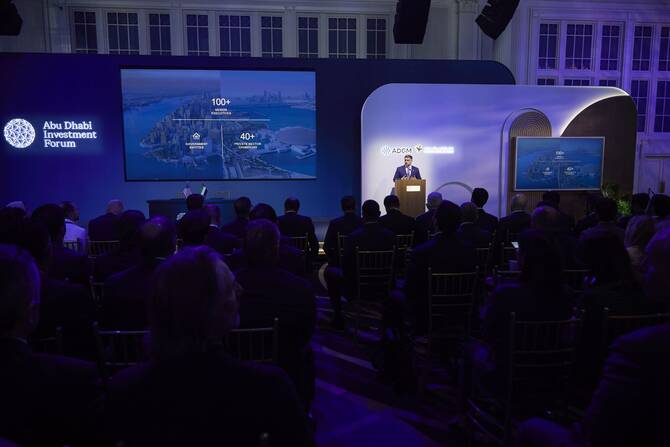

JEDDAH: The UAE strengthened its economic partnership with the US during a three-day visit to New York, where Abu Dhabi officials signed a series of agreements in technology, finance, energy, and manufacturing.
The high-level delegation, led by Ahmed Jasim Al-Zaabi, chairman of the Abu Dhabi Department of Economic Development, met with US government officials and business leaders to boost trade and investment cooperation, according to the Emirates News Agency, also known as WAM.
The visit witnessed the inking of agreements to enhance cooperation in sectors including startups, family businesses, and small and medium enterprises, as well as digital infrastructure, new energy, advanced manufacturing, and financial services.
The two countries share a strong and growing economic relationship, with bilateral trade reaching $34.4 billion in 2024 — an 8.5 percent increase year on year — making the UAE the largest US trading partner in the Middle East, with trade spanning all 50 US states and supporting over 184,000 jobs.
In a statement, Al-Zaabi said: “We are proud of our strong and evolving partnership with the US. This visit has enabled us to build more collaborative initiatives to harness new trends, mega shifts, and technological transformations witnessed by the global economy.”
He added: “Backed by five decades of fruitful cooperation, our trade and investment ties with the US continue on an upward trajectory,” noting that mutual investments are also increasing and expanding, supercharging growth across various sectors and industries, and creating thousands of jobs.
He emphasized that this growth reflects the depth and strength of their cooperation with the US and affirmed their commitment to further enhancing it, enabling businesses and investors to grow, thrive, and expand.
In recent years, Abu Dhabi’s non-oil trade with the US has grown by 28.4 percent, while US companies operating in Abu Dhabi have seen a 52.9 percent compound annual growth rate, reflecting deepening ties in key economic sectors.
According to a report released in May by the White House, US President Donald Trump announced over $200 billion in commercial deals between the two countries — bringing the total of investment agreements in the Gulf region to over $2 trillion.
This builds on the UAE’s commitment to a 10-year, $1.4 trillion investment framework that will contribute to the US boom in AI infrastructure, semiconductors, energy, quantum computing, biotechnology, and manufacturing, as per the US official release.
The New York event brought together 15 of Abu Dhabi’s largest listed companies from diverse sectors, with a combined market capitalization exceeding $300 billion, and featured more than 100 one-on-one meetings with leading US institutional investors managing assets of over $10 billion.
The delegation included senior officials from Abu Dhabi’s public and private sectors, among them Ghannam Al-Mazrouei, chairman of the Abu Dhabi Securities Exchange Group, Hamad Sayah Al-Mazrouei, undersecretary of ADDED, and Badr Al-Olama, director general of the Abu Dhabi Investment Office.