Pakistan sends first batch of rare earth elements to US under $500 million deal — report

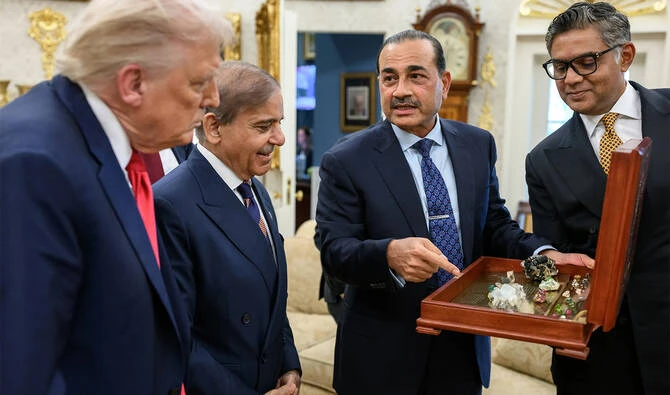
Pakistan's Army Chief Field Marshal Asim Munir (second from right) presents mineral samples to US President Donald Trump (left) at The White House in Washington DC, US, on September 26, 2025. (The White House)
Short Url
Updated 05 October 2025
Follow

Pakistan sends first batch of rare earth elements to US under $500 million deal — report

  • The US-Pakistan agreement, signed on Sept. 9, aimed to create a framework for joint development of the entire mineral value chain
  • We see this as the first step to bolster economic trade and friendship between our two countries, the US Strategic Metals firm says

ISLAMABAD: Pakistan has dispatched its first ever shipment of rare earth and critical minerals to the United States (US), a Chicago-based US public relations (PR) firm said this week, following a landmark $500 million deal between the two countries.

The development comes weeks after American firm US Strategic Metals (USSM) and Pakistan’s Frontier Works Organization (FWO) signed the agreement for collaboration across a range of critical minerals essential for the defense, aerospace and technology industries.

The agreement was signed between American firm US Strategic Metals (USSM) and Pakistan’s Frontier Works Organization (FWO) at the Prime Minister’s House in Islamabad, according to the US embassy in Islamabad.

It aimed to create a framework for joint development of the entire mineral value chain, including exploration, beneficiation, concentrate production and eventual establishment of refineries in Pakistan.

“In a historic milestone for bilateral cooperation, Pakistan has successfully delivered its first batch of enriched rare earth elements and critical minerals to US Strategic Metals (USSM) in the United States,” PR Newswire, an American public relations firm headquartered in Chicago, said this week.

“This achievement inaugurates a $500 million partnership framework, signed earlier this month, and signals the beginning of a new chapter in the Pakistan–US strategic partnership.”

In this first shipment, Pakistan has indigenously sourced and prepared antimony, copper concentrate, rare earth elements with neodymium and praseodymium, strategic and economic significance, according to the PR firm.

With this first delivery and a multi-phase investment framework underway, Pakistan is now positioned as a rising force in the global critical mineral economy.

“We see this as the first step in our exciting journey together with the Frontier Works Organization of Pakistan to provide critical minerals to the United States and bolster economic trade and friendship between our two countries,” USSM CEO Stacy W. Hastie was quoted as saying.


IMF Executive Board to review $1.2 billion loan disbursement for Pakistan today

Updated 4 sec ago
Follow

IMF Executive Board to review $1.2 billion loan disbursement for Pakistan today

  • Pakistan, IMF reached a Staff-Level Agreement in October for second review of $7 billion Extended Fund, climate fund program
  • Economists view IMF bailout packages as essential for cash-strapped Pakistan grappling with a prolonged macroeconomic crisis

ISLAMABAD: The Executive Board of the International Monetary Fund (IMF) is set to meet in Washington today to review a $1.2 billion loan disbursement for Pakistan, state media reported on Monday.

Pakistan and the IMF reached a Staff-Level Agreement (SLA) in October for the second review of a $7 billion Extended Fund Facility (EFF) and the first review of its $1.4 billion Resilience and Sustainability Facility (RSF). 

The agreement between the two sides took place after an IMF mission, led by the international lender’s representative Iva Petrova, held discussions with Pakistani authorities during a Sept. 24–Oct. 8 visit to Karachi, Islamabad and Washington D.C.

“The International Monetary Fund’s (IMF) Executive Board is set to meet in Washington today to review and approve $1.2 billion in loan for Pakistan,” state broadcaster Pakistan TV reported. 

Pakistan has been grappling with a prolonged macroeconomic crisis that has drained its financial resources and triggered a balance of payments crisis for the past couple of years. Islamabad, however, has reported some financial gains since 2022, which include recording a surplus in its current account and bringing inflation down considerably.

Economists view the IMF’s bailout packages as crucial for cash-strapped Pakistan, which has relied heavily on financing from bilateral partners such as Saudi Arabia, China and the United Arab Emirates, as well as multilateral lenders including the IMF, World Bank, Asian Development Bank and Islamic Development Bank. 

Speaking to Arab News last month, Pakistan’s former finance adviser Khaqan Najeeb said the $1.2 billion disbursement will further stabilize Pakistan’s near-term external position and unlock additional official inflows.

“Continued engagement also reinforces macro stability, as reflected in recent improvements in inflation, the current account, and reserve buffers,” Najeeb said.

Pakistan came close to sovereign default in mid-2023, when foreign exchange reserves fell below three weeks of import cover, inflation surged to a record 38% in May, and the country struggled to secure external financing after delays in its IMF program. Fuel shortages, import restrictions, and a rapidly depreciating rupee added to the pressure, while ratings agencies downgraded Pakistan’s debt and warned of heightened default risk.

The crisis eased only after Pakistan reached a last-minute Stand-By Arrangement with the IMF in June 2023, unlocking emergency support and preventing an immediate default.