Pakistan, Indonesia set to discuss defense, investments as President Prabowo arrives in Islamabad

This handout photograph taken and released by the Pakistan's President Office on December 8, 2025 shows Indonesia's President Prabowo Subianto (C) walking along with his Pakistani counterpart Asif Ali Zardari (L) and Prime Minister Shehbaz Sharif upon his arrival at the Nur Khan military airbase in Rawalpindi. (AFP/Pakistan's President Office)
Short Url
Updated 08 December 2025
Follow

Pakistan, Indonesia set to discuss defense, investments as President Prabowo arrives in Islamabad

  • Indonesian leader lands in Pakistan on first presidential visit since 2018
  • Delegation-level talks, MoUs, high-level meetings scheduled in Islamabad

ISLAMABAD: Indonesian President Prabowo Subianto arrived in Islamabad on Monday for a two-day visit aimed at exploring new avenues of cooperation in trade, defense, investment, health, education and other sectors, state news agency APP reported. 

This is Subianto’s maiden trip to Pakistan and the first visit by an Indonesian president since 2018. He touched down at Nur Khan Airbase alongside a high-level delegation of ministers and senior officials, coinciding with the 75th anniversary of diplomatic relations between Islamabad and Jakarta.

During his stay, Subianto will hold delegation-level talks with Prime Minister Shehbaz Sharif and will also meet President Asif Ali Zardari and Chief of Army Staff and Chief of Defense Forces Field Marshal Syed Asim Munir.

“Both countries will hold comprehensive discussions on promoting cooperation in various fields including trade, investment, defense, health, IT, climate, education and culture, as well as further strengthening partnership at regional and global levels,” APP reported.
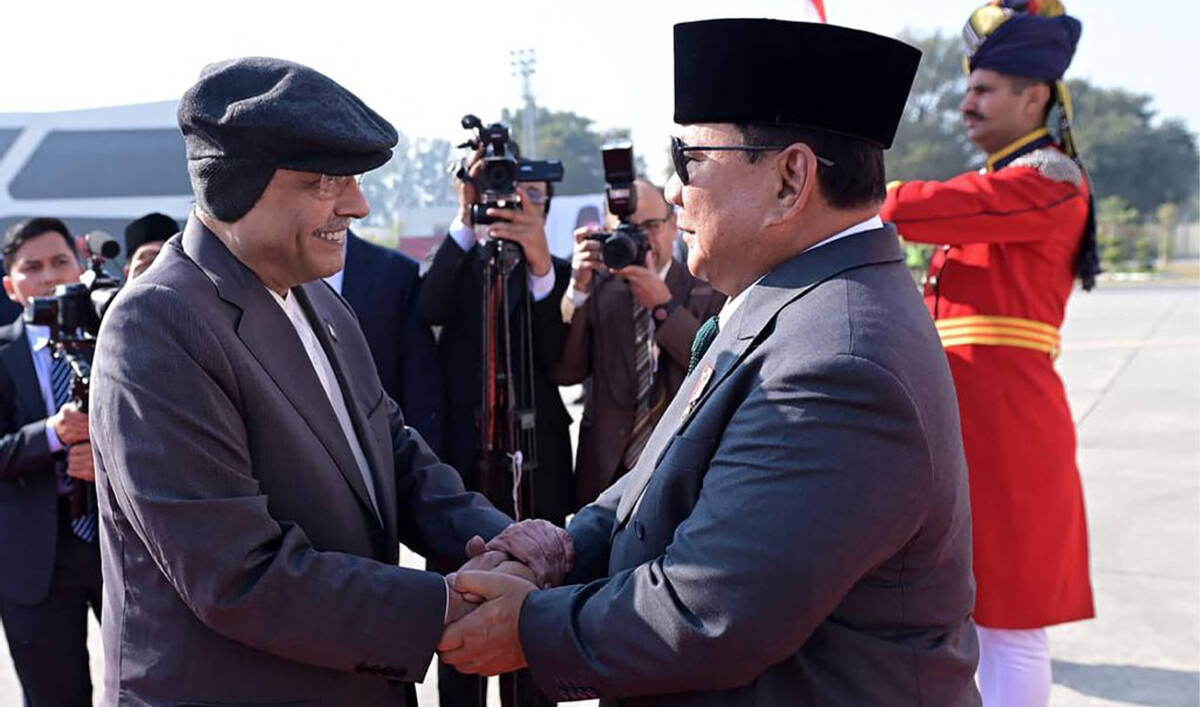


This handout photograph taken and released by the Pakistan's President Office on December 8, 2025 shows Indonesia's President Prabowo Subianto shaking hands with his Pakistani counterpart Asif Ali Zardari upon his arrival at the Nur Khan military airbase in Rawalpindi. (AFP / Pakistan's President Office)

“President Prabowo Subianto’s visit will provide an important opportunity to further strengthen bilateral relations and expand mutually beneficial cooperation, which will contribute to the continuous advancement of the partnership between the two countries.”

Several Memoranda of Understanding (MoUs) are also expected to be signed during the visit.
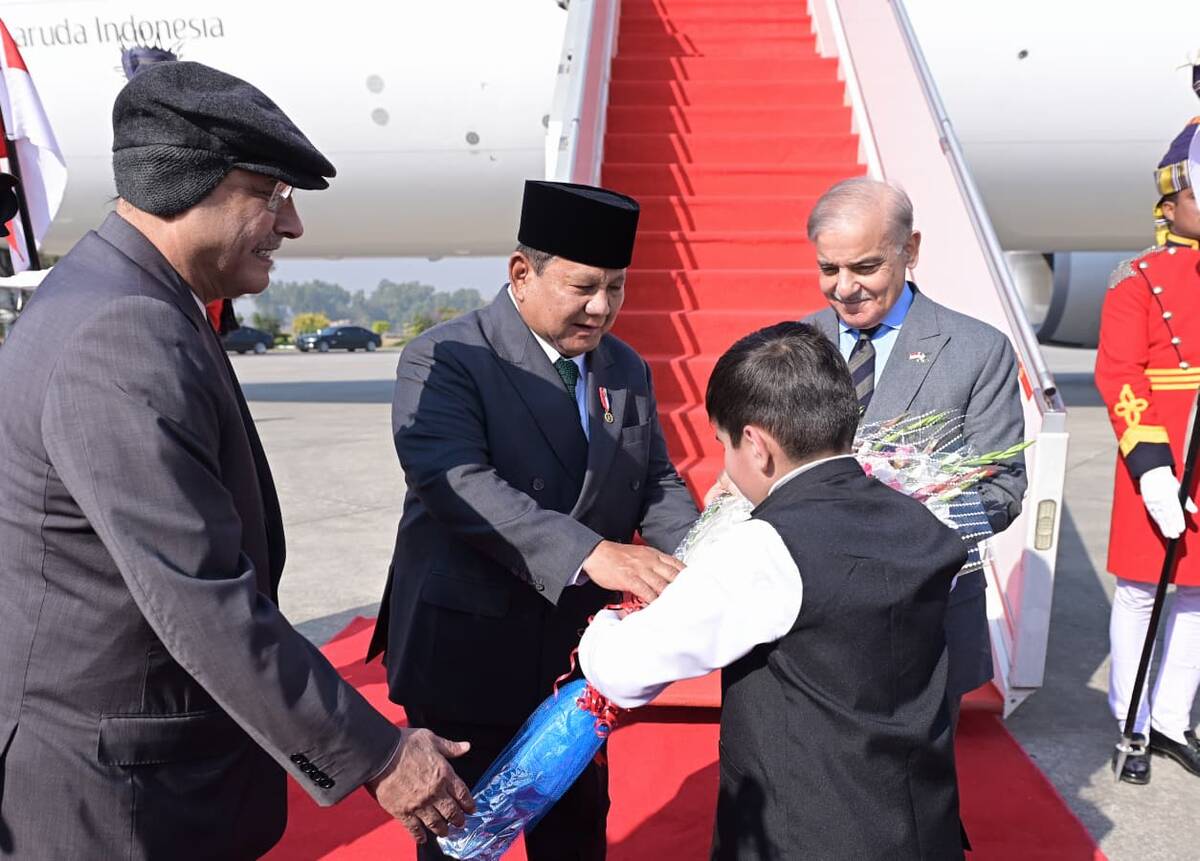


This handout photograph taken and released by the Pakistan's President Office on December 8, 2025, shows Indonesia's President Prabowo Subianto receiving flowers upon his arrival at the Nur Khan military airbase in Rawalpindi. (AFP / Pakistan's President Office)

Indonesia hosts a small Pakistani expatriate community, engaged mainly in restaurants, hand-knotted carpets, gemstones, textiles and herbal products. 

As of fiscal year 2024-25, trade between Pakistan and Indonesia surged to $4.7 billion, up from $3.36 billion the previous year, highlighting a sharp increase in economic exchange between the two nations. 

Under the existing Indonesia-Pakistan Preferential Trade Agreement, operational since 2013, Pakistan exports cotton fabrics, cereals and other commodities to Indonesia, while Indonesia supplies Pakistan with palm oil, coal and other imports. 

With both governments now negotiating the upgrade of the agreement to a full free trade accord, Islamabad and Jakarta aim to further deepen trade, investment, and economic cooperation across multiple sectors.
Pakistan, China hold joint counterterrorism drills as military cooperation deepens

Updated 6 sec ago
Follow

Pakistan, China hold joint counterterrorism drills as military cooperation deepens

  • Warrior-IX exercise aims to boost counterterror coordination between the two nations’ armies
  • Drills come as both countries cite shared security concerns along regional militant routes

ISLAMABAD: Pakistan and China are conducting a two-week joint counterterrorism exercise, the Pakistan Army said on Thursday, marking another expansion in military cooperation between the two strategic partners.

The drills, known as Warrior-IX, run from Nov. 28 to Dec. 14 at Pakistan’s National Counter Terrorism Center (NCTC) in Pabbi, a major training hub for operations against militant networks that have carried out attacks across the country. Such exercises have become a recurring feature of Pakistan-China security ties, which span counterterrorism coordination, intelligence sharing, and defense technology partnerships.

Senior delegations attended the Distinguished Visitors Day on Thursday, including China’s ambassador to Pakistan, Jiang Zaidong, and Pakistan’s Chief of General Staff Field Marshal Syed Asim Munir. Officials observed field drills and received briefings on the objectives and scope of the exercise.

“The exercise reflects strong defense collaboration between Pakistan and China and reaffirms the commitment of both Armed Forces to working together for peace and stability,” the Pakistan military said.

According to the army, dignitaries viewed a range of counterterrorism demonstrations and praised the participating troops for their professionalism and operational readiness. China’s People’s Liberation Army (PLA) and Pakistan Army units regularly train together as both countries cite shared security threats, including attacks targeting Chinese nationals and projects inside Pakistan.

Pakistan and China have maintained one of Asia’s closest defense partnerships since the 1960s, rooted in shared strategic interests and long-term military cooperation. China is Pakistan’s largest supplier of military hardware, providing fighter aircraft, naval vessels, air-defense systems and armored platforms, including co-production of the JF-17 fighter jet under a major joint program launched in 1999. The two militaries routinely collaborate on training, intelligence exchange and counterterrorism coordination, and conduct regular joint exercises across all three services: army, navy, and air force.

Security cooperation has deepened further under the China–Pakistan Economic Corridor (CPEC), where Beijing has sought enhanced protection for Chinese workers and infrastructure targeted by insurgent groups. In recent years, the two sides have carried out joint counterterrorism drills, maritime security exercises in the Arabian Sea, and high-level defense consultations aimed at improving interoperability and responding to shared threats, including militant violence and regional instability. Both governments publicly describe their military ties as a “strategic partnership” and “ironclad friendship.”