

Pakistan denies reports of US proposal for Arabian Sea port at Pasni — state media

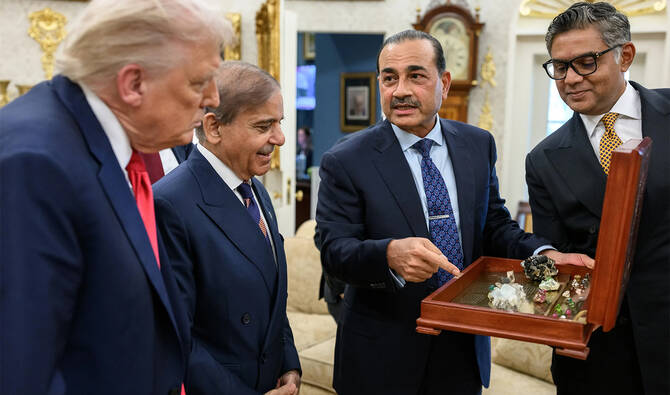
Pakistan's Army Chief Field Marshal Asim Munir (second from right) presents mineral samples to US President Donald Trump (left) at The White House in Washington DC, US, on September 26, 2025. (The White House)
Short Url
Updated 05 October 2025
Follow

Pakistan denies reports of US proposal for Arabian Sea port at Pasni — state media

  • Financial Times report claimed Field Marshal Munir’s advisers approached US with proposal to build Arabian sea port
  • “Conversations with private companies were exploratory, not official initiatives,” security official tells state media

ISLAMABAD: Pakistan has not offered the United States access to a proposed port at Pasni, a senior security official told state-run Pakistan TV on Sunday, saying there had been no official communication with Washington and any discussions on the idea were “purely exploratory.”

The clarification follows a Financial Times report this week that advisers to Pakistan’s army chief, Field Marshal Asim Munir, had approached US officials with a proposal to build and operate a port on the Arabian Sea. The plan reportedly envisions American investors developing and managing a port in the southwestern town of Pasni, located in Balochistan’s Gwadar district, to facilitate access to Pakistan’s critical minerals.

A senior security official told Pakistan TV the report did not represent official government or military policy.

“Conversations with private companies were exploratory, not official initiatives,” the state-run digital outlet quoted him as saying on condition of anonymity.

“There is no plan to hand over Pasni’s security to any foreign power. The Chief of Army Staff does not have advisers in any official capacity. Linking these ideas directly to him is misleading and inaccurate,” he added, saying the army chief should not be directly linked with any such proposals.

Pasni, a small fishing town of about 70,000 people, has long been viewed as a potential site for port development because of its naturally deep waters.

“Pasni’s location may make it significant in global geopolitics … but at this stage, it is only an idea, not an initiative,” the official added. 

The US State Department, White House and Pakistan’s army and foreign ministry have not commented on the FT report.

While the Pakistan TV report said the Pasni port proposal may have been floated by private parties but was never routed through official channels or reviewed at a strategic level, the Financial Times said the proposal was discussed with some US officials and shared with Munir ahead of his meeting with President Donald Trump at the White House late last month.

The report highlighted that the plan does not include any provision for US military bases but sought development financing to build a rail network connecting the port to Pakistan’s mineral-rich western provinces.

China already has a major presence in Gwadar and the Pasni port proposal would offer the US a potential foothold in the region. 

The development could add a new layer to the strategic competition between Washington and Beijing in the Indian Ocean. It may also test Islamabad’s ability to balance its ties with both powers while pursuing much-needed foreign investment. 


Pakistan increases Reko Diq investment to $244 million as Barrick reviews project

Updated 5 sec ago
Follow

Pakistan increases Reko Diq investment to $244 million as Barrick reviews project

  • State-owned PPL injects $50.2 million more in special purpose vehicle formed to manage Islamabad’s 25 percent stake in copper-gold mine
  • Canadian operator Barrick Mining Corporation this month ordered project’s review following deadly separatist attacks in Balochistan province

KARACHI: The state-run Pakistan Petroleum Limited (PPL) has invested an additional Rs14 billion ($50.2 million) equity in the multi-billion-dollar Reko Diq copper-gold mine, the company said in its latest financial report on Thursday, as the project’s Canadian operator reviews the project following recently deadly attacks. 

Canada’s Barrick Mining Corporation owns a 50 percent share in Reko Diq in the southwestern Balochistan province, along with three Pakistani federal state-owned enterprises including PPL that own 25 percent, while the Balochistan government has the remaining 25 percent share in the project.

The Canadian company announced earlier this month it planned to “immediately” begin a comprehensive review of all aspects of the Reko Diq project following coordinated attacks in Balochistan on Jan. 30-31 that killed 36 civilians and 22 security forces personnel. 

“With respect to the Reko Diq project, the company has made further equity investment in Pakistan Minerals Private Limited (PMPL) during the period amounting to Rs14,025 million ($50.2m),” PPL told its shareholders in its financial statement for the half year ending at Dec. 31.

The additional equity has increased PPL’s total cost of investment in the PMPL to Rs68.1 billion ($243.6 million), it added. 

The PMPL is a special purpose vehicle formed to manage the federal government’s 25 percent stake in the Reko Diq project. It is a consortium of three state-owned enterprises (SOEs) namely the PPL, the Oil & Gas Development Company Limited (OGDCL) and Government Holdings (Private) Limited (GHPL) which is responsible for handling financing, equity contributions and strategic, legal or technical dealings with partners like Barrick.

“The project continued to advance site works during the period (July-December FY26),” the PPL said. “The operator (Barrick) is undertaking a review of all aspects of the project, including with respect to the project’s security arrangements, development timetable and capital budget.” 

This week, Balochistan Chief Minister Sarfraz Bugti assured investors that Pakistan has the “capacity and capability” to secure the Reko Diq project amid surging militancy. 

The PPL explores, drills, and produces oil and natural gas. Its current portfolio, together with its subsidiaries and associates, consists of 47 exploratory blocks that include one offshore Block-5 in Abu Dhabi and one onshore block in Yemen.

In December, PPL signed a strategic Deed of Assignment under which it assigned 25 percent of its participating interest (PI) and operatorship of Eastern Offshore Indus C block to Turkish Petroleum Overseas Company, a unit of state-owned Türkiye Petrolleri Anonim Ortaklığı.

Assigning 20 percent PI each to OGDCL and Mari Energies Limited, the company has retained the remaining 35 percent PI to play a key role in the block’s development.