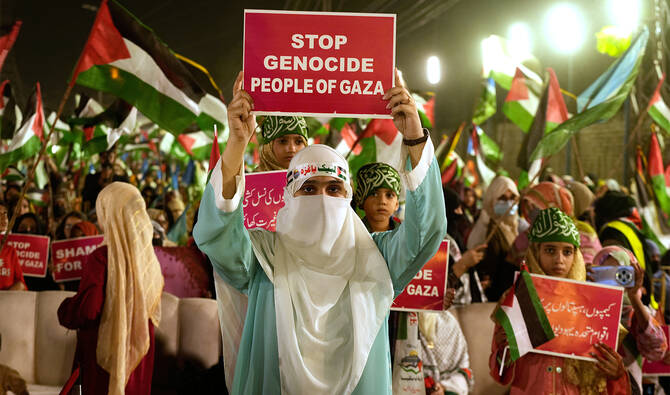

LAHORE: Thousands of pro-Palestinian demonstrators rallied in Pakistan’s eastern city of Lahore on Saturday to protest Israel’s interception of the Global Sumud Flotilla and to condemn what they called threats to Palestinian land and rights.
The Global Sumud Flotilla was seeking to breach an Israeli naval blockade of Gaza, which has been decimated by a two-year Israeli assault. It consisted of more than 40 civilian boats carrying about 500 parliamentarians, lawyers and activists, including Swedish climate campaigner Greta Thunberg.
The flotilla failed to reach Gaza as the boats were intercepted and escorted to Israel this week. But over the course of ten days it emerged as the highest-profile opposition to Israel’s blockade. Buoyed by that publicity, another flotilla of 11 boats has already set sail.
Wednesday’s seizure triggered protests in cities across Europe and as far afield as Argentina, Mexico and Pakistan, and drew criticism from politicians and leaders from Colombia to Malaysia.
“The Global Sumud Flotilla is currently under Israeli custody. Our demand is to release these people that were unarmed and going to help the people,” said Liaquat Bloch, leader of Jamaat-e-Islami Pakistan religio-political party, speaking at the Lahore protest.
“They wanted to break the siege of this famine-stricken region and deliver aid to the people. Now it is the responsibility of the international community to ensure the return of all them.”

Supporters of the Pakistani religious group "Jamaat-e-Islami" participate in a march to show solidarity with Palestinian people living in Gaza, in Lahore, Pakistan, on October 4, 2025. (AP)
Israel first imposed a blockade on Gaza in 2007 when Hamas took over the territory, but efforts by activists to raise awareness have gained traction since the outbreak of the latest war in October 2023.
Israeli authorities say they intercepted the flotilla at sea and detained hundreds of participants. Media reports and official statements indicate dozens of vessels and some 500 activists were involved in the attempt, and that a large number of detainees have since been processed or deported.
Humanitarian groups have used footage and testimony from the flotilla to draw attention to the conditions inside Gaza, while rights bodies have criticized the interception and urged all parties to ensure detainees’ rights are respected.
The flotilla episode has added fresh momentum to global protests against the blockade and intensified scrutiny of international responses to the humanitarian crisis in Gaza.
At the Lahore demonstration, other protesters echoed a hard-line stance toward US President Donald Trump’s Gaza peace plan, which is widely viewed by Palestinians and their supporters as an attempt to legitimize Israeli control and sideline Palestinian claims to statehood.
Announced on Sept. 29, the plan lays out a 20-point framework calling for an immediate ceasefire, the release of all hostages and prisoners within 72 hours, Hamas’s disarmament and a staged withdrawal of Israeli forces from Gaza. It also proposes the creation of an interim international peacekeeping force led by Muslim nations, Gaza’s reconstruction with foreign funding, and the re-establishment of local governance structures under Palestinian oversight.
“Our message to [US President] Donald Trump, representing people of the world, is that we will not allow the land of Palestine and Palestinians’ sacrifices to be exchanged in any deal,” said Mugees Qureshi, a protester.
“We will not give Israel even an inch of the land.”