

Thousands rally in Lahore to protest Israel’s seizure of Gaza aid flotilla

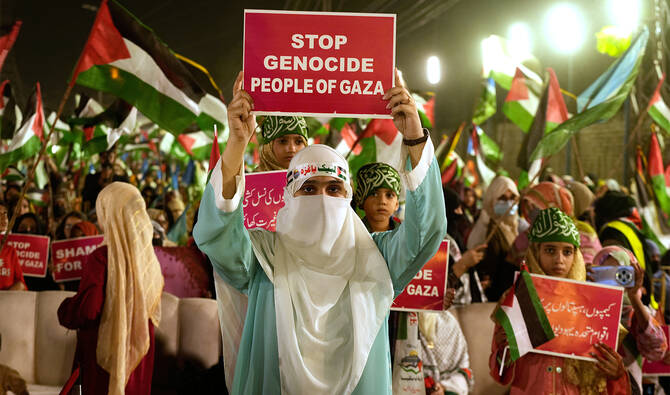
Supporters of the Pakistani religious group "Jamaat-e-Islami" participate in a march to show solidarity with Palestinian people living in Gaza, in Lahore, Pakistan, on October 4, 2025. (AP)
Short Url
Updated 05 October 2025
Follow

Thousands rally in Lahore to protest Israel’s seizure of Gaza aid flotilla

  • Protesters demand release of detained Global Sumud Flotilla activists by Israel
  • Demonstrators denounce Trump’s Gaza plan, vow no compromise on Palestinian land

LAHORE: Thousands of pro-Palestinian demonstrators rallied in Pakistan’s eastern city of Lahore on Saturday to protest Israel’s interception of the Global Sumud Flotilla and to condemn what they called threats to Palestinian land and rights.

The Global Sumud Flotilla was seeking to breach an Israeli naval blockade of Gaza, which has been decimated by a two-year Israeli assault. It consisted of more than 40 civilian boats carrying about 500 parliamentarians, lawyers and activists, including Swedish climate campaigner Greta Thunberg.

The flotilla failed to reach Gaza as the boats were intercepted and escorted to Israel this week. But over the course of ten days it emerged as the highest-profile opposition to Israel’s blockade. Buoyed by that publicity, another flotilla of 11 boats has already set sail.

Wednesday’s seizure triggered protests in cities across Europe and as far afield as Argentina, Mexico and Pakistan, and drew criticism from politicians and leaders from Colombia to Malaysia.

“The Global Sumud Flotilla is currently under Israeli custody. Our demand is to release these people that were unarmed and going to help the people,” said Liaquat Bloch, leader of Jamaat-e-Islami Pakistan religio-political party, speaking at the Lahore protest.

“They wanted to break the siege of this famine-stricken region and deliver aid to the people. Now it is the responsibility of the international community to ensure the return of all them.” 


Supporters of the Pakistani religious group "Jamaat-e-Islami" participate in a march to show solidarity with Palestinian people living in Gaza, in Lahore, Pakistan, on October 4, 2025. (AP)

Israel first imposed a blockade on Gaza in 2007 when Hamas took over the territory, but efforts by activists to raise awareness have gained traction since the outbreak of the latest war in October 2023.

Israeli authorities say they intercepted the flotilla at sea and detained hundreds of participants. Media reports and official statements indicate dozens of vessels and some 500 activists were involved in the attempt, and that a large number of detainees have since been processed or deported.

Humanitarian groups have used footage and testimony from the flotilla to draw attention to the conditions inside Gaza, while rights bodies have criticized the interception and urged all parties to ensure detainees’ rights are respected. 

The flotilla episode has added fresh momentum to global protests against the blockade and intensified scrutiny of international responses to the humanitarian crisis in Gaza. 

At the Lahore demonstration, other protesters echoed a hard-line stance toward US President Donald Trump’s Gaza peace plan, which is widely viewed by Palestinians and their supporters as an attempt to legitimize Israeli control and sideline Palestinian claims to statehood.

Announced on Sept. 29, the plan lays out a 20-point framework calling for an immediate ceasefire, the release of all hostages and prisoners within 72 hours, Hamas’s disarmament and a staged withdrawal of Israeli forces from Gaza. It also proposes the creation of an interim international peacekeeping force led by Muslim nations, Gaza’s reconstruction with foreign funding, and the re-establishment of local governance structures under Palestinian oversight.

“Our message to [US President] Donald Trump, representing people of the world, is that we will not allow the land of Palestine and Palestinians’ sacrifices to be exchanged in any deal,” said Mugees Qureshi, a protester. 

“We will not give Israel even an inch of the land.” 


Pakistan’s finance chief says country shifting from aid to trade, investment with Gulf nations

Updated 5 sec ago
Follow

Pakistan’s finance chief says country shifting from aid to trade, investment with Gulf nations

  • Aurangzeb says remittances from the GCC topped $38 billion last fiscal year, projected at $42 billion this time
  • He tells an international media outlet discussions on a free trade agreement with the GCC are at an advanced stage

ISLAMABAD: Pakistan is no longer seeking aid-based support and is instead pivoting toward trade- and investment-led partnerships, Finance Minister Muhammad Aurangzeb said in an interview with an international media outlet circulated by the finance division on Monday, acknowledging longstanding economic backing from Gulf countries.

Aurangzeb spoke to CNN Business Arabia at a time when Pakistan seeks to consolidate macroeconomic stability after a prolonged crisis marked by soaring inflation, currency pressure and external financing gaps.

Aurangzeb said the government’s economic direction, articulated by Prime Minister Shehbaz Sharif, aims to replace reliance on external assistance with sustainable growth driven by investment and exports, particularly from partners in the Gulf Cooperation Council (GCC), which includes Saudi Arabia, the United Arab Emirates, Qatar, Kuwait, Oman and Bahrain.

“We are not looking for aid flows anymore,” he said. “For us, we are very clear ... that going forward is really trade and investment, which is going to bring sustainability and be win-win for our longstanding bilateral partners in GCC and for Pakistan.”

“This FDI [foreign direct investment] is going to help us in terms of GDP growth [and] more employment opportunities as we go forward,” he continued. “So, you know, all hands are on deck at this point in time to make this materialize.”

Aurangzeb said Pakistan’s shift was underpinned by improving macroeconomic indicators following an 18-month stabilization program.

He noted that inflation, which peaked at 38 percent in 2023, has fallen to single-digit levels, while the country has posted primary fiscal surpluses and kept the current account deficit within targeted limits, adding that foreign exchange reserves now cover about 2.5 months of imports.

The finance chief described recent international assessments as external validation of the government’s reform path.

“All three international credit rating agencies are now aligned in terms of their upgrades and outlook for Pakistan this year,” he said, adding that the successful completion of the second review under the International Monetary Fund’s loan program, approved by the lending agency’s executive board, reinforced confidence in Pakistan’s economic management.

The finance minister said reforms across taxation, energy, state-owned enterprises, public finance and privatization were central to consolidating stability and supporting growth.

He pointed out Pakistan’s tax-to-GDP ratio had risen to about 10.3 percent from 8.8 percent at the start of the reform program and is on track to reach 11 percent, driven by efforts to widen the tax base to include under-taxed sectors such as real estate, agriculture and wholesale and retail trade, while tightening compliance through technology-based monitoring.

Aurangzeb also highlighted the role of the GCC in supporting Pakistan’s external position, particularly through remittances.

He said inflows reached about $38 billion last fiscal year and are projected to rise to nearly $42 billion this time, with more than half originating from GCC states, reflecting the contribution of Pakistani nationals working in the region.

The finance chief said Pakistan was actively engaging Gulf partners to attract investment in sectors including energy, oil and gas, mining, artificial intelligence, digital infrastructure, pharmaceuticals and agriculture, while discussions on a free trade agreement with the GCC were at an advanced stage.