PORTLAND, Oregon: A federal judge in Oregon temporarily blocked President Donald Trump’s administration from deploying the National Guard in Portland, ruling in a lawsuit brought by the state and city.
US District Judge Karin Immergut issued the order pending further arguments in the suit. The plaintiffs say a deployment would violate the US Constitution as well as a federal law that generally prohibits the military from being used to enforce domestic laws.
Immergut wrote that the case involves the intersection of three fundamental democratic principles: “the relationship between the federal government and the states, between the military and domestic law enforcement, and the balance of powers between the executive, legislative and judicial branches of government.
“Whether we choose to follow what the Constitution mandates with respect to these three relationships goes to the heart of what it means to live under the rule of law in the United States,” she wrote.
Generally speaking the president is allowed “a great level of deference” to federalize National Guard troops in situations where regular law enforcement forces are not able to execute the laws of the United States, the judge said, but that has not been the case in Portland.
Plaintiffs were able to show that the demonstrations at the Portland immigration facility were not significantly violent or disruptive in the days or weeks leading up to the president’s order, the judge wrote, and “overall, the protests were small and uneventful.”
“The President’s determination was simply untethered to the facts.”
The Defense Department had said it was placing 200 members of Oregon’s National Guard under federal control for 60 days to protect federal property at locations where protests are occurring or likely to occur after Trump called the city “war-ravaged.”
Oregon officials said that description was ludicrous. The US Immigration and Customs Enforcement building in the city has recently been the site of nightly protests, which typically drew a couple dozen people in recent weeks before the deployment was announced.
Trump The Republican president has deployed or threatened to deploy troops in several US cities, particularly ones led by Democrats, including Los Angeles, Washington, Chicago and Memphis. Speaking Tuesday to US military leaders in Virginia, the president proposed using cities as training grounds for the armed forces.
Last month a federal judge ruled that Trump’s deployment of some 4,700 National Guard soldiers and Marines in Los Angeles earlier this year was illegal, but he allowed the 300 who remain in the city to stay as long as they do not enforce civilian laws.
As for Portland, the Defense Department announced that it was placing 200 members of Oregon’s National Guard under federal control for 60 days to protect federal property at locations where protests are occurring or likely to occur.
That announcement came after Trump called “war-ravaged” in late September, a characterization that Oregon officials called ludicrous while saying they do not need or want federal troops there.
The US Immigration and Customs Enforcement building in Portland has been the site of nightly protests, and the demonstrations and occasional clashes with law enforcement have been limited to a one-block area in a city that covers about 145 square miles (375 square km) and has about 636,000 residents.
A handful of immigration and legal advocates often gather at the building during the day. At night, recent protests have typically drawn a couple dozen people.
A larger crowd demonstrated Sept. 28 following the announcement of the guard deployment. The Portland Police Bureau, which has said it does not participate in immigration enforcement and only intervenes in the protests if there is vandalism or criminal activity, arrested two people on assault charges.
A peaceful march earlier that day drew thousands to downtown and saw no arrests, police said.
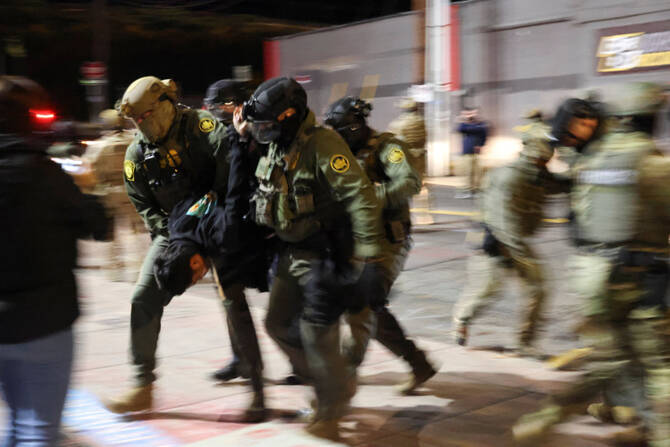
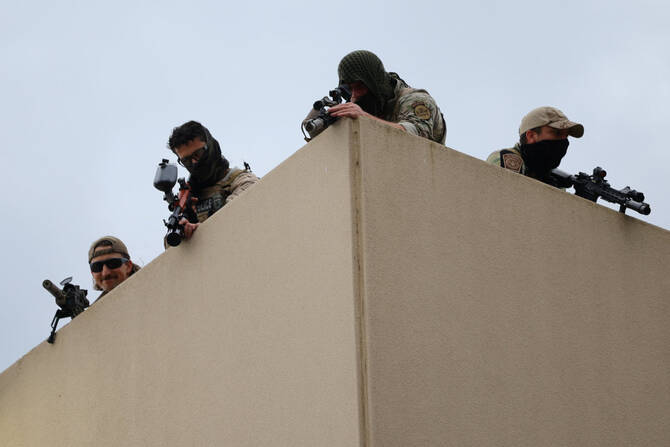
Trump sent federal officers to Portland over the objections of local and state leaders in 2020 during long-running racial justice protests following George Floyd’s killing by Minneapolis police. The administration sent hundreds of agents for the stated purpose of protecting the federal courthouse and other federal property from vandalism.
That deployment antagonized demonstrators and prompted nightly clashes. Federal officers fired rubber bulled and used tear gas.
Viral videos captured federal officers arresting people and hustling them into unmarked vehicles. A report by the Department of Homeland Security’s inspector general found that while the federal government had legal authority to deploy the officers, many of them lacked the training and equipment necessary for the mission.
The government agreed this year to settle an excessive force lawsuit brought by the American Civil Liberties Union by paying compensating several plaintiffs for their injuries.


![]()
![]()

US judge temporarily blocks Trump administration from deploying troops in Portland, Oregon
Short Url
https://arab.news/mr2ug
US judge temporarily blocks Trump administration from deploying troops in Portland, Oregon
- US District Judge Karin Immergut issued the order pending further arguments in a lawsuit brought by the state and city
- Trump has deployed or threatened to deploy troops in several US cities, particularly ones led by Democrats, including Los Angeles, Washington, Chicago and Memphis


Latest updates


© 2026 SAUDI RESEARCH & PUBLISHING COMPANY, All Rights Reserved And subject to Terms of Use Agreement.