



WASHINGTON: Some National Guard units patrolling the nation’s capital at the direction of President Donald Trump have started carrying firearms, an escalation of his military deployment that makes good on a directive issued late last week by his defense secretary.
A Defense Department official who was not authorized to speak publicly said some units on certain missions would be armed — some with handguns and others with rifles. The spokesperson said that all units with firearms have been trained and are operating under strict rules for use of force.
An Associated Press photographer on Sunday saw members of the South Carolina National Guard outside Union Station with holstered handguns.
A statement from the joint task force that has taken over policing in the nation’s capital said units began carrying their service weapons on Sunday and that the military’s rules say force should be used “only as a last resort and solely in response to an imminent threat of death or serious bodily harm.” It said the force is committed to protecting “the safety and wellbeing” of Washington’s residents.
The development in Trump’s extraordinary effort to override the law enforcement authority of state and local governments comes as he is considering expanding the deployments to other Democratic-led cities, including Baltimore, Chicago and New York.
Earlier Sunday, the president threatened to expand his military deployments to more Democratic-led cities, responding to an offer by Maryland’s governor to join him in a tour of Baltimore by saying he might instead “send in the ‘troops.’” He earlier said he was considering deploying troops to Chicago and New York.
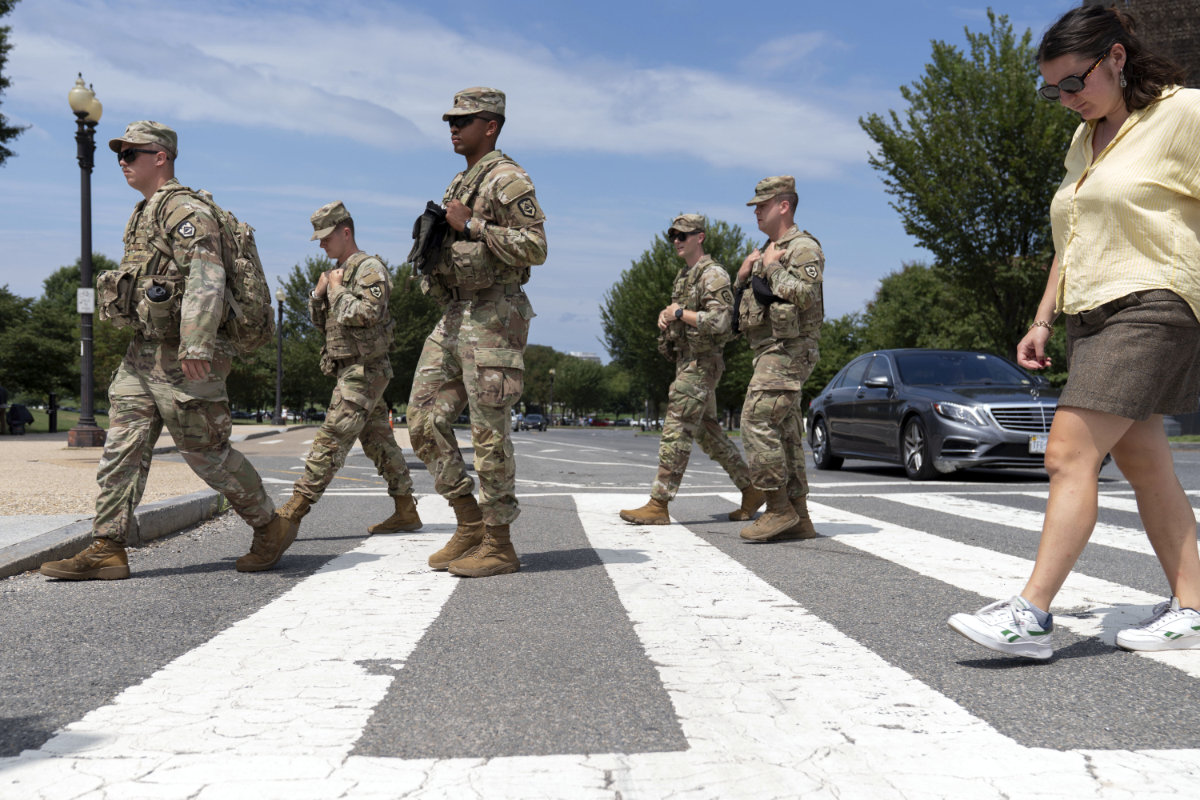
Members of the West Virginia National Guard patrol the National Mall on Aug. 24, 2025, in Washington. (AP)
Thousands of National Guard and federal law enforcement officers are now patrolling the district’s streets, drawing sporadic protests from local residents.
Trump made the threat to Baltimore in a spat with Maryland Gov. Wes Moore, a Democrat who has criticized Trump’s unprecedented flex of federal power aimed at combatting crime and homelessness in Washington. Moore last week invited Trump to visit his state to discuss public safety and walk the streets.
In a Truth Social post on Sunday, Trump said Moore asked “in a rather nasty and provocative tone,” and then raised the specter of repeating the National Guard deployment he made in Los Angeles over the objections of California’s Democratic governor, Gavin Newsom.
“Wes Moore’s record on Crime is a very bad one, unless he fudges his figures on crime like many of the other ‘Blue States’ are doing,” Trump wrote, as he cited a pejorative nickname he uses frequently for the California governor. “But if Wes Moore needs help, like Gavin Newscum did in L.A., I will send in the ‘troops,’ which is being done in nearby DC, and quickly clean up the Crime.”
Moore said he invited Trump to Maryland “because he seems to enjoy living in this blissful ignorance” about improving crime rates in Baltimore. After a spike during the pandemic that matched nationwide trends, Baltimore’s violent crime rate has fallen. The 200 homicides reported last year were down 24 percent from the prior year and 42 percent since 2021, according to city data. Between 2023 and 2024, overall violent crime was down nearly 8 percent and property crimes down 20 percent.
“The president is spending all of his time talking about me,” Moore said on CBS’s “Face the Nation” on Sunday. “I’m spending my time talking about the people I serve.”
Trump is “spouting off a bunch of lies about public safety in Maryland,” Moore said in a fundraising email.
In Washington, where Trump is surging National Guard troops and federal law enforcement officers, a patchwork of protests popped up throughout the city over the weekend, while some normally bustling corners were noticeably quiet. In some of the most populated areas, residents walked by small groups of national guardsmen, often talking among themselves. Videos of arrests and detainments circulated on social media.
Trump has said Chicago and New York are most likely his next targets, eliciting strong pushback from Democratic leaders in both states. The Washington Post reported Saturday that the Pentagon has spent weeks preparing for an operation in Chicago that would include National Guard troops and potentially active-duty forces.

An Immigration and Customs Enforcement, or ICE, police SUV patrols the National Mall, Sunday, Aug. 24, 2025, in Washington. (AP Photo/Jose Luis Magana)
Asked about the Post report, the White House pointed to Trump’s earlier comments discussing his desire to expand his use of military forces to target local crime.
“I think Chicago will be our next,” Trump told reporters at the White House on Friday, adding, “And then we’ll help with New York.”
Trump has repeatedly described some of the nation’s largest cities — run by Democrats, with Black mayors and majority-minority populations — as dangerous and filthy. Baltimore Mayor Brandon Scott is Black, as is Moore. The District of Columbia and New York also have Black mayors.
The Rev. Al Sharpton, speaking during a religious event Sunday at Howard University in Washington, said the Guard’s presence in the nation’s capital was not about crime: “This is about profiling us.”
“This is laced with bigotry and racism,” he later elaborated to reporters. “Not one white mayor has been designated. And I think this is a civil rights issue, a race issue, and an issue of D.C. statehood.”
Illinois Gov. JB Pritzker, a Democrat, said there is no emergency warranting the deployment of National Guard troops in Chicago.
“Donald Trump is attempting to manufacture a crisis, politicize Americans who serve in uniform, and continue abusing his power to distract from the pain he’s causing families,” Pritzker wrote on X. “We’ll continue to follow the law, stand up for the sovereignty of our state, and protect Illinoisans.”
Chicago Mayor Brandon Johnson said the city doesn’t need “a military occupation” and would sue to block one. He said there has been no communication from the White House about a possible military deployment.
“We’re not going to surrender our humanity to this tyrant,” Johnson said Sunday on MSNBC. “I can tell you this, the city of Chicago has a long history of standing up against tyranny, resisting those who wish to undermine the interests of working people.”


