

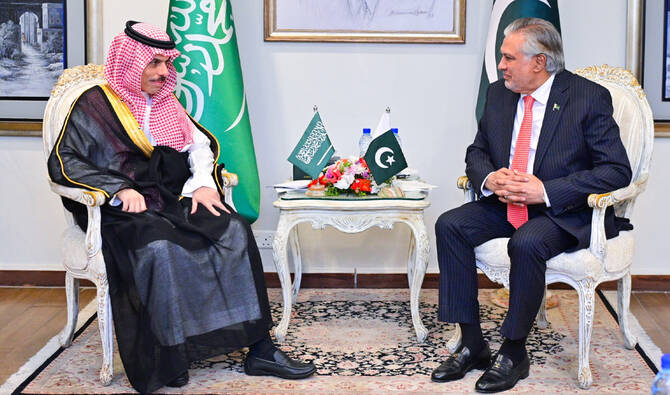

ISLAMABAD: Pakistan and Saudi Arabia on Saturday discussed ongoing efforts for a durable ceasefire in Gaza after Hamas accepted parts of a peace plan proposed by US President Donald Trump, with both countries pledging to stay engaged with other Muslim nations on the issue.
Trump unveiled his 20-point plan last month to end the two-year war in Gaza after consulting leaders of eight Arab-Islamic nations in New York and holding a meeting with Israeli Prime Minister Benjamin Netanyahu.
The plan called for an immediate ceasefire in the Palestinian territory, the return of all Israeli hostages within a specified period and a phased Israeli withdrawal from the area. It also proposed Hamas’s disarmament and exclusion from governance, with Gaza to be run by a temporary technocratic Palestinian committee overseen by an international “Board of Peace” chaired by Trump.
Hamas said it was willing to accept some elements of the deal, though it noted there were aspects of the plan requiring further consultations among Palestinians. The US president subsequently ordered Israel to stop bombing Gaza while welcoming Hamas’s statement.
Pakistan and Saudi Arabia discussed the situation in a phone call between Deputy Prime Minister and Foreign Minister Ishaq Dar and Saudi Foreign Minister Prince Faisal bin Farhan Al Saud, according to an official statement.
“The two leaders discussed regional developments, particularly the situation in Gaza,” Pakistan’s foreign office said in a social media post. “They reviewed ongoing diplomatic efforts, including engagements and consultations among the eight Arab-Islamic countries and the United States in New York, aimed at achieving an immediate and durable ceasefire, ensuring unhindered humanitarian assistance and securing lasting peace in Gaza.”
“Both Ministers reaffirmed their firm commitment to the Palestinian cause and agreed to remain closely engaged with Arab and Islamic partners, as well as the international community, to advance a just, comprehensive, and lasting peace based on the two-state solution,” it added.
The war in Gaza started after Hamas’s attack on Southern Israel on Oct. 7, 2023, which left around 1,200 people dead, while 251 others were taken hostage. The group described the attack in response to the deteriorating condition of Palestinian people living under Israeli occupation.
Israel’s retaliatory military offensive in Gaza has so far killed over 67,000 people, mostly women and children, and wounded nearly 170,000 others.
Pakistan’s Prime Minister Shehbaz Sharif said earlier in the day Hamas’s acceptance of parts of Trump’s plan had increased the chances of a ceasefire in Gaza, pledging Islamabad’s continued support for everlasting peace in Palestine.
Media reports said Israel’s army had also started preparing for the first phase of Trump’s plan following Washington’s directive for a halt to airstrikes.
Pakistan and Saudi Arabia have stepped up high-level consultations on regional developments after signing a bilateral defense pact last month, formalizing their decades-long security partnership to strengthen joint deterrence by pledging to treat aggression against one country as an attack on both.


